
Critical Analysis in Literature Reviews: Moving Beyond Summary to Synthesis and Evaluation A strong literature review is never just a collection of summaries. Yet many university students across the UK still struggle with one core academic challenge: understanding what is a critical analysis of a literature review and how to move beyond simply describing sources. Whether you are writing an undergraduate dissertation, a master’s thesis, or a PhD research proposal, your ability to critically evaluate and synthesises academic literature can significantly influence your final grade.
In UK higher education, critical thinking is considered a cornerstone of academic success. Universities such as the University of Oxford, University of Manchester, and King’s College London consistently emphasises analytical depth in dissertation assessment criteria. According to guidance from the Quality Assurance Agency for Higher Education (QAA), students are expected to demonstrate independent judgement, critical reflection, and the ability to engage with competing ideas rather than merely reproduce information.
This is where many students become stuck. They understand how to find journal articles and books, but they are less certain about how to critically analyses them, compare different perspectives, identify research gaps, and build a convincing academic argument. A literature review that only summarise existing studies often appears descriptive and superficial. In contrast, a critical literature review demonstrates intellectual engagement, scholarly maturity, and research awareness. masters dissertation help
Critical Analysis in Literature Reviews: Moving Beyond Summary to Synthesis and Evaluation In this guide, you will learn what critical analysis in literature means, how to apply synthesis and evaluation in your literature review, the 4 steps of critical analysis, the 5 C’s in a literature review, and how UK students can develop stronger academic writing practices. We will also explore practical examples, common mistakes, and effective strategies used in high-scoring dissertations.

Critical Analysis in Literature Reviews What Is Critical Analysis in Literature?

Critical Analysis in Literature Reviews: Moving Beyond Summary to Synthesis and Evaluation Many students ask, “What is critical analysis in literature?” In simple terms, critical analysis involves evaluating academic sources rather than simply describing them. It means examining the strengths, weaknesses, assumptions, methods, findings, and relevance of existing research.
A critical literature review goes beyond answering questions such as:
- What did the researcher say?
- What methods were used?
- What were the findings?
Instead, it also asks:
- Was the research method appropriate?
- Are the findings reliable and transferable?
- How does this study compare with other research?
- What limitations exist?
- What gaps remain unexplored?
For example, if several studies discuss social media’s impact on student mental health, a descriptive review may simply summarises each article individually. A critical analysis literature review, however, would compare methodologies, discuss contradictions between findings, assess sample sizes, and explain where further research is needed Critical Analysis in Literature Reviews: Moving Beyond Summary to Synthesis and Evaluation.
This analytical depth is particularly important within UK dissertation structure expectations because universities often allocate a substantial percentage of marks to critical evaluation.
How to Choose a Winning Dissertation Topic
What Is a Critical Analysis of a Literature Review?
A critical analysis of a literature review refers to the process of assessing and synthesing scholarly sources to create a coherent academic discussion. Rather than presenting isolated summaries, you connect ideas, identify patterns, challenge assumptions, and evaluate the quality of evidence.
In practical terms, this means your literature review should function as an academic conversation. You are not simply reporting what others have written. You are interpreting and evaluating their contributions in relation to your research question.
Critical Analysis in Literature Reviews: Moving Beyond Summary to Synthesis and Evaluation For instance, a student researching remote learning in UK universities after COVID-19 may find studies highlighting increased flexibility and accessibility. Other studies may focus on student isolation, reduced engagement, and digital inequality. A critical literature review would compare these contrasting perspectives and explain why differences occur.
You may discover that studies supporting online learning relied on surveys from technology-rich universities, while studies reporting negative experiences focused on disadvantaged student groups. This comparison demonstrates critical thinking because you are analysings context, methodology, and bias.
Moving Beyond Summary to Synthesis and Evaluation
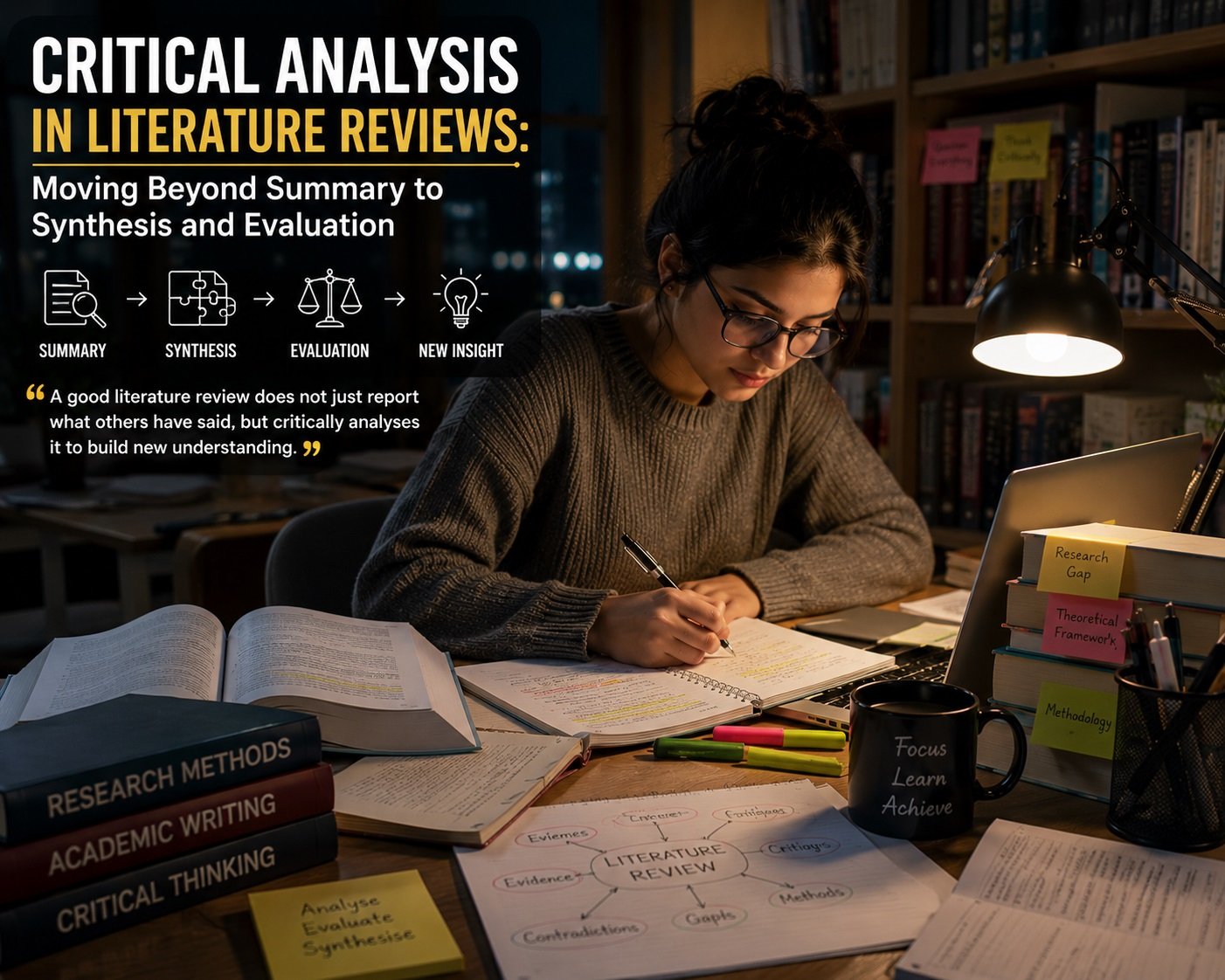
One of the biggest transitions students must make during dissertation writing UK projects is learning how to synthesise information.
Summary tells the reader what individual authors said.
Synthesis combines ideas from multiple studies to reveal broader themes, debates, and trends.
Evaluation assesses the quality and significance of those ideas.
A literature review that relies heavily on summary often reads like this:
“Smith (2021) found that online learning improved flexibility. Jones (2022) argued that online learning reduced student engagement. Ahmed (2023) suggested that digital accessibility remains unequal.”
Although factually correct, this structure lacks analytical depth.
A more critical and synthesised approach would read:
“Research into online learning presents mixed findings. While Smith (2021) argues that remote education increases flexibility for working students, Jones (2022) highlights declining classroom engagement and reduced peer interaction. These contrasting conclusions may stem from differences in research populations and institutional contexts. Ahmed’s (2023) study of widening participation students further suggests that socioeconomic inequalities continue to shape digital access within UK higher education.”
The second example demonstrates comparison, interpretation, and evaluation rather than isolated summary.
Organising Your Literature Review: Thematic, Chronological, Methodological, or Theoretical Structures – Pros, Cons, and Templates
What Are the 4 Steps of Critical Analysis?
Students frequently search for “What are the 4 steps of critical analysis?” because developing a systematic approach makes academic writing far less overwhelming.
1. Understanding the Source
Begin by identifying the purpose, argument, methodology, and conclusions of the study. At this stage, you should understand not only what the author is saying but why the research matters.
Pay attention to publication date, sample size, theoretical framework, and academic credibility. Peer-reviewed journal articles generally carry more academic weight than opinion pieces or non-scholarly websites.
2. Evaluating the Evidence
Critical Analysis in Literature Reviews: Moving Beyond Summary to Synthesis and Evaluation The next step involves assessing the strength and reliability of the research. Consider whether the methods were appropriate, whether conclusions were supported by evidence, and whether bias may have influenced results.
For example, if a study about UK student wellbeing surveyed only 20 participants from one university, the findings may lack broader generalisability.
3. Comparing and Synthesising Sources
Critical analysis requires comparing studies against one another. Identify patterns, contradictions, debates, and emerging themes.
This stage is where strong dissertations begin to stand out. Rather than discussing articles individually, you group evidence according to themes and research questions.
4. Developing Your Own Academic Position
Finally, you must explain how the literature informs your research. What gaps exist? Which theories appear most convincing? How does existing research shape your dissertation methodology or argument?
This final step demonstrates intellectual independence, which UK examiners value highly.
What Are the 5 C’s in a Literature Review?
Another common question students ask is: “What are the 5 C’s in a literature review?” These principles provide a useful framework for producing analytical academic writing.
Cite
Accurately reference all academic sources using your university’s required referencing style, such as Harvard, APA, or OSCOLA.
Compare
Analyse similarities and differences between studies. This is essential for synthesis.
Contrast
Identify disagreements, conflicting findings, or competing theories within the literature.
Critique
Evaluate the strengths and weaknesses of existing research rather than accepting findings uncritically.
Connect
Link ideas together to build a coherent narrative that supports your research aims.
These five principles help transform a descriptive review into a sophisticated critical literature review.
Critical Literature Review Structure
Critical Analysis in Literature Reviews A well-organised critical literature review structure is essential for clarity and readability. Although structures vary across disciplines, most UK dissertations follow a similar pattern.
Introduction
The introduction explains the scope of the review, introduces key themes, and outlines the purpose of the discussion.
Thematic Discussion
Critical Analysis in Literature Reviews: Moving Beyond Summary to Synthesis and Evaluation Rather than discussing one article at a time, organise literature into themes, debates, methodologies, or theoretical perspectives Critical Analysis in Literature Reviews.
For example, a dissertation about artificial intelligence in education may include sections on:
- Student engagement
- Ethical concerns
- Academic performance
- Data privacy
Within each section, compare and evaluate multiple studies.
Research Gaps
Strong literature reviews identify unresolved issues or under-researched areas.
For example, you may discover that most research on AI in education focuses on undergraduate students, leaving postgraduate experiences largely unexplored Critical Analysis in Literature Reviews.
Conclusion
The conclusion summarises key findings, highlights major debates, and explains how the literature informs your research direction Critical Analysis in Literature Review.
Critical Literature Review vs Systematic Review
Students are often confused about the difference between a critical literature review vs systematic review.
Critical Analysis in Literature Reviews: Moving Beyond Summary to Synthesis and Evaluation A critical literature review focuses on analysing and interpreting literature to build an argument around a research topic. It allows greater flexibility in source selection and discussion.
A systematic review, by contrast, follows a strict methodological process for identifying, selecting, and evaluating studies. It is more structured and commonly used in healthcare, psychology, and evidence-based disciplines.
For example, a nursing dissertation may require a systematic review using PRISMA guidelines, whereas a sociology dissertation may use a critical literature review to explore social theories and debates.
Understanding the distinction is important because universities assess these review types differently.
Critical Literature Review in Research Methodology
The literature review pl
