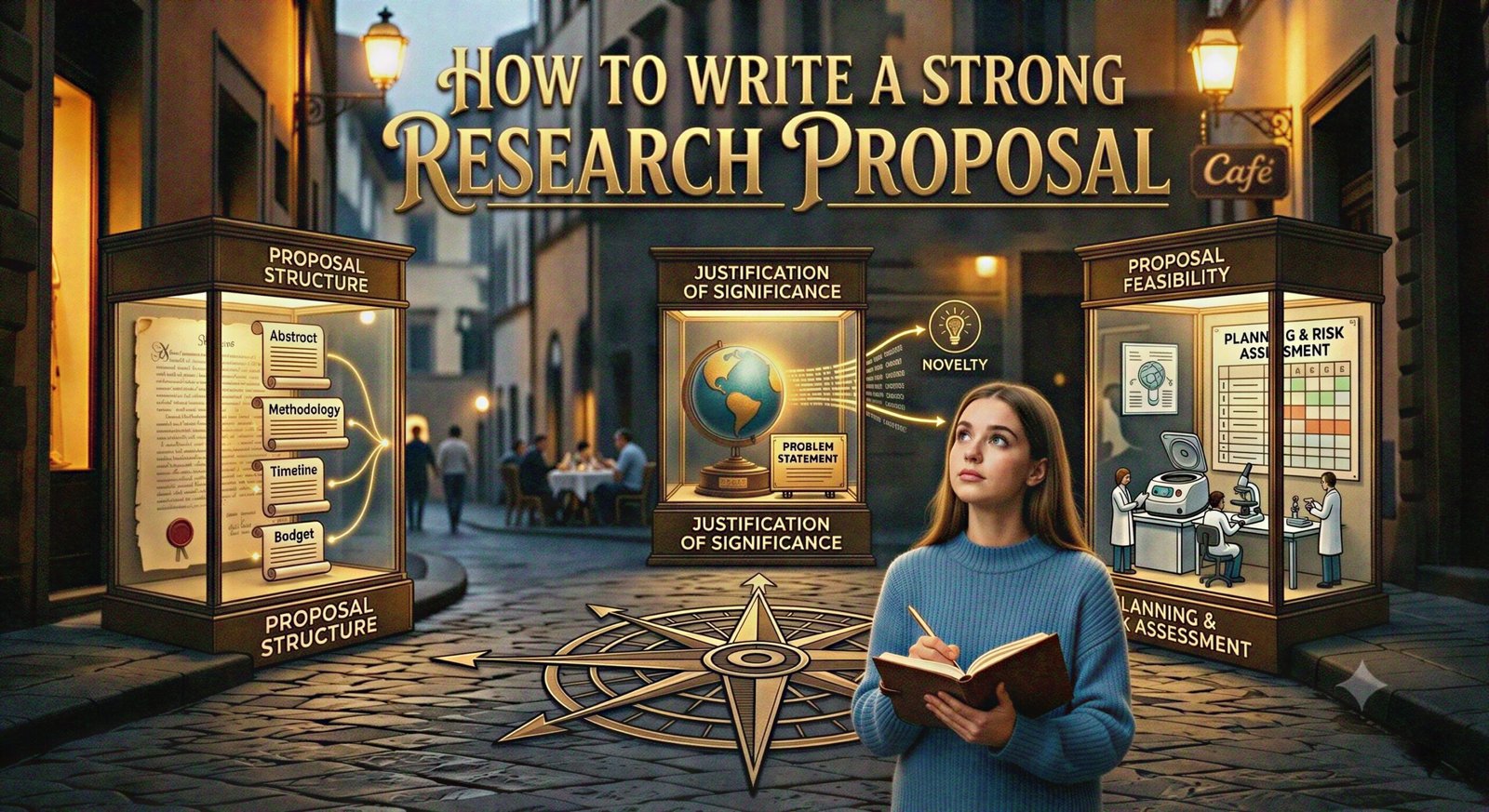
Writing a research proposal is one of the most important stages of any university research project. Whether you are preparing a dissertation, thesis, or funded research application, the quality of your proposal often determines whether your project is approved in the first place. Many students across the UK search for a Research proposal structure pdf, Research proposal structure example, or How to write a research proposal PDF because they feel uncertain about academic expectations and formatting standards. The good news is that writing a strong proposal is far more manageable when you understand the purpose behind each section and how universities evaluate research viability
Students learn how to set your literature review : Organising-your-literature-review-thematic-chronological-methodological-or-theoretical-structures-pros-cons-and-templates
A research proposal is not simply a formality. It is your opportunity to demonstrate academic maturity, intellectual curiosity, methodological awareness, and project feasibility. Universities such as the University of Oxford, University College London, and the University of Manchester all emphasise that a proposal should clearly explain what you want to study, why it matters, and how you intend to complete the research within realistic limitations.
In this guide, you will learn the complete structure of a research proposal, practical techniques for justifying significance and feasibility, examples suitable for undergraduate and postgraduate students, common mistakes to avoid, and expert guidance based on current UK academic expectations. Whether you are looking for a Research proposal example for students or need a detailed Research proposal structure for students, this article will help you create a compelling proposal with confidence.
What Is a Research Proposal and Why Does It Matter?
A research proposal is a formal academic document that outlines your intended research project before the full study begins. It explains the research question, aims, literature background, methodology, significance, ethical considerations, and timeline of the study.
In UK higher education, proposals are commonly required for:
- Undergraduate dissertations
- Master’s dissertations
- PhD applications
- Research funding applications
- Ethics approval submissions
According to guidance from the UK Quality Assurance Agency , independent research projects should demonstrate critical thinking, methodological understanding, and originality. Your proposal acts as evidence that you are capable of conducting rigorous academic research.
Students avoid in these mistakes in writing dissertation: 10 Common Mistakes in Masters Dissertation Writing and How to Avoid Them
A strong proposal also benefits you personally. It creates direction, prevents scope creep, and allows you to identify potential challenges before investing months into your dissertation or thesis.
As we discussed in our guide to choosing a dissertation topic, many students struggle because they begin writing without a clearly defined research framework. A proposal solves this problem by creating a structured road map.
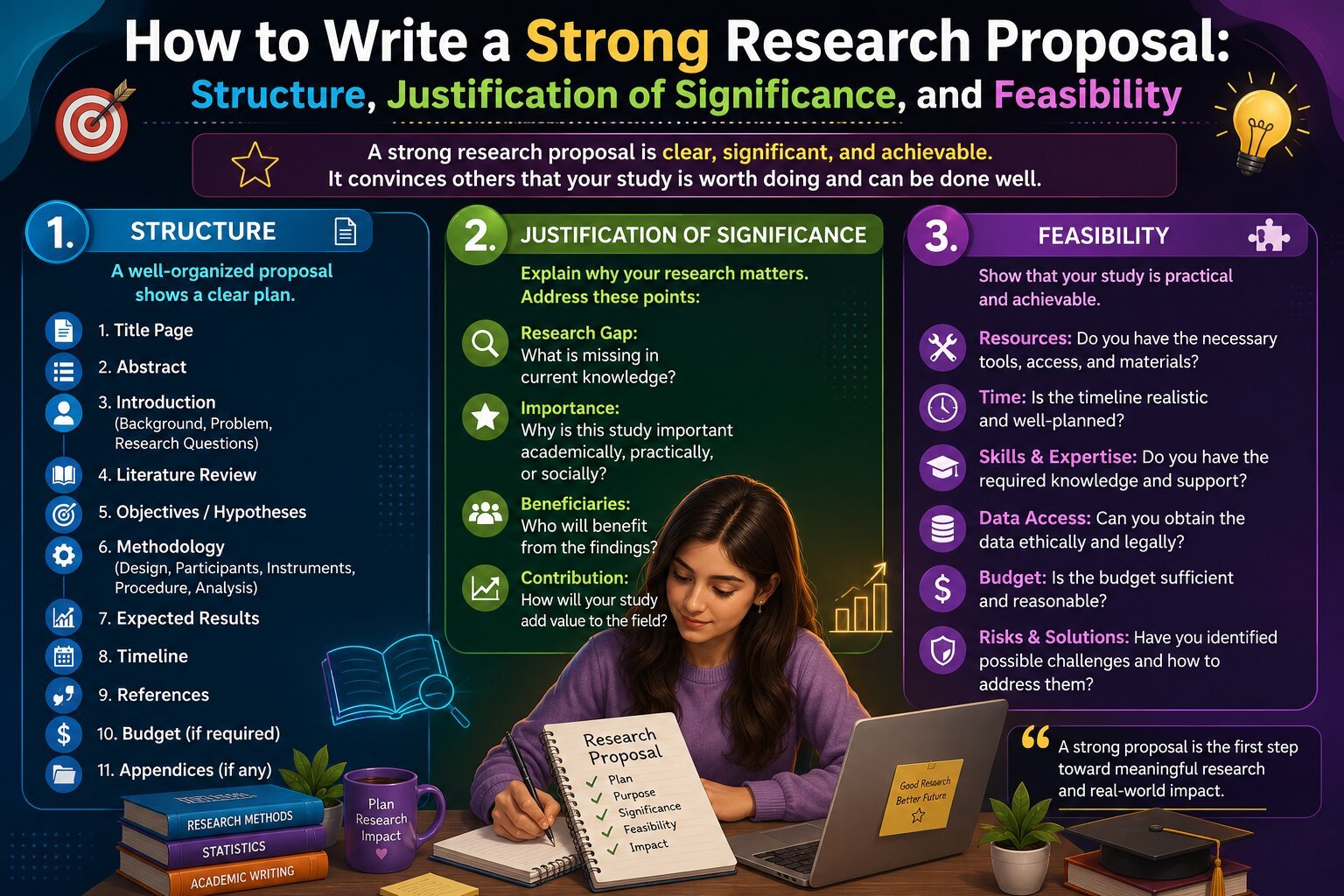
\What Is the Structure of a Research Proposal?
One of the most common questions students ask is: What is the structure of a research proposal?
Students get: masters dissertation help
Although formatting varies slightly between universities and disciplines, most UK institutions expect the following core components.
What Are the 7 Parts of a Research Proposal?
The seven essential parts of a research proposal are:
- Title
- Introduction
- Literature Review
- Research Aims and Questions
- Methodology
- Significance and Feasibility
- Timeline and References
Some universities may divide these sections further, while others combine certain elements. Nevertheless, these components form the foundation of nearly every successful proposal.
Title: Creating a Clear and Focused Research Direction
Your title should communicate the core focus of the research without sounding vague or overly broad. Many weak proposals fail because the topic is too ambitious.
For example:
Weak title:
“Social Media and Society”
Improved title:
“The Impact of TikTok Trendsetter Marketing on Purchasing Behaviour Among UK University Students”
The second example identifies:
- The platform
- The research focus
- The target population
- The geographical context
A focused title immediately signals academic clarity.
Introduction: Establishing Context and Purpose
The introduction explains the background of your topic and introduces the problem your research will address. This section should demonstrate awareness of current academic discussions and practical relevance.
A strong introduction usually includes:
- Contextual background
- The research problem
- Existing knowledge gaps
- Why the topic matters
- Brief overview of methodology
For instance, if your dissertation concerns artificial intelligence in education, you might discuss the rapid adoption of AI tools in UK universities and ongoing concerns regarding academic integrity, assessment authenticity, and student learning outcomes.
Recent debates around generative AI in higher education make this a particularly timely topic. The Research Excellence Framework (REF) increasingly values socially relevant and impact full research, meaning proposals connected to current societal or educational issues often attract stronger interest.
Literature Review: Demonstrating Academic Awareness
The literature review shows that you understand the existing research landscape. Many students mistakenly summarise sources individually instead of critically analysing patterns, debates, and gaps.
A strong literature review should answer questions such as:
- What has already been researched?
- What theories dominate this field?
- Where do scholars disagree?
- What research gap still exists?
Suppose your study explores remote working and employee productivity. Your literature review might compare pre-pandemic and post-pandemic findings while highlighting inconsistencies in long-term productivity measurement.
Rather than simply describing sources, evaluate them critically. Compare methodologies, identify limitations, and explain how your research contributes something meaningful.
Students often search online for a Research proposal sample because they struggle with this section more than any other. The key is remembering that the literature review is analytical, not descriptive.
Research Aims, Objectives, and Questions
This section defines exactly what your study intends to achieve.
Research Aim
The aim is the broad purpose of the study.
Example:
“To examine the impact of hybrid working models on employee productivity in UK technology firms.”
Research Objectives
Objectives break the aim into smaller actionable tasks.
Example objectives:
- To analyse employee perceptions of hybrid working
- To identify productivity trends in remote environments
- To compare managerial and employee perspectives
Research Questions
These guide the investigation itself.
Example questions:
- How does hybrid working influence employee productivity?
- What challenges do UK technology firms face in implementing hybrid models?
Clear objectives improve proposal coherence and help supervisors assess feasibility.
Methodology: Explaining How the Research Will Be Conducted
The methodology section is often the deciding factor in proposal approval. Supervisors want evidence that your research design is realistic, ethical, and academically appropriate.
Choosing Between Qualitative and Quantitative Methods
A qualitative approach may involve interviews, focus groups, or thematic analysis. Quantitative research may use surveys, statistical testing, or numerical datasets.
For example:
- A psychology study measuring anxiety levels may use quantitative surveys.
- A sociology study exploring refugee experiences may use qualitative interviews.
Mixed-methods research combines both approaches when appropriate.
Data Collection Methods
You should explain:
- Who your participants are
- How data will be collected
- Why your method is appropriate
- Ethical considerations
- Sampling strategy
Example:
“This study will distribute online questionnaires to 150 undergraduate students across three UK universities.”
Be specific. Vague methodology sections weaken credibility immediately.
Ethical Considerations
UK universities place increasing emphasis on research ethics, particularly after GDPR regulations and stricter institutional ethics processes.
You should mention:
- Participant consent
- Confidentiality
- Data storage
- Right to withdraw
- Potential risks
Even relatively simple student projects must demonstrate ethical awareness.
Justification of Significance: Why Your Research Matters
One of the most overlooked proposal sections is significance. Students often explain what they want to study but fail to explain why it matters academically or socially.
A strong significance section addresses:
- Academic contribution
- Practical implications
- Policy relevance
- Industry value
- Societal importance
For example, research into student mental health services in UK universities could contribute to institutional well being policies and student support strategies.
Similarly, business-related studies may help organisations improve management practices or consumer engagement.
Universities increasingly value impact-driven research. Your proposal becomes far stronger when you clearly explain who benefits from the findings and why.
Feasibility: Proving the Project Is Realistic
Many students underestimate the importance of feasibility. A brilliant idea can still be rejected if the project appears impossible to complete within time or resource limitations.
What Are the 8 Steps of Writing a Research Proposal?
The process usually includes:
- Selecting a focused topic
- Conducting preliminary reading
- Identifying research gaps
- Developing aims and questions
- Choosing methodology
- Evaluating feasibility
- Creating a timeline
- Revising and proofreading
Feasibility considerations include:
- Time constraints
- Budget limitations
- Access to participants
- Availability of data
- Technical skills
- Ethical approval requirements
For example, interviewing CEOs from multinational corporations may sound impressive but could be unrealistic for a master’s student working within a three-month dissertation schedule.
Supervisors appreciate proposals that balance ambition with practicality.
Timeline and Project Planning
Most UK proposals include a timeline, especially at postgraduate level.
A simple timeline may outline:
- Literature review completion
- Ethics submission
- Data collection
- Data analysis
- Final writing
- Editing and submission
This demonstrates organisation and project management skills.
Many students preparing a How to write a research proposal PDF template forget that time planning is often assessed as part of feasibility.
What Are the 7 Parts of a Research Paper?
Students sometimes confuse a research proposal with a completed research paper. While they share similarities, they serve different purposes.
A research paper typically includes:
- Abstract
- Introduction
- Literature Review
- Methodology
- Results
- Discussion
- Conclusion
A proposal focuses on planned research, whereas a research paper presents completed findings.
Understanding this distinction helps prevent common structural errors.
Practical Research Proposal Example for Students
Imagine a postgraduate education student investigating online learning engagement among UK university students.
Example Proposal Topic
“Factors Influencing Student Engagement in Online Learning Environments in UK Higher Education”
Strong Features of This Proposal
The topic is focused, timely, and research able. The literature review could examine post-pandemic educational shifts. Data collection may involve student surveys and lecturer interviews. The study has clear practical relevance for universities adapting digital learning strategies.
This is an excellent example of a realistic and impact full research proposal structure for students.
Common Challenges Students Face When Writing Proposals
Even strong students often struggle during the proposal stage.
Topic Is Too Broad
Broad topics lead to unclear aims and unmanageable projects.
Instead of:
“The Effects of Technology on Education”
Try:
“The Impact of AI Writing Tools on Academic Integrity Among First-Year UK University Students”
Weak Research Questions
Weak questions are vague or descriptive.
Poor example:
“What is social media?”
Improved example:
“How does Instagram marketing influence consumer trust among Generation Z users in the UK?”
Insufficient Literature Review
Students frequently rely on outdated or non-academic sources. Use peer-reviewed journals, university databases, and recent scholarly publications wherever possible.
Google Scholar, Scopus, and university library resources are essential.
Unrealistic Methodology
Some proposals suggest enormous sample sizes or inaccessible participants.
Always consider:
- Available time
- Budget
- Access limitations
- Ethical approval timelines
A smaller, well-designed study is usually better than an overambitious project.
Expert Tips for Writing a High-Quality Proposal
Strong proposals share several common characteristics.
First, they are focused rather than overly broad. Clarity is far more valuable than complexity.
Second, they demonstrate genuine engagement with current scholarship. Supervisors can immediately identify superficial reading.
Third, they maintain logical flow. Each section should connect naturally to the next. Your literature review should support your research questions, and your methodology should answer those questions effectively.
Finally, successful proposals undergo multiple revisions. Editing is not optional. Many UK university tutors report that structural clarity and coherence matter just as much as content quality.
Reading a Research proposal structure example from your university department can also help you understand faculty-specific expectations.
Conclusion
Writing a strong research proposal requires far more than filling in academic headings. It involves demonstrating intellectual clarity, critical thinking, methodological understanding, and realistic planning. From the introduction and literature review to significance and feasibility, every section contributes to the overall persuasiveness of your proposal.
If you understand the structure, justify the importance of your topic effectively, and present a feasible methodology, you place yourself in a much stronger position for dissertation success.
Remember that even experienced researchers refine their proposals repeatedly before approval. Treat the proposal process as an opportunity to sharpen your ideas rather than merely satisfy a university requirement.
If you need additional guidance, reviewing university-approved examples, speaking with supervisors, and consulting professional academic support resources can make a significant difference. As we explored in our guide to dissertation planning strategies, early preparation almost always leads to stronger research outcomes and reduced stress later in the academic journey.
Written by the academic team at Dissertation Writing UK