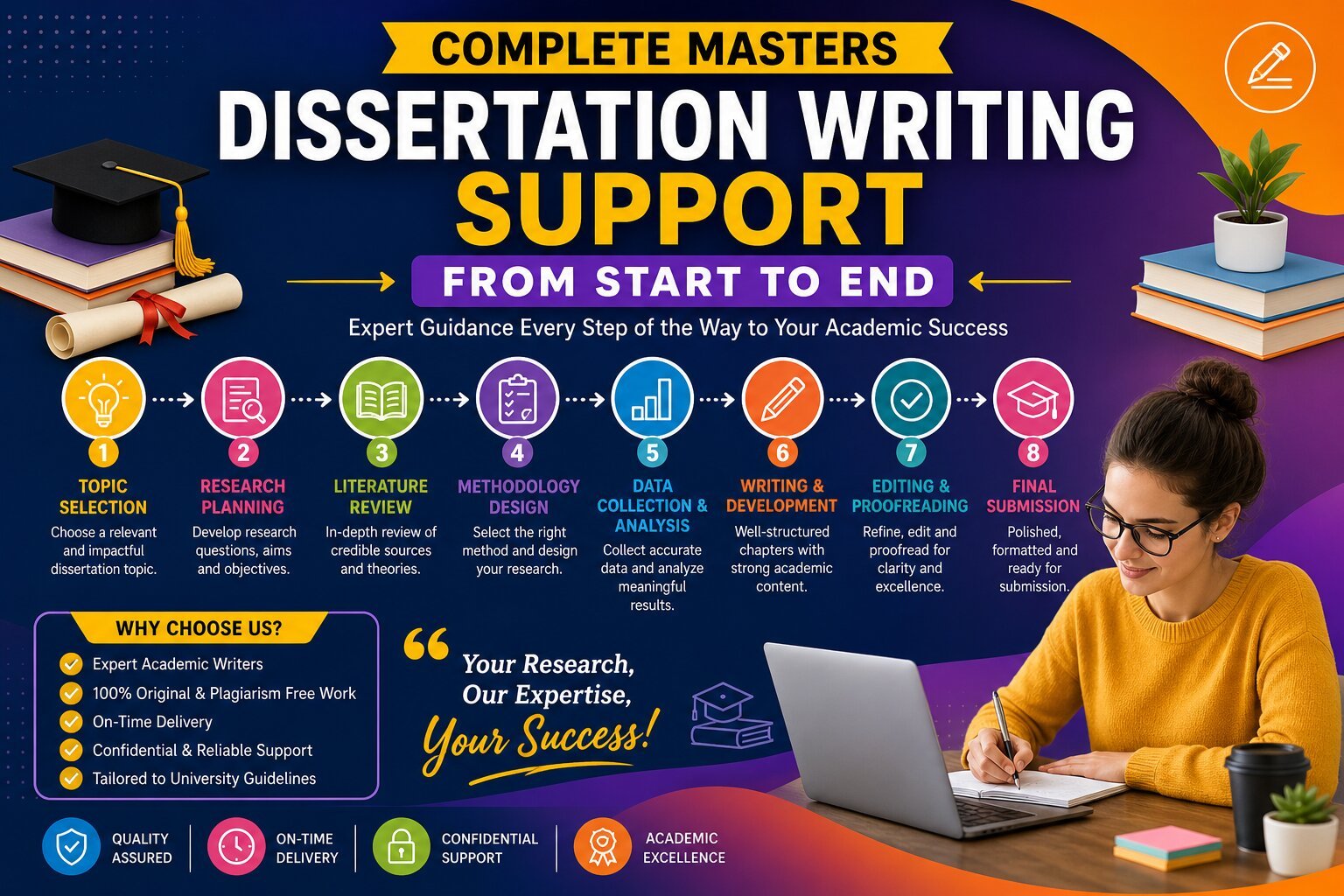
A master’s dissertation is one of the most important academic milestones in postgraduate education. It is more than a lengthy assignment—it is a rigorous test of critical thinking, independent research, academic discipline, and subject knowledge. For many students, the process can feel exciting at first but quickly becomes demanding when deadlines, complex research methods, literature reviews, data analysis, and academic standards begin to pile up. That is why masters dissertation writing support has become an essential part of postgraduate success.
Students across UK universities often balance lectures, part-time work, family commitments, and other responsibilities while attempting to produce a high-quality dissertation. The pressure can be intense. Choosing the right topic, conducting reliable research, structuring chapters, and presenting arguments in a scholarly way all require time, expertise, and careful planning. With complete masters dissertation writing support from start to end, students can manage the process with greater confidence, clarity, and control.
Understanding the Importance of a Master’s Dissertation
A dissertation is not simply another academic paper. It demonstrates your ability to investigate a topic independently, analyse evidence critically, and produce original academic work. Universities expect postgraduate students to show depth of understanding, strong methodology, logical argumentation, and academic integrity.
Because the dissertation often carries a significant percentage of the final degree classification, it can directly affect your academic standing, future employment opportunities, and progression into research or doctoral study. This is why professional guidance in masters dissertation writing can make a meaningful difference.
The dissertation journey may seem complex, but when broken into clear stages, it becomes manageable. Each stage requires attention, planning, and precision. From topic selection to final proofreading, every part contributes to the final result.
Students get information about dissertation How to Start Writing a Dissertation for the First Time: A Complete Step-by-Step Guide.
Starting with the Right Topic
The first and often most challenging stage is selecting the right dissertation topic. Many students struggle because they choose subjects that are either too broad, too narrow, or lacking sufficient research material.
A strong dissertation topic should:
- match your academic interests
- fit your degree programme
- offer enough academic sources
- be practical within your available time
- provide room for analysis and critical discussion
The quality of your topic shapes the entire dissertation. Strong masters dissertation writing begins with a focused research area that is relevant, original, and academically valuable.
For example, instead of choosing a broad subject such as digital marketing, narrowing it to “The impact of influencer marketing on consumer trust among UK university students” creates a sharper research direction.
When students receive early support in topic development, they often save significant time later in the process.
Students read about Impact of Artificial Intelligence on Dissertation Writing
Developing a Clear Research Proposal
After selecting a topic, the next step is preparing the research proposal. This document explains what you intend to study, why the topic matters, and how you plan to conduct the research.
A strong proposal typically includes:
- background of the study
- research problem
- aims and objectives
- research questions
- preliminary literature
- proposed methodology
The proposal is crucial because it creates a clear academic road map. Good masters dissertation writing depends on having a precise plan from the beginning.
Many students make the mistake of writing vague objectives. For example, “to study consumer behaviour” is too broad. A sharper objective would be “to examine how social media reviews influence purchasing decisions among postgraduate students in the UK.”
Clear objectives keep the entire project focused.
 Conducting Effective Literature Review
The literature review is often one of the longest and most demanding chapters. It is not merely a summary of previous studies. Instead, it critically evaluates existing academic work and identifies gaps that your research aims to address.
An effective literature review should:
- discuss major theories
- compare academic viewpoints
- identify patterns and contradictions
- highlight research gaps
- connect previous studies to your research question
This stage requires strong reading, note-taking, and analytical skills. High-quality masters dissertation writing depends on building a strong theoretical foundation.
Students often collect too many sources without organising them. A better strategy is to group sources by themes, concepts, or debates. This creates stronger structure and more persuasive academic discussion.
For example, if researching employee motivation, literature could be organised under intrinsic motivation, extrinsic motivation, leadership influence, and workplace culture.
Choosing the Right Research Methodology
The methodology chapter explains how the research was conducted. It demonstrates academic rigour and allows readers to evaluate the credibility of your findings.
In masters dissertation writing, methodology usually covers:
- research philosophy
- research approach
- research design
- sampling method
- data collection
- ethical considerations
- data analysis method
The choice between qualitative, quantitative, or mixed methods depends on your research objectives.
Qualitative research
Useful for exploring opinions, behaviours, and experiences. Methods include interviews, focus groups, and thematic analysis.
Quantitative research
Useful for measuring patterns and relationships using surveys, numerical data, and statistical analysis.
Mixed methods
Combines both approaches for deeper understanding.
A common mistake is choosing methods that are too ambitious for the available time. Strong research design should be realistic as well as academically appropriate.
Professional masters dissertation writing guidance helps students choose practical and defensible methodology.
Collecting Reliable Data
Data collection is where the research moves from planning to execution. This stage requires accuracy, ethical awareness, and careful organisation.
If using primary research, students may collect data through:
- online surveys
- interviews
- questionnaires
- case studies
- observations
If using secondary research, data may come from:
- journal articles
- government reports
- industry publications
- academic databases
Reliable masters dissertation writing requires data that is relevant, credible, and directly linked to the research question.
Before collecting data, ethical approval may be required by your university. Participants should provide informed consent, and confidentiality must be respected.
Planning data collection early prevents unnecessary delays close to submission.
Analysing the Findings
Once data has been collected, it must be analysed carefully. This is where students transform raw information into meaningful academic insight.
For quantitative studies, analysis may involve:
- descriptive statistics
- correlation analysis
- charts and tables
- statistical software
For qualitative studies, analysis may include:
- coding themes
- identifying recurring ideas
- interpreting patterns
- linking findings to theory
Effective masters dissertation writing does not simply describe findings. It interprets what the findings mean and why they matter.
For example, stating that 68% of respondents prefer online shopping is descriptive. Explaining how convenience and social proof influence this behaviour creates stronger analytical value.
Critical interpretation is what elevates postgraduate-level work.
Writing Strong Dissertation Chapters
One of the biggest challenges students face is structuring chapters logically. A clear structure improves readability, coherence, and academic impact.
A typical dissertation structure includes:
Introduction
The introduction sets the scene. It explains the topic, research problem, objectives, and dissertation structure.
Literature Review
This chapter critically evaluates academic sources and establishes theoretical context.
Methodology
This explains how the research was designed and conducted.
Findings
This presents the research results objectively.
Discussion
This interprets findings, links them to literature, and explores implications.
Conclusion
This summarises key insights, contributions, limitations, and recommendations.
Well-structured masters dissertation writing ensures each chapter contributes clearly to the overall research argument.
Academic Writing Style Matters
Postgraduate writing must be formal, precise, and analytical. Many students understand their topic well but struggle to present ideas in strong academic language.
Effective academic writing should be:
- clear
- objective
- logical
- evidence-based
- concise
- critical
Weak writing often relies on description. Strong masters dissertation writing uses critical analysis, comparisons, interpretation, and evaluation.
For example:
Weak: “Many people use social media.”
Stronger: “Existing studies indicate that social media significantly shapes consumer decision-making through peer influence and perceived credibility.”
Academic language increases authority and professionalism.
 Referencing and Citation Accuracy
Referencing is a critical academic requirement. Incorrect citations can lead to plagiarism concerns, lower grades, and loss of credibility.
Common referencing styles include:
- Harvard
- APA
- MLA
- Chicago
Students must check their university guidelines carefully.
High-quality masters dissertation writing requires consistent citation in both in-text references and bibliography.
Useful referencing practices include:
- keeping source records from the beginning
- using citation software where appropriate
- checking formatting carefully
- verifying page numbers and publication details
Accurate referencing reflects academic discipline.
Editing, Proofreading, and Polishing
Many students underestimate the final stage of dissertation preparation. Editing and proofreading are essential for improving clarity, flow, and overall quality.
This stage involves checking:
- grammar
- sentence structure
- chapter transitions
- formatting consistency
- citation accuracy
- spelling
- word count
- table numbering
- headings and subheadings
Professional masters dissertation writing support often makes the greatest difference during this stage because small errors can weaken otherwise excellent research.
A polished dissertation feels confident, coherent, and submission-ready.
Common Challenges Students Face
Postgraduate students often encounter similar difficulties throughout the dissertation journey.
Time pressure
Balancing academic responsibilities, work, and personal life can reduce research time.
Lack of direction
Many students know their topic but struggle to structure ideas clearly.
Research anxiety
Uncertainty about methodology or data collection can cause delays.
Writing confidence
Even capable students may find academic writing demanding.
Revision overload
Editing large documents can feel overwhelming close to deadlines.
Structured masters dissertation writing support helps reduce these pressures by creating clear milestones and manageable steps.
Practical Strategies for Dissertation Success
A successful dissertation is not produced through last-minute effort. It requires planning and disciplined progress.
Create a timeline
Break the project into weekly goals.
Start reading early
Early reading strengthens topic clarity.
Keep organised notes
Track sources, ideas, and references.
Write regularly
Consistent writing builds momentum.
Seek feedback
Supervisor feedback can strengthen direction.
Revise strategically
Edit in stages rather than all at once.
These habits make masters dissertation writing more efficient and less stressful.
Why Professional Dissertation Support Helps
Professional support does not replace student effort. Instead, it strengthens the process through guidance, clarity, and expert insight.
Students often benefit from help with:
- refining research questions
- structuring chapters
- improving academic language
- selecting methodology
- reviewing coherence
- proofreading final drafts
Reliable masters dissertation writing support can improve confidence, reduce uncertainty, and help students meet university expectations more effectively.
For students facing tight deadlines or complex research demands, structured support can be especially valuable.
Final Thoughts
A master’s dissertation is one of the most rewarding achievements in postgraduate education. It demands intellectual depth, research discipline, and academic commitment. While the journey can be challenging, it becomes far more manageable when approached step by step.
From choosing a focused topic to refining the final draft, every stage matters. Strong planning, critical thinking, careful research, and polished writing all contribute to better academic outcomes.
Complete masters dissertation writing support from start to end helps students navigate complexity with confidence. Instead of feeling overwhelmed, students can move forward with a clear road map, stronger academic direction, and greater control over the process.
With the right structure, informed guidance, and consistent effort, your dissertation can become more than a requirement—it can become a powerful demonstration of your academic capability and a foundation for future success.