University of Oxford (2026)
The University of Oxford is one of the world’s oldest, most prestigious, and academically respected universities. For over 900 years, Oxford has shaped global education by producing influential leaders, Nobel Prize winners, groundbreaking researchers, entrepreneurs, scientists, writers, and innovators. Its reputation for academic excellence, world-class research, and exceptional graduate outcomes has made it one of the most sought-after universities for students from around the globe.
Every year, thousands of talented applicants compete for a limited number of places at University of oxford. Whether you are a UK student applying through UCAS or an international student planning to study in England, understanding the admissions process, academic expectations, tuition fees, scholarships, and student life is essential before submitting your application.
University of oxford is not only famous for its historic colleges and centuries-old traditions but also for its innovative research, personalised teaching through the world-renowned tutorial system, and strong links with leading employers and institutions worldwide. Students benefit from learning alongside internationally recognised academics while studying in one of the most inspiring educational environments in the world.
According to the Times Higher Education World University Rankings 2026, the University of Oxford continues to rank among the world’s leading universities, reflecting its excellence in teaching, research quality, international outlook, and industry collaboration. It also consistently performs exceptionally well in the QS World University Rankings and other respected global league tables.
Whether you plan to study Computer Science, Medicine, Engineering, Law, Economics, Business, Artificial Intelligence, Mathematics, Humanities, or Social Sciences, Oxford offers outstanding academic programmes supported by cutting-edge research facilities and a vibrant collegiate community.
This comprehensive 2026 guide is designed to help prospective students make informed decisions by providing accurate, well-researched, and up-to-date information about every major aspect of studying at Oxford.
In this guide, you will learn about:
- The history and global reputation of the University of Oxford
- Oxford’s latest national and international rankings
- Colleges and the unique collegiate system
- Undergraduate and postgraduate courses
- Teaching methods and the famous tutorial system
- Undergraduate admissions process
- Entry requirements for UK and international students
- Tuition fees and living costs
- Scholarships and financial aid
- Student accommodation
- Campus life and extracurricular opportunities
- Career prospects after graduation
- Support available for international students
- Practical application tips
- Frequently Asked Questions
By the end of this guide, you will have a clear understanding of what makes the University of Oxford one of the world’s most respected institutions and how you can prepare a competitive application.University of Oxford
Quick Facts About the University of Oxford
| Feature | Details |
|---|---|
| Official Name | University of Oxford |
| Established | Teaching dates back to 1096 |
| Location | Oxford, Oxfordshire, England, United Kingdom |
| University Type | Collegiate Research University |
| Number of Colleges | 36 Colleges and 4 Permanent Private Halls |
| Student Population | More than 26,000 students |
| International Students | Students from over 160 countries |
| Undergraduate Acceptance Rate | Approximately 14% (varies by course) |
| Global Reputation | One of the world’s leading universities |
| Teaching Style | Tutorials, lectures, seminars, practical classes, and independent research |
Table of Contents
- Brief History of the University of Oxford
- University of Oxford Rankings (2026)
- Colleges and Academic Structure
- Courses and Teaching Style
- Undergraduate Admissions Process
- Graduate Admissions
- Entry Requirements
- Tuition Fees
- Living Costs
- Scholarships and Financial Aid
- Accommodation
- Student Life
- Career Opportunities
- International Students
- Admission Timeline
- Required Documents
- English Language Requirements
- Tips to Increase Your Chances of Admission
- Why Choose the University of Oxford?
- Frequently Asked Questions
- Conclusion
Brief History of the University of Oxford
The University of Oxford is the oldest university in the English-speaking world and one of the oldest continuously operating universities globally. Teaching at Oxford can be traced back to 1096, and the institution expanded rapidly after 1167, when English students were prevented from studying at the University of Paris. This period marked the beginning of Oxford’s rise as England’s leading centre of higher education.
During the 13th century, Oxford developed its distinctive collegiate system, which remains one of its defining characteristics today. Instead of studying on a single central campus, students become members of individual colleges that provide accommodation, academic support, dining facilities, libraries, and a close-knit community while the university oversees teaching and awards degrees.
Several of Oxford’s earliest colleges, including University College, Balliol College, and Merton College, continue to educate students today, preserving centuries of academic tradition while embracing modern research and innovation.
Throughout its history, Oxford has educated many of the world’s most influential figures, including prime ministers, presidents, Nobel Prize winners, renowned scientists, distinguished judges, bestselling authors, entrepreneurs, and global business leaders. Its alumni network continues to shape politics, science, medicine, literature, technology, economics, and international affairs.
Today, the University of Oxford combines over nine centuries of academic heritage with world-leading research, cutting-edge facilities, and an international outlook, making it one of the most respected universities in the world and a dream destination for ambitious students.
University of Oxford

Courses and Teaching Style
The University of Oxford offers one of the widest selections of undergraduate and postgraduate programmes in the United Kingdom. With more than 350 graduate courses and dozens of undergraduate degree programmes across multiple disciplines, students can pursue studies in the humanities, sciences, engineering, medicine, law, social sciences, business, and many other fields.
Oxford’s courses are academically demanding and designed to develop independent thinking, analytical skills, research ability, and subject expertise. Students are encouraged to challenge ideas, participate in discussions, and engage deeply with their chosen discipline rather than simply memorising information.
Popular Undergraduate Courses
Some of Oxford’s most sought-after undergraduate degrees include:
- Computer Science
- Engineering Science
- Medicine
- Law (Jurisprudence)
- Economics and Management
- Mathematics
- Physics
- Chemistry
- Biomedical Sciences
- Philosophy, Politics and Economics (PPE)
- English Language and Literature
- History
- Psychology
- Geography
- Modern Languages
Many of these programmes consistently rank among the best in the world and attract applicants from every continent.
Graduate Programmes
Oxford also offers a wide variety of postgraduate qualifications, including:
- Master’s Degrees (MSc, MPhil, BCL, MJur and others)
- Doctoral Degrees (DPhil, Oxford’s equivalent of a PhD)
- Postgraduate Diplomas
- Postgraduate Certificates
- Professional and Executive Courses
Graduate students benefit from access to internationally recognised researchers, advanced laboratories, specialised libraries, and extensive academic networks.
Oxford’s Unique Tutorial System
One of the biggest reasons students choose Oxford is its famous tutorial system, which is considered one of the most personalised methods of university teaching in the world.
Instead of relying solely on large lectures, students regularly attend tutorials with an expert academic, usually in groups of one to three students.
During a tutorial, students may:
- Present essays they have written.
- Solve complex academic problems.
- Discuss research papers.
- Defend their arguments.
- Receive detailed, personalised feedback.
- Ask questions directly to leading experts in their field.
This teaching style encourages independent learning, confidence, critical thinking, and effective communication.
Although tutorials require significant preparation each week, many students consider them the most valuable part of studying at Oxford.
Lectures, Classes and Practical Learning
In addition to tutorials, Oxford students participate in:
- University lectures
- Seminars
- Laboratory practicals
- Workshops
- Fieldwork (where applicable)
- Research projects
- Group discussions
Science and engineering students spend considerable time in laboratories, while humanities students often focus on essays, reading, archival research, and tutorials.
Assessment Methods
Assessment varies by subject but commonly includes:
- Written examinations
- Coursework
- Essays
- Practical assessments
- Laboratory reports
- Presentations
- Research projectsc
- Final examinations
- Dissertations (for many postgraduate programmes)
Oxford maintains rigorous academic standards, and students are expected to demonstrate originality, analytical thinking, and subject mastery.
Join Us On Whatsapp
Undergraduate Admissions Process (2026 Entry)
Admission to the University of Oxford is highly competitive. Every application is assessed carefully, and successful candidates usually demonstrate exceptional academic achievement alongside genuine enthusiasm for their chosen subject.
Each course has its own specific requirements, so applicants should always check the official course page before applying.
Step 1: Choose the Right Course
Before starting an application, students should carefully research:
- Course content
- Required subjects
- Entry requirements
- Admissions tests (if applicable)
- Written work requirements
- College preference (or make an open application)
Oxford admits students to a specific course rather than to the university in general, making course selection one of the most important decisions in the application process. University of oxford
Step 2: Submit Your UCAS Application
Applications for undergraduate study are submitted through UCAS.
Unlike most UK universities, Oxford has an earlier application deadline, which is typically in mid-October for entry the following year. Applicants should always confirm the exact deadline on the official Oxford and UCAS websites, as dates can vary slightly.
A complete UCAS application generally includes:
- Personal details
- Academic qualifications
- Predicted grades (if applicable)
- Personal statement
- Academic reference
- Course choice
Applicants cannot apply to both Oxford and Cambridge for undergraduate entry in the same admissions cycle.
Step 3: Admissions Tests
Many Oxford courses require applicants to take an admissions test as part of the selection process.
The required assessment depends on the course and may change over time. Applicants should always consult the official admissions page for the latest information on:
- Whether a test is required
- Registration deadlines
- Test format
- Preparation guidance
Strong performance in admissions tests can significantly strengthen an application, particularly for highly competitive courses.
Step 4: Written Work (Where Required)
Some humanities and social science courses require applicants to submit written work.
Examples may include:
- School essays
- Coursework
- Research assignments
The university provides clear guidance on the type of work accepted for each course.
Step 5: Interviews
Applicants who are shortlisted are normally invited to attend interviews, which usually take place in December.
Interviews may be conducted:
- In person
- Online (where applicable)
Oxford interviews are designed to assess how applicants think, analyse unfamiliar problems, and engage with academic discussion—not simply how much they already know.
Interviewers often present new ideas, data, or scenarios and ask applicants to explain their reasoning. They are looking for intellectual curiosity, logical thinking, and the ability to learn, rather than rehearsed answers.
Step 6: Admission Decisions
Final undergraduate admission decisions are generally released in January.
Successful applicants usually receive a conditional offer, meaning they must achieve the required examination results before their place is confirmed.
Conditions vary depending on:
- Course
- Qualification type
- Country of study
International students should check the university’s guidance for accepted qualifications in their region.

Entry Requirements
Oxford’s entry requirements vary by course, but successful applicants typically have outstanding academic records.
For UK applicants, competitive offers often involve top grades in A Levels or equivalent qualifications.
For international students, Oxford accepts a range of qualifications from different countries. Applicants should refer to the official international qualifications guidance to confirm whether their academic background meets the requirements for their chosen course.
In addition to excellent grades, tutors consider:
- Academic potential
- Motivation for the subject
- Critical thinking ability
- Performance in any required admissions test
- Interview performance
- Quality of written work (if required)
- Teacher or referee recommendations
Meeting the minimum entry requirements does not guarantee an offer, as many courses receive far more qualified applicants than available places.
Acceptance Rate
Admission to Oxford is extremely competitive.
In recent undergraduate admissions cycles, around 23,000–24,000 applicants competed for approximately 3,200–3,300 places, resulting in an overall acceptance rate of about 14%. However, competition varies significantly between courses, with some programmes attracting far more applicants per place than others.
Applicants should focus on presenting the strongest possible academic profile rather than relying on overall acceptance statistics.
Tuition Fees (2026/27)
The cost of studying at the University of Oxford varies depending on your fee status (Home or Overseas) and the course you choose.
Home (UK) Undergraduate Tuition Fees
For the 2026/27 academic year, the tuition fee for eligible Home (UK) undergraduate students is:
£9,790 per year
This fee is regulated by the UK Government and applies to most undergraduate degree programmes.
Overseas (International) Undergraduate Tuition Fees
International tuition fees depend on the subject because laboratory-based and clinical courses cost significantly more to deliver than classroom-based programmes.
For 2026/27, overseas undergraduate tuition fees generally range from:
£37,380 to £62,820 per year
Examples include:
- Humanities and Social Sciences – generally at the lower end of the fee range.
- Engineering and Physical Sciences – usually higher due to specialist facilities.
- Medicine and clinical programmes – among the highest tuition fees.
Applicants should always check the official course page for the latest fee information for their chosen programme.
Living Costs in Oxford
Oxford is one of the UK’s most popular student cities, and living expenses should be carefully considered alongside tuition fees.
Although spending varies depending on lifestyle, accommodation choice, and personal circumstances, the University of Oxford publishes estimated living costs to help students plan their finances.
Students should budget for:
- Accommodation
- Food and groceries
- Books and study materials
- Local transport
- Mobile phone and internet
- Clothing
- Personal expenses
- Leisure and entertainment
For many students, estimated living costs are approximately:
£12,000–£16,000+ for a nine-month academic year.
Some students may spend more depending on accommodation preferences and personal lifestyle.
Creating a realistic budget before arriving in Oxford can help reduce financial stress throughout your studies.
Scholarships and Financial Aid
Oxford offers a wide range of scholarships, bursaries, and funding opportunities for both UK and international students. However, many awards are highly competitive and have separate eligibility criteria and deadlines.
Reach Oxford Scholarship
The Reach University of Oxford Scholarship supports academically outstanding students from eligible low-income and developing countries who may not otherwise be able to study at Oxford.
Depending on the award, funding may include:
- Tuition fees
- College fees
- Living expenses
- One return airfare per year (where applicable)
Availability and eligibility vary, so applicants should consult the official scholarship information before applying.
Clarendon Fund
The Clarendon Fund is one of Oxford’s most prestigious graduate scholarship programmes.
Eligible graduate applicants are automatically considered if they apply by the relevant deadline for many courses.
Awards typically cover:
- Full tuition fees
- College fees
- Annual living-cost support
Rhodes Scholarship
The internationally renowned Rhodes Scholarship supports exceptional postgraduate students from selected countries.
The scholarship is highly competitive and recognises academic excellence, leadership potential, and commitment to making a positive impact on society.
College and Departmental Scholarships
Many Oxford colleges and academic departments also provide funding through:
- Merit-based scholarships
- Need-based bursaries
- Research studentships
- Subject-specific awards
The availability of these opportunities varies between colleges and programmes.
External Funding
Students may also be eligible for financial support from:
- National governments
- Educational foundations
- Charitable organisations
- Employer sponsorship schemes
- International scholarship programmes
Applicants are encouraged to explore funding opportunities well before application deadlines.
Accommodation
One of the advantages of studying at Oxford is that many colleges provide accommodation for undergraduate students, particularly during the first year and, in many cases, for additional years of study.
Accommodation options differ between colleges and may include:
- Traditional college rooms
- Shared flats
- Modern student residences
- Graduate accommodation
College accommodation often offers benefits such as:
- Easy access to teaching facilities
- Inclusive student communities
- Welfare support
- Dining halls
- Libraries
- Social events
Students who live outside college can also find private accommodation within Oxford, although availability and costs vary.
Student Life at Oxford
Oxford offers a vibrant student experience that extends well beyond the classroom.
With students representing more than 160 nationalities, the university provides a diverse and welcoming academic community.
Student Societies
There are hundreds of student societies covering interests such as:
- Entrepreneurship
- Artificial Intelligence
- Politics
- Literature
- Music
- Drama
- Photography
- Volunteering
- Cultural groups
- Languages
- Debate
Joining societies is an excellent way to build friendships, develop leadership skills, and explore new interests.
Sports
Oxford has an extensive sporting tradition.
Students can participate in:
- Football
- Cricket
- Rugby
- Tennis
- Rowing
- Athletics
- Swimming
- Hockey
- Basketball
- Cycling
The annual Oxford–Cambridge Boat Race remains one of the university’s most famous sporting traditions.
Libraries and Museums
Oxford is home to world-class academic resources, including:
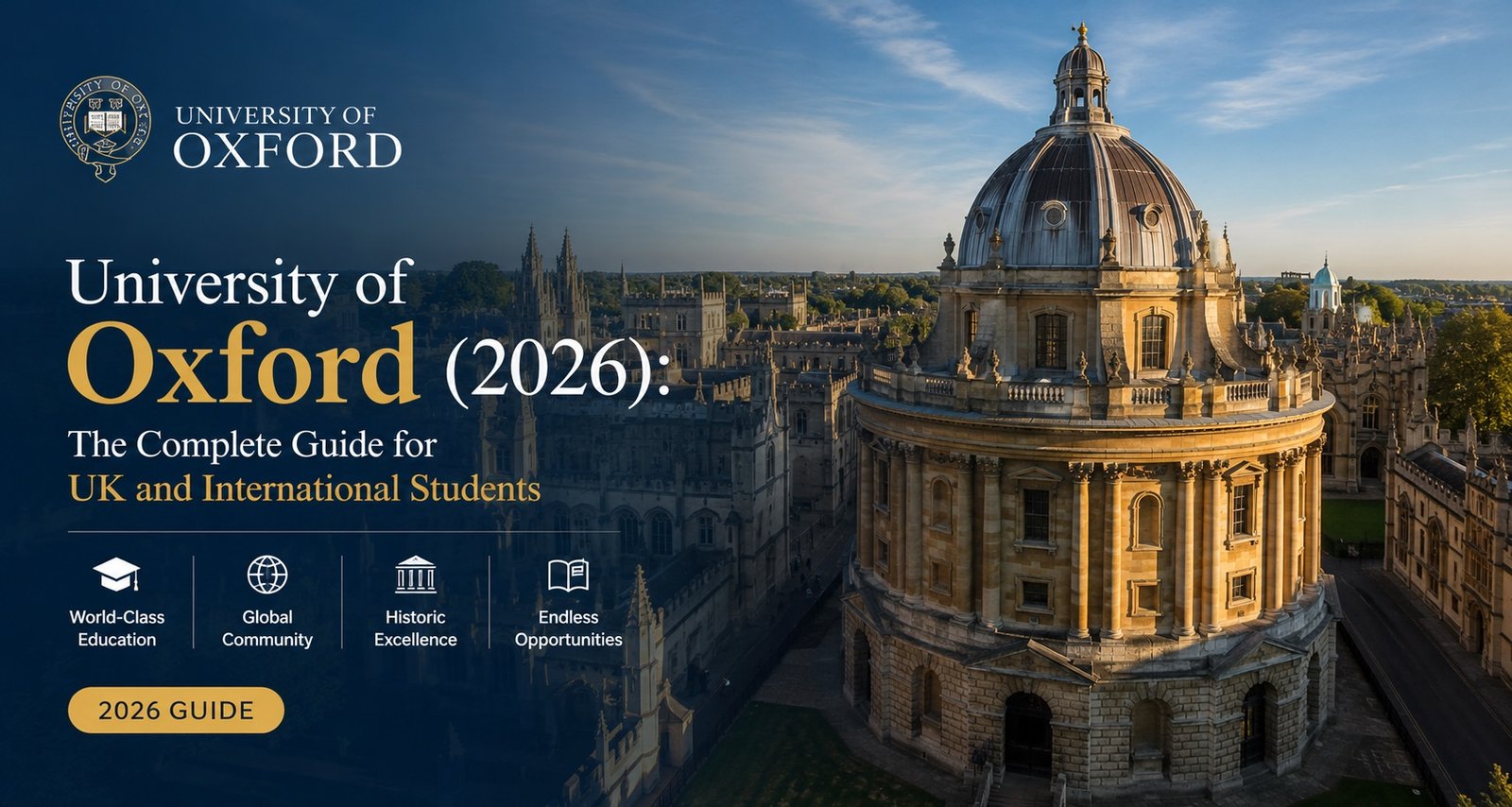
- Bodleian Libraries
- Radcliffe Camera
- Ashmolean Museum
- Museum of Natural History
- Pitt Rivers Museum
These facilities support learning, research, and cultural exploration throughout students’ academic journeys.
Student Support Services
The University of Oxford provides a broad range of support services, including:
- Academic guidance
- Careers advice
- Mental health and wellbeing support
- Disability support
- International student assistance
- Welfare teams within colleges
- Financial advice services
Students are encouraged to seek support whenever needed, and many services are available throughout the academic year.
Career Opportunities After Graduation
An Oxford degree is recognised and respected around the world.
Graduates benefit from strong employer recognition and often pursue careers in:
- Technology
- Artificial Intelligence
- Finance
- Investment Banking
- Law
- Medicine
- Government
- Public Policy
- Engineering
- Scientific Research
- Academia
- Journalism
- International Organisations
- Consulting
- Entrepreneurship
Oxford’s Careers Service provides support through:
- Career coaching
- CV and application reviews
- Internship opportunities
- Employer events
- Networking sessions
- Skills workshops
Many graduates continue to postgraduate study or research at leading universities around the world.
International Students
Oxford welcomes talented students from across the globe and offers dedicated support throughout the application process and student journey.
International applicants should:
- Check country-specific academic qualification requirements.
- Confirm English language requirements for their course.
- Prepare application materials well before deadlines.
- Research available scholarships and funding.
- Budget carefully for tuition fees and living costs.
- Apply for a UK Student visa if required after receiving an eligible offer.
- Explore pre-arrival guidance and orientation programmes provided by the university.
Starting preparations early can make the application process smoother and improve your overall experience.
Why Choose the University of Oxford?
Choosing a university is one of the most important decisions a student can make.
Oxford continues to attract ambitious students because it offers:
- A world-renowned academic reputation.
- Outstanding teaching through its unique tutorial system.
- Cutting-edge research opportunities.
- Highly experienced academics and researchers.
- Excellent graduate employment prospects.
- A diverse and international student community.
- Historic colleges with modern facilities.
- Extensive extracurricular opportunities.
- Strong global alumni connections.
- Access to one of the world’s richest academic environments.
For students who enjoy intellectual challenge, independent learning, and academic excellence, Oxford offers an experience that can shape both personal and professional success.

Frequently Asked Questions (FAQs)
Is the University of Oxford difficult to get into?
Yes. Admission is highly competitive, and successful applicants usually demonstrate exceptional academic achievement, strong subject knowledge, and excellent performance throughout the admissions process.
Can international students apply to Oxford?
Yes. Oxford welcomes applications from students worldwide, provided they meet the academic and English language requirements for their chosen course.
Can I apply to both Oxford and Cambridge?
No. Undergraduate applicants cannot apply to both universities in the same admissions cycle through UCAS.
Does my college choice affect my chances of admission?
Not usually. Oxford has procedures to help ensure applicants are considered fairly across colleges, regardless of where they apply.
Is Oxford good for Computer Science?
Yes. Oxford’s Computer Science programme is internationally recognised for its strong theoretical foundation, research excellence, and close links with mathematics, artificial intelligence, and industry.
Does Oxford provide scholarships for international students?
Yes. University of Oxford offers several scholarships for international students, although eligibility, availability, and funding levels vary by programme and applicant circumstances.
Where can I find official information?
For the most accurate and up-to-date details on admissions, courses, tuition fees, scholarships, and application deadlines, always refer to the official University of Oxford website.
Imperial College London 2026: Complete Guide
Final Thoughts
The University of Oxford remains one of the world’s most respected institutions of higher education. Its combination of academic excellence, pioneering research, personalised teaching, and global reputation makes it an outstanding choice for students seeking a world-class education.
Whether you are applying for an undergraduate or postgraduate programme, careful preparation, strong academic performance, and a genuine passion for your chosen subject can significantly strengthen your application.
By researching your course thoroughly, understanding the admissions process, planning your finances, and making use of the university’s support services, you can approach your Oxford application with greater confidence and clarity.
Studying at Oxford is undoubtedly challenging, but for many students, it is also one of the most rewarding educational experiences available anywhere in the world.University of oxford