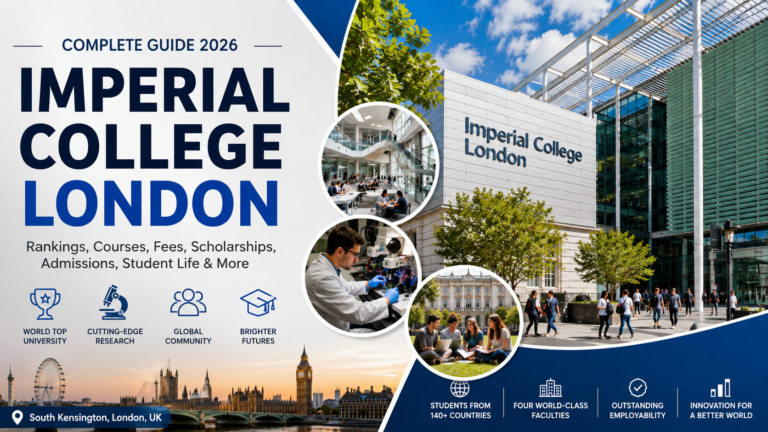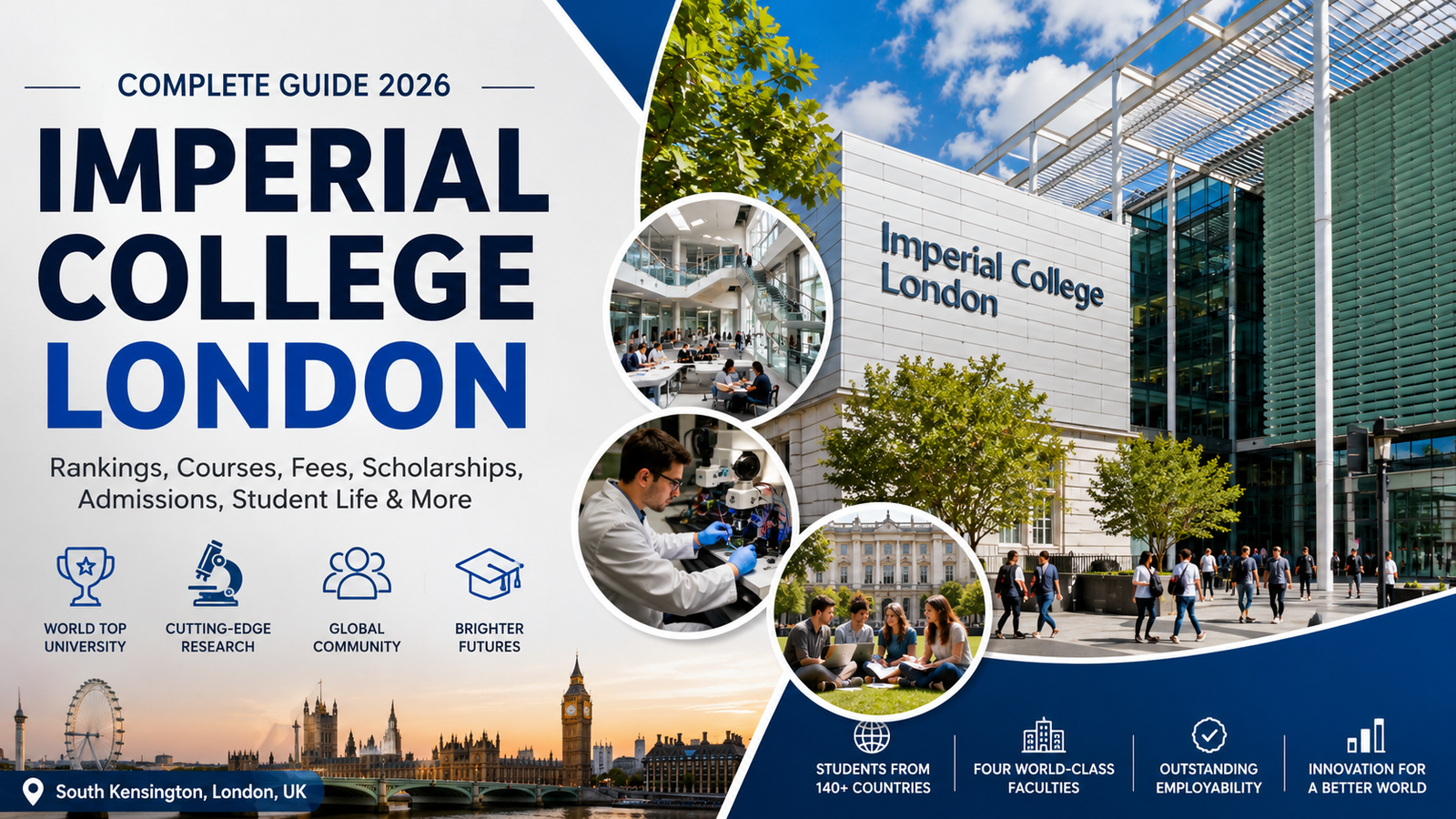
Choosing the right university is one of the most important decisions you’ll ever make. If you’re looking for a world-class institution that excels in science, engineering, medicine, technology, and business, Imperial College London 2026 deserves to be at the top of your shortlist.
Recognised globally for academic excellence, cutting-edge research, and outstanding graduate employability, Imperial College London continues to attract ambitious students from more than 140 countries. Its graduates are highly sought after by employers, and its research plays a significant role in solving global challenges.
Whether you’re planning to pursue an undergraduate degree, a master’s programme, or doctoral research, this comprehensive guide will help you understand everything about Imperial College London 2026.
In this guide, you’ll learn about:
- Latest global rankings
- University history
- Faculties and departments
- Popular undergraduate and postgraduate courses
- Entry requirements
- Tuition fees
- Scholarships
- Student accommodation
- Campus life
- Graduate career opportunities
- Step-by-step application process
If you’re serious about studying in the UK, this guide will help you make an informed decision.
Table of Contents
- Why Choose Imperial College London 2026?
- Imperial College London Global Rankings
- History of Imperial College London
- Faculties and Academic Structure
- Most Popular Courses
- Entry Requirements
- Tuition Fees
- Scholarships
- Student Life
- Accommodation
- Career Opportunities
- How to Apply
- Frequently Asked Questions
- Final Thoughts
Why Choose Imperial College London 2026?
Every year, thousands of students compete for admission to Imperial College London. The reason is simple—Imperial is consistently recognised as one of the world’s leading universities for science, technology, engineering, medicine, and business.
Unlike many traditional universities, Imperial focuses on innovation, research, entrepreneurship, and solving real-world problems. Students benefit from modern laboratories, internationally recognised professors, industry collaborations, and excellent career prospects after graduation.
Some of the biggest advantages of studying at Imperial College London 2026 include:
- World-class teaching quality
- Globally recognised degrees
- Excellent graduate employment rates
- Strong links with leading companies
- Cutting-edge research facilities
- International student community
- Prime London location
- Extensive scholarship opportunities
- Outstanding alumni network
These advantages make Imperial one of the most competitive universities not only in the United Kingdom but also across the world.
Imperial College London Rankings 2026
One of the strongest reasons students choose Imperial College London 2026 is its exceptional performance in international university rankings.
For several consecutive years, Imperial has maintained its position among the world’s top universities because of its academic reputation, employer reputation, research output, innovation, and graduate success. According to the source article, it ranks among the world’s leading institutions across multiple major ranking systems.
Latest Global Rankings
| Ranking Organisation | Position |
|---|---|
| QS World University Rankings 2027 | #2 Worldwide |
| QS UK Ranking | #1 |
| Times Higher Education 2026 | Top 10 Globally |
| QS Sustainability Rankings | Top 10 Worldwide |
| Graduate Employability | Among the UK’s Best |
These rankings reflect Imperial’s commitment to delivering outstanding education, pioneering research, and excellent career outcomes for graduates.
What Makes These Rankings So Important?
Many students look only at overall rankings when choosing a university, but it’s equally important to understand what those rankings represent.
Imperial College performs exceptionally well in areas such as:
- Academic reputation
- Employer reputation
- Faculty-to-student ratio
- Research citations
- International diversity
- Graduate employability
- Innovation and entrepreneurship
Because of this, an Imperial degree is recognised and respected by employers across the UK and internationally.
Graduates frequently secure positions at multinational technology companies, engineering firms, financial institutions, healthcare organisations, pharmaceutical companies, and research centres.
History of Imperial College London
Understanding the university’s history helps explain why it has become one of the world’s leading research institutions.
Imperial College London traces its origins to the vision of Prince Albert, who wanted South Kensington to become a global centre for education, science, and culture following the success of the Great Exhibition of 1851. Over time, several prestigious institutions merged, leading to the establishment of Imperial College in 1907 through a Royal Charter. It later expanded further with medical schools and business education before becoming fully independent from the University of London in 2007.
Today, Imperial focuses on four key disciplines:
- Science
- Engineering
- Medicine
- Business
This specialised approach has helped the university maintain its reputation for producing groundbreaking research and highly skilled graduates.
Why International Students Prefer Imperial College London
International students choose Imperial College London 2026 for several reasons beyond rankings.
The university provides a multicultural environment where students from around the globe collaborate on research, innovation, and entrepreneurship. Studying in London also gives students access to internships, networking events, global companies, museums, financial institutions, and one of the world’s most dynamic job markets.
Some additional benefits include:
- Modern teaching facilities
- Industry-focused curriculum
- Practical laboratory experience
- Global networking opportunities
- High graduate salaries
- Strong research funding
- Safe and welcoming campus environment
For students seeking a globally respected degree with excellent career prospects, Imperial remains one of the strongest choices in higher education.
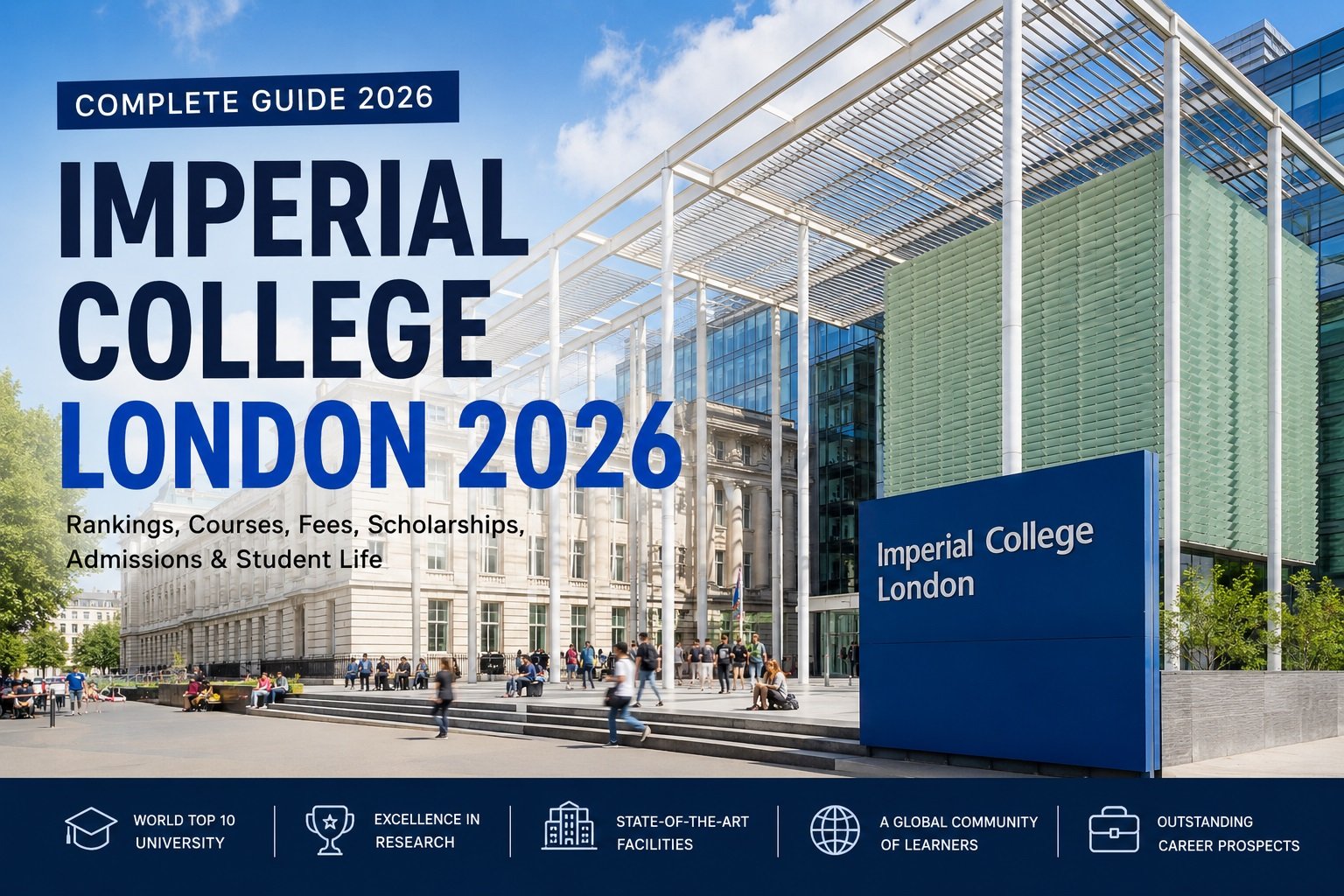
Faculties and Academic Structure at Imperial College London 2026
One of the biggest strengths of Imperial College London 2026 is its specialised academic structure. Unlike many universities that offer hundreds of unrelated subjects, Imperial focuses on areas where it has built a world-class reputation: Science, Technology, Engineering, Medicine, and Business (STEMB). The source article explains that the university is organised into four main faculties with a newer interdisciplinary school supporting cross-disciplinary research.
This focused approach allows students to learn from leading academics, access advanced research facilities, and collaborate on projects that address global challenges.
Faculty of Engineering
The Faculty of Engineering is one of the largest and most prestigious engineering schools in Europe. Students benefit from practical learning, research opportunities, and strong industry partnerships.
Popular departments include:
- Aeronautics
- Bioengineering
- Chemical Engineering
- Civil and Environmental Engineering
- Computing
- Design Engineering
- Electrical and Electronic Engineering
- Materials
- Mechanical Engineering
Graduates from these departments are highly valued by employers in sectors such as aerospace, automotive, robotics, renewable energy, and artificial intelligence.
Faculty of Medicine
Imperial’s Faculty of Medicine combines academic excellence with clinical experience. Students train through teaching hospitals and gain exposure to both research and patient care. The source notes that the faculty maintains strong clinical and research links across London hospitals.
Students interested in healthcare, biomedical sciences, or medical research will find access to modern laboratories, experienced clinicians, and internationally recognised research.
Faculty of Natural Sciences
This faculty provides education across several core scientific disciplines, including:
- Chemistry
- Life Sciences
- Mathematics
- Physics
- Earth Science and Engineering
Students develop analytical, laboratory, and research skills that prepare them for careers in academia, industry, and scientific innovation.
Imperial Business School
Imperial Business School combines business education with science and technology. According to the source, it offers undergraduate, master’s, MBA, and executive programmes with a strong quantitative and technological focus.
Students studying business also benefit from exposure to innovation, entrepreneurship, and collaboration with engineering and science disciplines.
School of Convergence Science
Imperial has also introduced a newer interdisciplinary school focused on bringing together expertise from multiple fields. Areas highlighted in the source include:
- Health and Technology
- Sustainability
- Space and Security
- Human and Artificial Intelligence
This approach encourages students and researchers to solve complex global challenges by combining knowledge from different disciplines.
Popular Undergraduate and Postgraduate Courses at Imperial College London 2026
Choosing the right course is just as important as choosing the right university. Imperial College London 2026 offers a range of programmes that are recognised worldwide for academic quality and industry relevance.
The source identifies several of the university’s most popular undergraduate programmes.
Most Popular Undergraduate Courses
Some of the most sought-after undergraduate degrees include:
- Computer Science (Computing)
- Mechanical Engineering
- Chemical Engineering
- Electrical and Electronic Engineering
- Medicine (MBBS)
- Mathematics
- Physics
- Biochemistry
- Biological Sciences
- Design Engineering
- Materials Science and Engineering
Many engineering programmes include opportunities for industrial placements or study abroad, helping students gain valuable real-world experience.
Popular Postgraduate Courses
Imperial is also highly regarded for postgraduate study. The source highlights popular areas such as:
- Artificial Intelligence
- Data Science
- Finance
- Biomedical Engineering
- Public Health
- Sustainable Energy
- Advanced Materials
Research degrees such as MPhil and PhD are also available for students wishing to pursue advanced academic research.
Why Students Choose These Courses
Students are attracted to these programmes because they offer:
- Research-led teaching
- Modern laboratories and facilities
- Industry collaboration
- Internship opportunities
- Strong graduate employment prospects
- International recognition
Graduates often go on to careers in technology, healthcare, engineering, finance, consulting, and scientific research.
Entry Requirements for International Students
Admission to Imperial College London 2026 is highly competitive, and applicants are expected to demonstrate excellent academic achievement. The source explains that undergraduate offers typically require qualifications equivalent to high A-level grades, with subject requirements depending on the course.
Undergraduate Entry Requirements
Applicants are generally expected to have strong academic results in relevant subjects. Accepted qualifications include:
- A-Levels (or equivalent)
- International Baccalaureate (IB)
- National qualifications recognised by Imperial
Some programmes may also require admissions tests or interviews, depending on the subject. Always review the requirements for your chosen course before applying.
English Language Requirements
International applicants usually need to demonstrate English language proficiency through an accepted test. Typical accepted tests include:
- IELTS
- TOEFL
- Other approved English language qualifications
Required scores vary by department and programme, so applicants should check the latest course-specific guidance.
Tips to Improve Your Chances
To strengthen your application to Imperial College London 2026, consider:
- Achieving excellent academic grades.
- Meeting all subject-specific requirements.
- Preparing carefully for any required admissions tests.
- Demonstrating genuine interest in your chosen field through relevant activities or projects.
- Applying well before deadlines where possible.
University of Cambridge (2026): Complete Guide for UK Students
Tuition Fees at Imperial College London 2026
Understanding the cost of studying is one of the most important parts of planning your university journey. While Imperial College London 2026 offers a world-class education, students should also prepare for tuition fees and living expenses before applying.
According to the source material, tuition fees vary depending on your fee status (Home or International), level of study, and chosen programme. Students should always check the official course page for the most up-to-date fee information because fees can change each academic year.
Undergraduate Tuition Fees
For UK (Home) students, undergraduate tuition fees for the 2026–27 academic year are set in line with the government-approved maximum.
International tuition fees are significantly higher and vary depending on the course. STEM programmes generally fall within a higher fee range due to their specialist facilities, laboratories, and practical teaching requirements.
Estimated Tuition Fee Overview
Student Type Estimated Annual Tuition Fee UK (Home) Students Government-approved rate International Students Varies by programme Postgraduate Taught Programmes Varies by subject Research Degrees (MPhil/PhD) Course-specific Note: Always verify the latest tuition fees on the official university website before submitting your application.
Living Costs in London
Besides tuition fees, students should budget for accommodation, food, transport, study materials, and personal expenses.
London is one of the world’s most exciting cities, but it is also one of the more expensive places to live. The source recommends budgeting carefully and notes that annual living costs depend on lifestyle and accommodation choices. Eligible first-year undergraduate students are normally guaranteed college-owned accommodation.
Typical living expenses may include:
- Accommodation
- Food and groceries
- Public transport
- Books and study materials
- Mobile phone and internet
- Personal expenses
- Entertainment and social activities
Planning a realistic budget before arriving in London can help reduce financial stress throughout your studies.
Scholarships and Funding Opportunities
Studying abroad is a major investment, but many students receive financial assistance through scholarships and funding programmes.
The source explains that Imperial College London 2026 offers a variety of scholarships, including:
- President’s Scholarships
- Faculty-specific awards
- Departmental scholarships
- External funding opportunities for eligible students
Some awards help with tuition fees, while others contribute towards living expenses. Competition is strong, so applicants are encouraged to prepare high-quality applications and apply early.
Tips for Scholarship Applications
- Apply as early as possible.
- Check eligibility criteria carefully.
- Submit all required documents before the deadline.
- Maintain excellent academic performance.
- Write a strong personal statement if requested.
International students may also explore scholarships from their home country, government-funded schemes, or recognised education organisations where applicable.
Campus Life and Student Experience
Studying at Imperial College London 2026 is about much more than attending lectures.
The university provides a vibrant academic and social environment where students can learn, collaborate, and develop personally.
According to the source, the main South Kensington campus is surrounded by some of London’s most famous cultural landmarks, while the White City campus supports innovation and entrepreneurship. Student life is supported by hundreds of clubs, societies, sports teams, volunteering opportunities, and dedicated student support services.
Students can participate in:
- Academic societies
- Sports clubs
- Cultural organisations
- Music and drama groups
- Entrepreneurship programmes
- Volunteering activities
- Networking events
Living in London also gives students access to museums, theatres, international businesses, and countless professional opportunities.
Accommodation at Imperial College London
Finding suitable accommodation is an important part of preparing for university.
The source states that eligible first-year undergraduate students who apply on time are normally guaranteed a place in college residences. Accommodation options include traditional halls of residence and self-catered flats, with both shared and en-suite room options available.
After the first year, many students choose private rented accommodation while others continue in university-managed housing if available.
When selecting accommodation, consider:
- Distance from campus
- Monthly budget
- Transport links
- Safety
- Included facilities
- Internet access
Choosing accommodation early provides more options and helps reduce moving-related stress.
Career Prospects and Graduate Employability
One of the biggest advantages of studying at Imperial College London 2026 is its excellent graduate employability.
The source highlights that Imperial consistently ranks among the UK’s leading universities for graduate employment because employers value the analytical, technical, and problem-solving skills of its graduates. Students benefit from internships, careers support, employer events, and strong industry connections.
Graduates commonly find opportunities in sectors such as:
- Engineering
- Artificial Intelligence
- Software Development
- Data Science
- Healthcare
- Finance
- Scientific Research
- Consulting
- Biotechnology
Imperial’s Careers Service supports students through CV guidance, interview preparation, and networking opportunities.
How to Apply to Imperial College London 2026
Applying early and preparing a complete application can improve your chances of success.
According to the source:
- Undergraduate applications are submitted through UCAS.
- Postgraduate applications are made through Imperial’s online application portal.
- International applicants must meet English language requirements and, where applicable, complete the student visa process after receiving the necessary university documentation.
Application Checklist
- ✔ Choose your preferred course.
- ✔ Check the entry requirements.
- ✔ Prepare academic transcripts.
- ✔ Meet the English language requirements.
- ✔ Submit your application before the deadline.
- ✔ Monitor your application status.
- ✔ Prepare for visa requirements if applicable.
Frequently Asked Questions (FAQs)
Is Imperial College London a good university?
Yes. According to the source, Imperial College London is recognised as one of the world’s leading universities, particularly for science, engineering, medicine, technology, and business.
Is Imperial College London good for international students?
Yes. Students from many countries study at Imperial each year, benefiting from its international community, research opportunities, and strong career support.
Does Imperial College London offer scholarships?
Yes. The university provides several scholarship opportunities, including President’s Scholarships, faculty awards, and departmental funding.
Where can I find the latest admission requirements?
Always check the official course page and admissions information before applying, as requirements may change from year to year.
Contact Us for more help On Whatsapp
Conclusion
Imperial College London 2026 remains one of the world’s most respected universities for students seeking excellence in science, engineering, medicine, technology, and business. With outstanding teaching, globally recognised research, modern facilities, strong employer connections, and an international learning environment, it offers exceptional opportunities for ambitious students.
Whether your goal is to build a successful career, contribute to groundbreaking research, or gain a globally recognised qualification, Imperial provides the resources and support to help you succeed.
Before applying, make sure you review the latest official admissions guidance, course details, tuition fees, and scholarship information for your chosen programme. Careful preparation today can help you make the most of the opportunities that Imperial College London 2026 has to offer.