
How to Avoid Plagiarism in Dissertation Writing

How to Avoid Plagiarism in Dissertation Writing
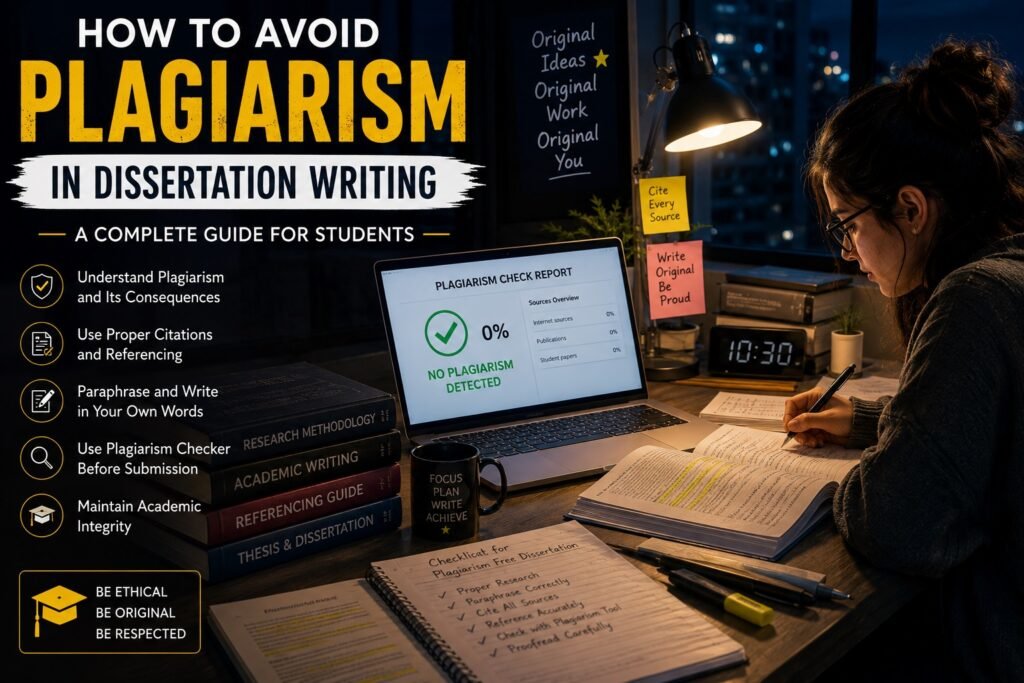
How to Avoid Plagiarism in Dissertation Writing Writing a dissertation is one of the most important academic tasks a student will complete during university life. It requires months of research, critical thinking, analysis, and academic writing. However, one of the biggest challenges students face during this process is avoiding plagiarism. Even unintentional plagiarism can seriously damage academic credibility and may lead to penalties, failed submissions, or disciplinary action from universities Plagiarism in Dissertation Writing. Many students mistakenly believe plagiarism only means copying someone else’s work word for word. In reality, plagiarism can happen in several different ways, including poor paraphrasing, missing citations, improper referencing, or reusing previous work without acknowledgment. Because dissertations involve extensive research and the use of multiple academic sources, students must understand how to maintain originality while properly integrating external information Plagiarism in Dissertation Writing. master thesis help This complete guide explains how to avoid plagiarism in dissertation writing, why academic integrity matters, and the practical strategies students can use to ensure their work remains authentic, professional, and plagiarism-free. Understanding Plagiarism in Dissertation Writing Plagiarism occurs when someone presents another person’s ideas, words, research, or intellectual property as their own without proper acknowledgment. Universities take plagiarism seriously because dissertations are meant to demonstrate independent research skills and original academic contribution. There are several common forms of plagiarism in dissertation writing. Direct plagiarism involves copying text exactly from a source without quotation marks or citations. Mosaic plagiarism occurs when students slightly modify original text but keep the same structure or ideas without proper referencing. Self-plagiarism happens when students reuse parts of their previous assignments without permission or acknowledgment. In dissertation writing, plagiarism may also occur accidentally. Many students unintentionally fail to cite a source correctly or forget where certain information originated. This is why proper research organization and citation management are essential throughout the writing process Plagiarism in Dissertation Writing. Why Avoiding Plagiarism Is So Important Academic integrity is the foundation of higher education. Universities expect students to demonstrate honesty, originality, and ethical research practices. A dissertation reflects not only subject knowledge but also a student’s ability to analyze information independently and contribute meaningful insights Plagiarism in Dissertation Writing. Plagiarism can have serious consequences. Some universities issue warnings for minor cases, while others may fail the dissertation entirely or suspend students from academic programs. Beyond university penalties, plagiarism can damage professional reputation and future career opportunities Plagiarism in Dissertation Writing. Avoiding plagiarism also improves the quality of academic writing. When students develop their own arguments, interpretations, and critical analysis, their dissertations become stronger, more engaging, and academically valuable. Start With Original Research and Ideas How to Avoid Plagiarism in Dissertation Writing One of the best ways to avoid plagiarism is to focus on original thinking from the beginning. While dissertations rely heavily on existing academic literature, students should aim to contribute their own interpretation, analysis, or perspective Plagiarism in Dissertation Writing. Before writing, spend time understanding the research topic thoroughly. Read multiple academic sources rather than depending on a single article or book. Comparing different viewpoints helps students develop unique arguments and reduces the temptation to copy existing material. Taking organized research notes is also extremely helpful. Separate direct quotations from paraphrased ideas while researching so there is no confusion later during writing. Clearly recording author names, publication details, and page numbers saves time and prevents accidental citation mistakes. Learn How to Paraphrase Properly Paraphrasing is one of the most important academic writing skills. Many students believe changing a few words is enough, but proper paraphrasing requires fully rewriting ideas in your own language and sentence structure while maintaining the original meaning Plagiarism in Dissertation Writing. Effective paraphrasing involves understanding the source completely before rewriting it naturally. Instead of copying the sentence structure, students should explain the concept as if teaching it to someone else. After paraphrasing, the original source must still be cited because the underlying idea belongs to the original author. For example, if a journal article discusses the impact of social media marketing on consumer behavior, students should not simply replace a few words with synonyms. Instead, they should rewrite the concept entirely while integrating it smoothly into their own discussion and analysis. Good paraphrasing demonstrates comprehension and critical thinking, which are essential qualities in dissertation writing Plagiarism in Dissertation Writing. Always Cite Your Sources Correctly How to Avoid Plagiarism in Dissertation Writing Proper citation is essential for avoiding plagiarism. Every idea, theory, statistic, quotation, image, or research finding taken from another source must be acknowledged using the required referencing style. Different universities use different citation styles such as Harvard, APA, MLA, or Chicago. Students must understand the specific requirements of their institution before starting their dissertation. In-text citations should appear immediately after paraphrased or quoted information. The reference list or bibliography at the end of the dissertation should include complete publication details for every cited source. Students often lose marks because of inconsistent referencing. Using one referencing style throughout the dissertation is important for professionalism and academic accuracy. For more guidance on academic writing and referencing, students can also explore related resources on Online Essay Writing Plagiarism in Dissertation Writing. Use Quotations Sparingly Direct quotations can strengthen a dissertation when used correctly, especially when presenting definitions, expert opinions, or important theoretical statements. However, overusing quotations may reduce originality and weaken academic analysis. Students should only quote when the exact wording is necessary. Quotations must always include quotation marks and proper citations with page numbers where required. How to Choose the Best Academic Writing Service Most dissertations should rely more on paraphrasing and critical discussion rather than lengthy quotations. Universities generally expect students to demonstrate independent understanding rather than simply repeating existing research Plagiarism in Dissertation Writing. Keep Track of Every Source You Use Dissertation research often involves dozens of journal articles, books, reports, and online resources. Without proper organization, students can easily forget where information came from, increasing the risk of accidental plagiarism. Using citation management tools such as Zotero, EndNote, or Mendeley

How Many Words Should a Master’s Dissertation Be?

How Many Words Should a Master’s Dissertation Be?

How Many Words Should a Master’s Dissertation Be? Writing a master’s dissertation is one of the biggest academic challenges many students will face during postgraduate study. Alongside researching, structuring arguments, analysings data, and meeting deadlines, one question causes constant stress for students across UK universities: How many words should a master’s dissertation be? The answer is not always straightforward. Different universities, departments, and degree programmers have varying expectations. A business management dissertation may have a completely different word count requirement compared to a psychology, education, or engineering dissertation. Yet understanding the ideal dissertation length is essential because it affects your planning, research depth, structure, and overall academic performance. Many students either write far too little and fail to demonstrate enough critical analysis, or they exceed the limit significantly and lose marks for poor academic discipline. The key is understanding not only the required word count but also how to use those words effectively. help with masters dissertation In this complete guide, you will learn the typical word count expectations for master’s dissertations in UK universities, how different chapters are usually divided, what counts towards the word limit, and practical strategies for meeting your target without sacrificing quality. Understanding the Standard Master’s Dissertation Word Count How Many Words Should a Master’s Dissertation Be? In most UK universities, a master’s dissertation is typically between 10,000 and 20,000 words. However, the exact length depends heavily on your subject area, university guidelines, and type of research project. For example, humanities and social science dissertations often range from 15,000 to 20,000 words because they require extensive literature reviews and detailed critical discussion. In contrast, STEM-related dissertations may be shorter due to the focus on experiments, calculations, tables, and technical data rather than long-form analysis. Most universities provide official dissertation handbooks that outline the required length. Institutions such as the University of Oxford, University of Manchester, and King’s College London generally specify clear word count expectations within postgraduate programmers guidelines. A common range for UK postgraduate dissertations includes: 10,000–12,000 words for taught master’s programmers 15,000–18,000 words for research-intensive courses Up to 20,000 words for humanities-based dissertations If you are unsure, always prioritises your university’s official handbook over general internet advice. Why Dissertation Word Count Matters Many students assume word count is simply a technical requirement, but universities use it as a way to assess academic precision and research depth. A dissertation demonstrates your ability to: Conduct independent research Analyses complex ideas critically Present arguments logically Communicate academically within set constraints Writing below the expected limit can make your work appear underdeveloped. On the other hand, exceeding the limit often indicates weak editing skills, repetitive discussion, or poor structure. Academic markers want concise, focused, and analytical writing rather than unnecessary filler content. Quality matters far more than quantity. As discussed in our guide to dissertation planning and structure, successful postgraduate writing depends heavily on strategic from the beginning. from the beginning. Typical Chapter-by-Chapter Word Count Breakdown One of the easiest ways to manage your dissertation length is by allocating approximate word counts to each section. Although structures vary by subject, most master’s dissertations follow a similar framework. Introduction The introduction usually accounts for around 10% of the total dissertation length. In a 15,000-word dissertation, this means approximately 1,500 words. This section introduces your research topic, objectives, research questions, rationale, and dissertation structure. A strong introduction provides readers with a clear understanding of what the study aims to achieve. Literature Review The literature review is often one of the longest sections, typically representing 25–30% of the total word count. For a 15,000-word dissertation, the literature review may contain between 3,500 and 4,500 words. This chapter demonstrates your understanding of existing research and identifies gaps within the academic literature. Students frequently lose marks here by summarising sources instead of critically analysing them. Methodology The methodology section generally makes up around 10–15% of the dissertation. Here, you explain your research methods, data collection process, ethical considerations, and analytical approach. Clarity and justification are essential. A methodology chapter does not need excessive length, but it must clearly explain why specific methods were chosen. From First Draft to Final Submission: A Realistic Masters Dissertation Timeline Results and Analysis This section often takes up the largest proportion of the dissertation. Depending on your subject, it may represent 30–35% of the total word count. Students should focus on interpretation rather than simply describing findings. Strong analysis connects results back to research questions and existing literature. Conclusion The conclusion usually represents around 5–10% of the dissertation. This section summarises findings, discusses implications, acknowledges limitations, and suggests areas for future research. Avoid introducing entirely new arguments in the conclusion. What Counts Towards the Dissertation Word Limit? One of the biggest misconceptions among students is uncertainty about what actually counts towards the word limit. Typically included in the count are: Introduction Literature review Main chapters Quotations In-text citations Usually excluded are: Title page Table of contents Reference list Bibliography Appendices However, universities differ significantly in their policies. Some institutions include tables, footnotes, and figure captions, while others exclude them entirely. Always check your department’s dissertation handbook carefully before submission. What Happens If You Go Over the Word Limit? How Many Words Should a Master’s Dissertation Be? Most UK universities allow a small margin, often around 10%. Exceeding this may lead to penalties. For example, a 15,000-word dissertation may permit up to 16,500 words before penalties apply. However, excessive length can negatively affect readability even if no formal penalty exists. Students often believe adding more content improves academic quality. In reality, markers usually prefer concise, focused arguments How Many Words Should a Master’s Dissertation Be?. If your dissertation is significantly over the limit, this often suggests: Repetition Poor structure Weak editing Lack of clear focus Effective editing is one of the most important academic skills at postgraduate level. How to Reach the Required Word Count Without Adding Fluff Many students struggle not because they write too much, but because they cannot reach the required length. The solution

How Many Words Should a Master’s Dissertation Be?

How Many Words Should a Master’s Dissertation Be?

How Many Words Should a Master’s Dissertation Be? Writing a master’s dissertation is one of the most important academic challenges postgraduate students face during their university journey. Alongside researching, structuring, and referencing the project properly, one of the most common concerns students have is understanding the required dissertation word count. Many students worry about whether their dissertation is too short, too long, or incorrectly balanced across different sections. As a result, questions such as “How many words should a master’s dissertation be?” are extremely common among postgraduate students in the UK and internationally Master’s Dissertation. The length of a dissertation matters because universities use word count guidelines to assess the depth, clarity, and academic quality of a student’s research. A dissertation that is significantly under the required word count may appear incomplete or lacking sufficient analysis, while an overly long dissertation can lose focus and reduce readability. Understanding how dissertation word counts work helps students plan their research, structure their chapters properly, and avoid unnecessary stress close to submission deadlines Master’s Dissertation. Fortunately, dissertation word count requirements are not as confusing as they initially seem. While exact expectations vary depending on the university, subject, and programmers level, most master’s dissertations follow fairly standard academic guidelines. This complete guide explains how many words a master’s dissertation should be, how word counts are divided between chapters, what universities expect from postgraduate research projects, and how students can manage their writing effectively without sacrificing quality Master’s Dissertation. Understanding Master’s Dissertation Word Count Requirements Most UK universities require master’s dissertations to fall between 10,000 and 20,000 words. However, the exact length depends on the subject area, department guidelines, and research methodology used in the project. For example, humanities and social science dissertations are often longer because they involve extensive critical discussion and literature analysis. In contrast, science and engineering dissertations may contain shorter written sections because research findings are presented through tables, experiments, graphs, and technical data. According to postgraduate guidance from the University of Oxford and University of Manchester, students should always check department-specific dissertation requirements before beginning the writing process Master’s Dissertation. How Many Words Should a Master’s: master thesis help Typical master’s dissertation word count ranges include: 10,000–12,000 words for smaller taught master’s programmers 15,000–18,000 words for most UK postgraduate degrees 20,000 words or more for research-intensive programmers Although these ranges are common, students should never assume all universities follow identical standards. Why Dissertation Word Count Matters Dissertation word counts are designed to ensure students demonstrate sufficient academic depth and critical thinking. Universities expect postgraduate dissertations to show evidence of independent research, analytical ability, and engagement with academic literature. A dissertation that is too short may indicate limited research or weak analysis. On the other hand, excessively long dissertations often include repetition, unnecessary detail, or poor organization. The purpose of the word count is not simply to measure quantity but to encourage focused, meaningful academic discussion. Strong dissertations communicate ideas clearly and efficiently without unnecessary filler content. As explained in our guide to choosing a dissertation topic, successful dissertations are usually well-planned from the beginning, including realistic writing targets for each section. Typical Word Count Breakdown by Dissertation Chapter One of the best ways to manage a dissertation successfully is by dividing the total word count across individual chapters. This prevents students from spending too many words on one section while neglecting another. Although structures vary slightly between disciplines, a typical 15,000-word master’s dissertation may look like this: Introduction – 10% The introduction usually accounts for around 1,500 words. This section introduces the research topic, explains the aims and objectives, outlines the research question, and briefly describes the dissertation structure. A strong introduction provides clear direction without becoming overly detailed. Literature Review – 30% The literature review is often the longest chapter, typically around 4,000–4,500 words in a 15,000-word dissertation. This section critically evaluates previous academic studies, theories, and debates related to the topic. Students are expected to identify research gaps and demonstrate understanding of existing scholarship. A weak literature review often summarises sources without sufficient analysis, while a strong review compares arguments and evaluates evidence critically. Methodology – 15% The methodology chapter generally contains 2,000–2,500 words. This section explains how the research was conducted, including research design, data collection methods, ethical considerations, and limitations. Students should justify why they selected particular methods rather than simply describing what they did. How to Write a Literature Review for Your Masters Dissertation (With Examples Findings and Analysis – 30% The findings and analysis section typically includes around 4,000–4,500 words. Here, students present research results and analyses them in relation to the research question and literature review. This chapter often determines the overall academic quality of the dissertation because it demonstrates independent critical thinking. Conclusion – 10% The conclusion is usually around 1,000–1,500 words. This section summarise the main findings, answers the research question, discusses limitations, and may suggest areas for future research. Strong conclusions avoid introducing entirely new arguments. References and Appendices References and appendices are generally excluded from the official dissertation word count, although students should always confirm this with university guidelines. Appendices may include interview transcripts, surveys, tables, charts, or supplementary research material. Do All Universities Have the Same Dissertation Word Count? No university follows exactly the same dissertation requirements. Even within the same university, departments may have different expectations depending on the subject area and assessment criteria. For example, a business management dissertation may require 15,000 words, while an engineering dissertation at the same university might require only 10,000 words due to the technical nature of the project. Students should carefully read official dissertation handbooks and module guidelines. Most universities provide detailed instructions about: Universities Tightening Rules on AI Content in Assignments Recommended word counts Formatting requirements Referencing style Chapter structure Submission guidelines Reliable academic guidance can also be found through resources such as Quality Assurance Agency for Higher Education and Purdue OWL Academic Writing Resources. What Happens If You Exceed the Word Limit? Many universities allow a small
