
Survey Design and Questionnaire Development: Best Practices, Likert Scales, Validity, Reliability, and Common Pitfalls

Designing a high-quality survey is one of the most important — and underestimated — parts of academic research. Whether you are conducting undergraduate coursework, a master’s dissertation, or PhD-level fieldwork, the success of your findings often depends on the strength of your survey instrument. A poorly designed questionnaire can lead to biased responses, weak data, low participation rates, and unreliable conclusions. In contrast, a carefully structured survey can generate valuable insights, improve academic credibility, and strengthen the overall quality of your dissertation. Many students searching for a Survey design and questionnaire development document, Survey design and questionnaire development template, or How to design a questionnaire for research PDF are often looking for practical guidance rather than theoretical jargon. This article provides exactly that. You will learn the foundations of effective questionnaire design, the importance of rating scales, how to ensure validity and reliability, the 7 steps of questionnaire design, and the most common mistakes students make during survey research. Students get help about literature review: Critical Analysis in Literature Reviews: Moving Beyond Summary to Synthesis and Evaluation If you are currently planning your methodology chapter, refining your data collection process, or struggling with questionnaire design principles, this guide will help you approach survey research with confidence and academic rigour. Understanding Survey Design and Questionnaire Development Before exploring techniques and frameworks, it is important to answer a question many students ask: What is the difference between survey design and questionnaire design? Survey design refers to the overall process of planning how data will be collected from participants. This includes defining research objectives, selecting the sample population, choosing data collection methods, and determining how responses will be analysed. Questionnaire design, on the other hand, focuses specifically on creating the actual questions participants will answer. It involves wording, sequencing, formatting, response scales, and layout. Students get complete step by step help about dissertation writing : How to Write a Dissertation: A Complete Step-by-Step Guide for UK Students In simple terms, survey design is the broader research strategy, while questionnaire design is one key component within that strategy. According to guidance from leading UK universities such as the University of Manchester and University College London, survey methodology should always align closely with the research aim and theoretical framework. This alignment improves both the reliability and academic credibility of the research. What Is Questionnaire Development? Another frequently asked question is: What is questionnaire development? Questionnaire development is the systematic process of creating questions that accurately measure the variables or concepts in your study. This process includes identifying research objectives, selecting question types, testing readability, piloting the survey, and revising questions based on feedback. For example, if your dissertation explores student satisfaction with online learning in UK universities, your questionnaire must include measurable items related to teaching quality, accessibility, engagement, and academic support. Random or poorly connected questions weaken the quality of the research. Strong questionnaire development combines methodological precision with an understanding of human psychology. Respondents must clearly understand what you are asking without confusion, pressure, or ambiguity. The 7 Steps of Questionnaire Design Many students specifically search for the 7 steps of questionnaire design because they provide a useful framework for academic research. While variations exist across textbooks and institutions, the following structure is widely accepted in social science research. Students get master thesis help 1. Define the Research Objectives Every successful survey begins with a clear research purpose. Ask yourself what information you genuinely need from participants and how it connects to your research questions. For example, if your dissertation investigates employee motivation in remote workplaces, your objectives may include measuring job satisfaction, communication quality, and work-life balance. Without precise objectives, questionnaires often become too broad and unfocused. 2. Identify the Target Population You must decide who should complete the questionnaire. This includes defining characteristics such as age, profession, educational background, or geographic location. A survey aimed at undergraduate students in London universities will differ significantly from one targeting healthcare professionals across the National Health Service. 3. Choose the Data Collection Method Students often ask: What are the 4 methods of collecting data? The four most common methods include: Surveys and questionnaires Interviews Observations Focus groups In modern dissertation research, online surveys using platforms such as Google Forms, and Microsoft Forms are increasingly popular because they are efficient, cost-effective, and suitable for larger sample sizes. 4. Write Effective Questions This stage forms the core of questionnaire design principles. Questions should be clear, concise, unbiased, and directly linked to the research objectives. Avoid academic jargon, double-barrelled questions, and emotionally loaded language. Poor example:“Do you think university tuition fees and poor lecturer communication negatively affect your learning experience?” Better example:“How satisfied are you with lecturer communication at your university?” 5. Select Appropriate Response Scales Rating scales are among the most commonly used response formats in dissertation surveys. A standard rating scales might include: Strongly Agree Agree Neutral Disagree Strongly Disagree These scales are useful for measuring attitudes, perceptions, and opinions because they generate quantifiable data suitable for statistical analysis. 6. Pilot Test the Questionnaire Pilot testing involves distributing the survey to a small sample before the full study begins. This step helps identify confusing wording, technical issues, or timing problems. Many UK ethics committees and dissertation supervisors strongly recommend pilot testing because it improves research quality and participant understanding. 7. Revise and Finalise the Survey Following pilot feedback, revise weak questions, improve formatting, and remove unnecessary items. The final questionnaire should feel logical, smooth, and easy to complete. Questionnaire Design Principles Every Researcher Should Follow Strong questionnaire design principles can significantly improve response quality and participant engagement. One of the most important principles is clarity. Respondents should never struggle to understand what a question means. Simplicity is especially important if your participant group includes people from diverse educational backgrounds. Another principle is neutrality. Questions must not encourage a particular response. For example, asking “How beneficial was the university’s excellent support service?” introduces bias because it assumes the service was excellent. Order also matters. Sensitive
Quantitative Data Analysis: From Descriptive Statistics to Inferential Tests (t-tests, ANOVA, Regression) – Step-by-Step with Interpretation

Introduction Quantitative Data Analysis: From Descriptive Statistics to Inferential Tests (t-tests, ANOVA, Regression) – Step-by-Step with Interpretation If you are currently working on a university dissertation, research project, or thesis in the UK, understanding quantitative data analysis is essential. Whether you are studying business, psychology, nursing, education, marketing, economics, or social sciences, the ability to analysed numerical data correctly can determine the quality and credibility of your research. Many students begin their research journey asking: What is quantitative data analysis? Others search for a reliable quantitative data analysis PDF, practical quantitative data analysis methods, or guidance on selecting the best quantitative data analysis software. The truth is that quantitative analysis can initially appear overwhelming, especially when statistical tests such as t-tests, ANOVA, and regression analysis are introduced. However, once you understand the purpose behind each method and how to interpret the findings, the process becomes far more manageable. In UK universities, quantitative analysis plays a central role in evidence-based academic research. According to guidance from institutions such as the University of Oxford, the University of Manchester, and the Quality Assurance Agency (QAA), students are expected not only to collect data but also to critically evaluate and interpret it using appropriate analytical techniques. masters dissertation help This guide will take you through the complete process of quantitative data analysis step-by-step. You will learn what quantitative analysis means, explore the four main types of quantitative data, understand descriptive and inferential statistics, and discover how tests such as t-tests, ANOVA, and regression are applied in real research projects. Along the way, we will also discuss practical examples, common mistakes, interpretation strategies, and useful dissertation tips. What Is Quantitative Data Analysis? Quantitative data analysis refers to the systematic process of examining numerical data to identify patterns, relationships, trends, and statistical significance. In simple terms, it helps researchers answer research questions using measurable evidence. Unlike qualitative research, which focuses on opinions, experiences, or themes, quantitative research relies on numbers and statistical testing. For example, a business student may analysed customer satisfaction survey scores, while a healthcare researcher may compare patient recovery rates across different treatments. In academic research, quantitative analysis allows you to: Test hypotheses objectively Measure relationships between variables Identify trends and patterns Compare groups or populations Produce findings that are statistically reliable A strong understanding of quantitative data analysis in research is especially important for dissertation students because universities increasingly emphasised methodological rigour and evidence-based conclusions. What Are the 4 Types of Quantitative Data? One of the first concepts students encounter when learning what are the 4 types of quantitative data is the distinction between data measurement scales. These categories determine which statistical tests you can use. Nominal Data Nominal data represents categories without any natural order. Examples include gender, nationality, marital status, or department names in a company. Although numbers may be assigned to categories, they do not hold mathematical meaning. Ordinal Data Ordinal data contains categories with a meaningful order, but the intervals between categories are not equal. Examples include satisfaction ratings such as “poor”, “average”, and “excellent”. Interval Data Interval data has equal intervals between values but lacks a true zero point. Temperature measured in Celsius is a common example. Ratio Data Ratio data possesses equal intervals and a meaningful zero point. Examples include income, age, height, weight, and exam scores. Understanding these categories is essential because choosing the wrong statistical method can undermine the reliability of your dissertation findings. What Are the 4 Types of Data Analysis? Students also frequently ask: What are the 4 types of data analysis? In research and business contexts, data analysis is generally divided into four broad categories. Descriptive Analysis Descriptive analysis summarises and presents data in a meaningful way. This includes averages, percentages, charts, frequency tables, and standard deviations. Diagnostic Analysis Quantitative Data Analysis Diagnostic analysis explores why something happened by identifying relationships and causes within datasets. You may also like to read: Critical Analysis in Literature Reviews: Moving Beyond Summary to Synthesis and Evaluation Predictive Analysis Predictive analysis uses historical data and statistical models to forecast future outcomes. Prescriptive Analysis Prescriptive analysis recommends actions or strategies based on analytical findings. Within university dissertations, descriptive and inferential analysis are the most commonly used approaches. Quantitative Data Analysis Methods Explained There are several important quantitative data analysis methods used in academic research. The appropriate method depends on your research question, hypotheses, and data type. Descriptive Statistics Quantitative Data Analysis Descriptive statistics provide a summary of your dataset. These techniques help researchers understand the general characteristics of the data before conducting more advanced tests. Common descriptive statistics include: Mean (average) Median Mode Standard deviation Frequency distributions Percentages For example, if you surveyed 200 UK university students about stress levels during dissertation writing, descriptive statistics could reveal the average stress score and the most common stress category. Descriptive analysis forms the foundation of all quantitative research because it provides context for later inferential testing. Inferential Statistics: Moving Beyond Description Quantitative Data Analysis Inferential statistics allow researchers to draw conclusions about larger populations based on sample data. This is where many dissertation students begin working with t-tests, ANOVA, and regression analysis. These tests help answer questions such as: Is there a significant difference between two groups? Do multiple groups differ from one another? Does one variable predict another? Inferential statistics are particularly valuable in social sciences, healthcare, management, and education research. Step-by-Step Guide to Conducting Quantitative Data Analysis Step 1: Define Your Research Question and Hypotheses Quantitative Data Analysis Every successful dissertation begins with a clear research aim and focused hypotheses. For example: Does social media usage affect academic performance among UK university students? Is there a difference in stress levels between undergraduate and postgraduate students? A hypothesis provides a testable prediction. For example: Increased social media usage negatively affects academic performance. Clear hypotheses help determine the correct statistical test. Step 2: Collect and Organised Your Data Quantitative Data Analysis Data collection methods may include surveys, questionnaires, experiments, structured observations, or existing datasets. Most UK students use
Critical Analysis in Literature Reviews: Moving Beyond Summary to Synthesis and Evaluation

Critical Analysis in Literature Reviews: Moving Beyond Summary to Synthesis and Evaluation A strong literature review is never just a collection of summaries. Yet many university students across the UK still struggle with one core academic challenge: understanding what is a critical analysis of a literature review and how to move beyond simply describing sources. Whether you are writing an undergraduate dissertation, a master’s thesis, or a PhD research proposal, your ability to critically evaluate and synthesises academic literature can significantly influence your final grade. In UK higher education, critical thinking is considered a cornerstone of academic success. Universities such as the University of Oxford, University of Manchester, and King’s College London consistently emphasises analytical depth in dissertation assessment criteria. According to guidance from the Quality Assurance Agency for Higher Education (QAA), students are expected to demonstrate independent judgement, critical reflection, and the ability to engage with competing ideas rather than merely reproduce information. This is where many students become stuck. They understand how to find journal articles and books, but they are less certain about how to critically analyses them, compare different perspectives, identify research gaps, and build a convincing academic argument. A literature review that only summarise existing studies often appears descriptive and superficial. In contrast, a critical literature review demonstrates intellectual engagement, scholarly maturity, and research awareness. masters dissertation help Critical Analysis in Literature Reviews: Moving Beyond Summary to Synthesis and Evaluation In this guide, you will learn what critical analysis in literature means, how to apply synthesis and evaluation in your literature review, the 4 steps of critical analysis, the 5 C’s in a literature review, and how UK students can develop stronger academic writing practices. We will also explore practical examples, common mistakes, and effective strategies used in high-scoring dissertations. Critical Analysis in Literature Reviews What Is Critical Analysis in Literature? Critical Analysis in Literature Reviews: Moving Beyond Summary to Synthesis and Evaluation Many students ask, “What is critical analysis in literature?” In simple terms, critical analysis involves evaluating academic sources rather than simply describing them. It means examining the strengths, weaknesses, assumptions, methods, findings, and relevance of existing research. A critical literature review goes beyond answering questions such as: What did the researcher say? What methods were used? What were the findings? Instead, it also asks: Was the research method appropriate? Are the findings reliable and transferable? How does this study compare with other research? What limitations exist? What gaps remain unexplored? For example, if several studies discuss social media’s impact on student mental health, a descriptive review may simply summarises each article individually. A critical analysis literature review, however, would compare methodologies, discuss contradictions between findings, assess sample sizes, and explain where further research is needed Critical Analysis in Literature Reviews: Moving Beyond Summary to Synthesis and Evaluation. This analytical depth is particularly important within UK dissertation structure expectations because universities often allocate a substantial percentage of marks to critical evaluation. How to Choose a Winning Dissertation Topic What Is a Critical Analysis of a Literature Review? A critical analysis of a literature review refers to the process of assessing and synthesing scholarly sources to create a coherent academic discussion. Rather than presenting isolated summaries, you connect ideas, identify patterns, challenge assumptions, and evaluate the quality of evidence. In practical terms, this means your literature review should function as an academic conversation. You are not simply reporting what others have written. You are interpreting and evaluating their contributions in relation to your research question. Critical Analysis in Literature Reviews: Moving Beyond Summary to Synthesis and Evaluation For instance, a student researching remote learning in UK universities after COVID-19 may find studies highlighting increased flexibility and accessibility. Other studies may focus on student isolation, reduced engagement, and digital inequality. A critical literature review would compare these contrasting perspectives and explain why differences occur. You may discover that studies supporting online learning relied on surveys from technology-rich universities, while studies reporting negative experiences focused on disadvantaged student groups. This comparison demonstrates critical thinking because you are analysings context, methodology, and bias. Moving Beyond Summary to Synthesis and Evaluation One of the biggest transitions students must make during dissertation writing UK projects is learning how to synthesise information. Summary tells the reader what individual authors said. Synthesis combines ideas from multiple studies to reveal broader themes, debates, and trends. Evaluation assesses the quality and significance of those ideas. A literature review that relies heavily on summary often reads like this: “Smith (2021) found that online learning improved flexibility. Jones (2022) argued that online learning reduced student engagement. Ahmed (2023) suggested that digital accessibility remains unequal.” Although factually correct, this structure lacks analytical depth. A more critical and synthesised approach would read: “Research into online learning presents mixed findings. While Smith (2021) argues that remote education increases flexibility for working students, Jones (2022) highlights declining classroom engagement and reduced peer interaction. These contrasting conclusions may stem from differences in research populations and institutional contexts. Ahmed’s (2023) study of widening participation students further suggests that socioeconomic inequalities continue to shape digital access within UK higher education.” The second example demonstrates comparison, interpretation, and evaluation rather than isolated summary. Organising Your Literature Review: Thematic, Chronological, Methodological, or Theoretical Structures – Pros, Cons, and Templates What Are the 4 Steps of Critical Analysis? Students frequently search for “What are the 4 steps of critical analysis?” because developing a systematic approach makes academic writing far less overwhelming. 1. Understanding the Source Begin by identifying the purpose, argument, methodology, and conclusions of the study. At this stage, you should understand not only what the author is saying but why the research matters. Pay attention to publication date, sample size, theoretical framework, and academic credibility. Peer-reviewed journal articles generally carry more academic weight than opinion pieces or non-scholarly websites. 2. Evaluating the Evidence Critical Analysis in Literature Reviews: Moving Beyond Summary to Synthesis and Evaluation The next step involves assessing the strength and reliability of the research. Consider whether the methods were
Organising Your Literature Review: Thematic, Chronological, Methodological, or Theoretical Structures – Pros, Cons, and Templates

Organisings Your Literature Review: Thematic, Chronological, Methodological, or Theoretical Structures – Pros, Cons, and Templates A literature review is one of the most intellectually demanding sections of any dissertation. It is far more than a summary of existing studies; it is a critical evaluation of research that demonstrates your understanding of the academic conversation surrounding your topic. Yet many students across UK universities struggle with one essential question: What are the 4 approaches to literature review and which one should you use? Whether you are completing an undergraduate dissertation, a master’s thesis, or doctoral research, understanding literature review methods in research is crucial for building a coherent and academically rigorous dissertation. The structure you choose can influence the clarity of your argument, the flow of your analysis, and ultimately your final grade. master dissertation help In this guide, we will explore the four major types of literature reviews commonly used in UK higher education: thematic, chronological, methodological, and theoretical structures. We will examine their advantages and disadvantages, provide practical templates, and explain how to choose the right approach for your dissertation topic. Along the way, we will also answer important questions such as What methods are used in a literature review?, What are the 5 C’s of literature review?, and how literature review methods qualitative research differ from systematic literature review methods. If you have been wondering how to write a dissertation literature review that feels organised, analytical, and academically credible, this comprehensive guide will help you move forward with confidence. Understanding the Purpose of a Literature Review Before exploring literature review types, it is important to understand what a literature review is designed to achieve. In UK academic writing, a literature review demonstrates your ability to engage critically with scholarly sources, identify research gaps, compare findings, and position your own research within the wider field. According to guidance from several UK universities, including the University of Manchester and University College London, a strong literature review should not simply describe previous studies. Instead, it should evaluate strengths and weaknesses, identify trends, and build a logical foundation for your own research methodology. This is where literature review methods become important. The way you organise your sources affects how effectively your reader understands your argument. What Are the 4 Types of Literature Review? The four major types of literature reviews most commonly used in dissertations are thematic, chronological, methodological, and theoretical reviews. Each approach organises research differently and serves a distinct academic purpose. How to Conduct a Systematic Literature Review vs Traditional Narrative Review Choosing the right structure depends on your research question, discipline, and the nature of existing scholarship in your field. Thematic Literature Review Structure A thematic literature review organises studies according to recurring themes or topics rather than publication dates or methodologies. This is one of the most popular literature review methods in qualitative research because it allows students to compare ideas across different studies in a structured and analytical way. For example, if your dissertation focuses on social media and student mental health, your themes might include anxiety, academic performance, sleep disruption, and online identity. Why UK Students Often Prefer Thematic Structures Organising Your Literature Review: Thematic, Chronological, Methodological, or Theoretical Structures – Pros, Cons, and Templates Thematic reviews are particularly common in humanities, education, sociology, and business management dissertations because they encourage critical discussion rather than descriptive reporting. They also align well with UK dissertation structure expectations, where analytical depth is highly valued. Advantages of a Thematic Literature Review One major advantage is flexibility. You can compare multiple perspectives within each theme and demonstrate sophisticated critical thinking. This structure also creates a smoother reading experience because related concepts are grouped together logically. Another strength is that thematic reviews naturally support argument-building. Instead of discussing studies one by one, you synthesise evidence across sources to create a coherent discussion. How to Conduct a Systematic Literature Review vs Traditional Narrative Review Potential Drawbacks However, thematic structures can become repetitive if themes overlap heavily. Some students also struggle to decide which themes deserve separate sections. Without careful planning, the review may lose focus. Simple Template Theme 1: Social Media and Academic Performance Discuss studies exploring concentration, productivity, and student engagement. Theme 2: Social Media and Mental Health Analyses findings related to anxiety, depression, and emotional wellbeing. Theme 3: Social Media and Communication Skills Evaluate research on interpersonal interaction and digital communication habits. Chronological Literature Review Structure A chronological literature review organises research according to time periods or publication dates. This approach is useful when your dissertation examines how theories, policies, or perspectives have evolved over time. For instance, a dissertation on remote working trends may compare research before COVID-19, during the pandemic, and post-pandemic developments. When Chronological Reviews Work Best Chronological reviews are particularly effective in history, political science, public policy, healthcare, and technology-related research where developments occur progressively. Benefits of a Chronological Structure This structure clearly demonstrates the evolution of research and helps readers understand how academic thinking has changed. It is especially valuable when discussing emerging fields such as artificial intelligence, digital learning, or sustainability research. How to Choose the Best Academic Writing Service Chronological reviews also help students identify turning points in academic debates and shifts in methodology. Common Weaknesses The main challenge is that chronological reviews can become overly descriptive. Students sometimes summarise studies year by year without offering enough critical analysis. Another issue is repetition. If similar arguments appear across multiple decades, the structure may feel fragmented. Example Chronological Template Early Research (2000–2010) Focus on foundational theories and early findings. Transitional Research (2011–2018) Discuss changing perspectives and technological developments. Contemporary Research (2019–Present) Analyses current debates, emerging methodologies, and research gaps. Methodological Literature Review Structure A methodological literature review organises sources according to research methods rather than themes or dates. This structure compares qualitative, quantitative, and mixed-methods studies to evaluate how researchers have investigated a topic. This is one of the most useful literature review methods for students conducting empirical research because it helps justify
How to Conduct a Systematic Literature Review vs Traditional Narrative Review
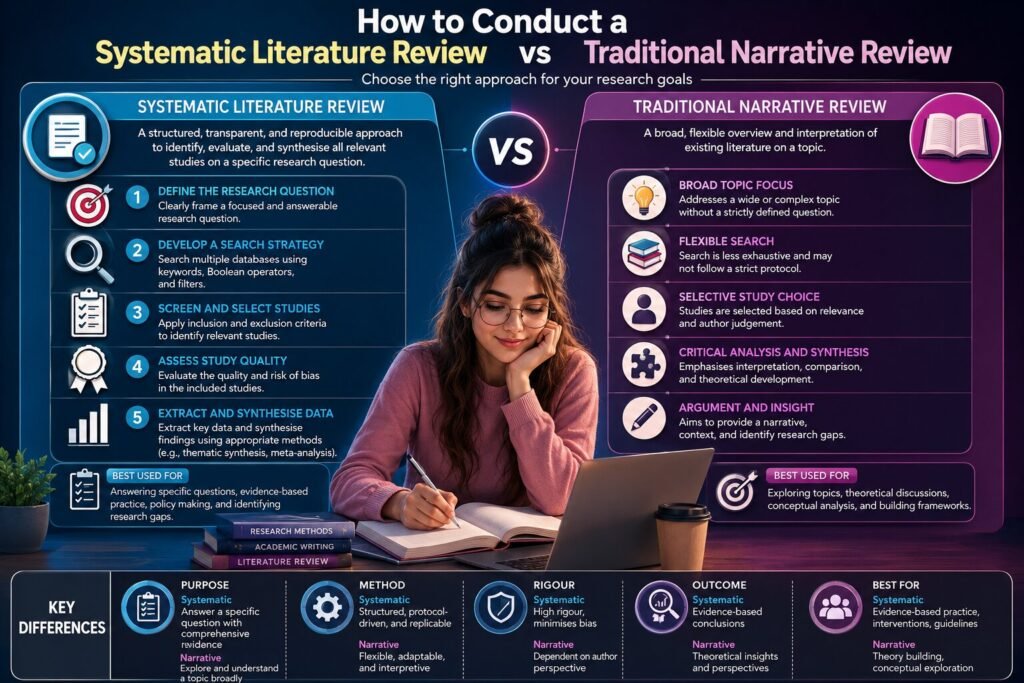
In modern academic research, knowing how to evaluate and synthesise existing evidence is just as important as collecting original data. Whether you are writing an undergraduate dissertation, a master’s thesis, or a PhD research project at a UK university, you will almost certainly need to complete some form of literature review. Yet many students struggle to understand the difference between a Systematic literature review vs literature review approach, and choosing the wrong method can weaken an entire research project. A well-structured Systematic literature review example can demonstrate academic rigour, transparency, and methodological reliability, while a traditional narrative review allows greater flexibility and critical discussion. Both approaches have value, but they serve different research purposes and require different strategies. In this guide, you will learn what a systematic literature review is, how it differs from a traditional narrative review, what the major stages involve, and when each method should be used. We will also explore practical examples, common mistakes, current trends in UK higher education, and the growing influence of Systematic literature review AI tools in academic research. Students get help how many word use in dissertation: How Many Words Should a Master’s Dissertation Be? What Is a Systematic Literature Review? One of the most common student questions is: What is a systematic literature review? In simple terms, a systematic literature review (SLR) is a highly structured method of identifying, evaluating, and synthesising all relevant research on a specific question. Unlike a standard review that may rely heavily on the writer’s interpretation or selected sources, a systematic review follows a transparent methodology. Every stage — from database searching to article selection and quality assessment — is carefully documented so another researcher could theoretically replicate the process. A Systematic literature review methodology is especially common in healthcare, education, psychology, business management, and social sciences. UK universities increasingly encourage systematic approaches because they align with evidence-based research standards promoted by organisations such as the Quality Assurance Agency and the Research Excellence Framework (REF). Students get help how to write an eassy fast: How to Write a University Essay in 24 Hours (When You’re Cramming) For example, a student researching the effectiveness of remote learning among UK university students might systematically collect peer-reviewed studies published between 2020 and 2025, apply inclusion and exclusion criteria, assess study quality, and synthesise findings objectively. This differs substantially from a traditional review, where the researcher may simply discuss selected studies without formally documenting search procedures. What Is a Traditional Narrative Literature Review? A traditional narrative review, often simply called a literature review, provides an interpretive overview of existing scholarship on a topic. Rather than attempting to capture every available study, the writer selects and discusses the most relevant or influential research. Narrative reviews are common in humanities, law, social sciences, and theoretical disciplines where interpretation, argument, and conceptual analysis are more important than exhaustive evidence collection. For instance, a dissertation exploring media representation of political leadership in Britain might use a narrative review to compare theories, highlight debates, and critically analyse scholarly perspectives. Students get master thesis help. The flexibility of narrative reviews allows students to build arguments creatively and engage deeply with theory. However, because source selection is less rigid, narrative reviews may introduce researcher bias if not conducted carefully. Systematic Literature Review vs Literature Review: The Core Differences Understanding the distinction between these approaches is crucial before beginning your dissertation. A systematic review is designed to answer a highly specific research question using explicit methods. It aims for comprehensiveness, transparency, and reproducibility. In contrast, a narrative literature review is broader, more interpretive, and often focused on developing theoretical understanding. The differences become particularly clear when examining methodology. A Systematic literature review Journal article typically includes sections detailing search databases, keywords, screening procedures, inclusion criteria, and quality assessment tools. Narrative reviews rarely provide this level of procedural detail. Another important difference involves objectivity. Systematic reviews attempt to minimise bias through structured processes, whereas narrative reviews rely more heavily on the author’s academic judgement and critical interpretation. Students often assume systematic reviews are automatically “better”, but that is not necessarily true. The best choice depends entirely on your research aims, discipline, and dissertation requirements. What Are the 4 Types of Literature Review? Many UK students are unaware that literature reviews exist in several forms. The four most commonly used types include: Narrative literature review Systematic literature review Scoping review Meta-analysis A narrative review offers a broad discussion of existing scholarship. A systematic review follows rigorous search and screening procedures. A scoping review maps the available evidence on an emerging topic without necessarily evaluating quality in detail. A meta-analysis statistically combines results from multiple quantitative studies. In practice, universities may also recognise integrative reviews, critical reviews, realist reviews, and rapid evidence assessments. Choosing the correct review type is essential because your methodology chapter must justify why the selected approach best addresses your research objectives. What Are the 5 Steps of Systematic Literature Review? Students frequently ask: What are the 5 steps of systematic literature review? While models vary slightly across disciplines, the process usually includes five key stages. 1. Defining the Research Question The first stage involves creating a focused and research able question. Many researchers use frameworks such (Population, Intervention, Comparison, Outcome) in health sciences or SPIDER in qualitative research. For example: “How effective are AI-powered learning platforms in improving academic performance among UK university students?” A narrowly focused question improves search precision and prevents the review from becoming unmanageable. 2. Developing a Search Strategy This stage involves selecting databases, keywords, and search strings. Researchers typically use databases such as Scopus, Web of Science, JSTOR, PubMed, or Google Scholar. Keywords might include: AI learning tools university education student performance higher education technology Boolean operators such as AND, OR, and NOT help refine searches. A strong Systematic literature review methodology requires documenting every search process carefully. 3. Screening and Selecting Studies After collecting search results, researchers apply inclusion and exclusion criteria. These may involve publication dates, study design,
How to Avoid Plagiarism in Dissertation Writing

How to Avoid Plagiarism in Dissertation Writing Writing a dissertation is one of the most important academic tasks a student will complete during university life. It requires months of research, critical thinking, analysis, and academic writing. However, one of the biggest challenges students face during this process is avoiding plagiarism. Even unintentional plagiarism can seriously damage academic credibility and may lead to penalties, failed submissions, or disciplinary action from universities Plagiarism in Dissertation Writing. Many students mistakenly believe plagiarism only means copying someone else’s work word for word. In reality, plagiarism can happen in several different ways, including poor paraphrasing, missing citations, improper referencing, or reusing previous work without acknowledgment. Because dissertations involve extensive research and the use of multiple academic sources, students must understand how to maintain originality while properly integrating external information Plagiarism in Dissertation Writing. master thesis help This complete guide explains how to avoid plagiarism in dissertation writing, why academic integrity matters, and the practical strategies students can use to ensure their work remains authentic, professional, and plagiarism-free. Understanding Plagiarism in Dissertation Writing Plagiarism occurs when someone presents another person’s ideas, words, research, or intellectual property as their own without proper acknowledgment. Universities take plagiarism seriously because dissertations are meant to demonstrate independent research skills and original academic contribution. There are several common forms of plagiarism in dissertation writing. Direct plagiarism involves copying text exactly from a source without quotation marks or citations. Mosaic plagiarism occurs when students slightly modify original text but keep the same structure or ideas without proper referencing. Self-plagiarism happens when students reuse parts of their previous assignments without permission or acknowledgment. In dissertation writing, plagiarism may also occur accidentally. Many students unintentionally fail to cite a source correctly or forget where certain information originated. This is why proper research organization and citation management are essential throughout the writing process Plagiarism in Dissertation Writing. Why Avoiding Plagiarism Is So Important Academic integrity is the foundation of higher education. Universities expect students to demonstrate honesty, originality, and ethical research practices. A dissertation reflects not only subject knowledge but also a student’s ability to analyze information independently and contribute meaningful insights Plagiarism in Dissertation Writing. Plagiarism can have serious consequences. Some universities issue warnings for minor cases, while others may fail the dissertation entirely or suspend students from academic programs. Beyond university penalties, plagiarism can damage professional reputation and future career opportunities Plagiarism in Dissertation Writing. Avoiding plagiarism also improves the quality of academic writing. When students develop their own arguments, interpretations, and critical analysis, their dissertations become stronger, more engaging, and academically valuable. Start With Original Research and Ideas How to Avoid Plagiarism in Dissertation Writing One of the best ways to avoid plagiarism is to focus on original thinking from the beginning. While dissertations rely heavily on existing academic literature, students should aim to contribute their own interpretation, analysis, or perspective Plagiarism in Dissertation Writing. Before writing, spend time understanding the research topic thoroughly. Read multiple academic sources rather than depending on a single article or book. Comparing different viewpoints helps students develop unique arguments and reduces the temptation to copy existing material. Taking organized research notes is also extremely helpful. Separate direct quotations from paraphrased ideas while researching so there is no confusion later during writing. Clearly recording author names, publication details, and page numbers saves time and prevents accidental citation mistakes. Learn How to Paraphrase Properly Paraphrasing is one of the most important academic writing skills. Many students believe changing a few words is enough, but proper paraphrasing requires fully rewriting ideas in your own language and sentence structure while maintaining the original meaning Plagiarism in Dissertation Writing. Effective paraphrasing involves understanding the source completely before rewriting it naturally. Instead of copying the sentence structure, students should explain the concept as if teaching it to someone else. After paraphrasing, the original source must still be cited because the underlying idea belongs to the original author. For example, if a journal article discusses the impact of social media marketing on consumer behavior, students should not simply replace a few words with synonyms. Instead, they should rewrite the concept entirely while integrating it smoothly into their own discussion and analysis. Good paraphrasing demonstrates comprehension and critical thinking, which are essential qualities in dissertation writing Plagiarism in Dissertation Writing. Always Cite Your Sources Correctly How to Avoid Plagiarism in Dissertation Writing Proper citation is essential for avoiding plagiarism. Every idea, theory, statistic, quotation, image, or research finding taken from another source must be acknowledged using the required referencing style. Different universities use different citation styles such as Harvard, APA, MLA, or Chicago. Students must understand the specific requirements of their institution before starting their dissertation. In-text citations should appear immediately after paraphrased or quoted information. The reference list or bibliography at the end of the dissertation should include complete publication details for every cited source. Students often lose marks because of inconsistent referencing. Using one referencing style throughout the dissertation is important for professionalism and academic accuracy. For more guidance on academic writing and referencing, students can also explore related resources on Online Essay Writing Plagiarism in Dissertation Writing. Use Quotations Sparingly Direct quotations can strengthen a dissertation when used correctly, especially when presenting definitions, expert opinions, or important theoretical statements. However, overusing quotations may reduce originality and weaken academic analysis. Students should only quote when the exact wording is necessary. Quotations must always include quotation marks and proper citations with page numbers where required. How to Choose the Best Academic Writing Service Most dissertations should rely more on paraphrasing and critical discussion rather than lengthy quotations. Universities generally expect students to demonstrate independent understanding rather than simply repeating existing research Plagiarism in Dissertation Writing. Keep Track of Every Source You Use Dissertation research often involves dozens of journal articles, books, reports, and online resources. Without proper organization, students can easily forget where information came from, increasing the risk of accidental plagiarism. Using citation management tools such as Zotero, EndNote, or Mendeley
From First Draft to Final Submission: A Realistic Masters Dissertation Timeline

Completing a master’s dissertation is one of the most intellectually demanding stages of postgraduate study. For many students across the UK, the dissertation represents not only a major academic challenge but also the bridge between university life and professional or research careers. Yet one of the most common questions students ask is: How long does it take to do a master’s dissertation? The answer is rarely straightforward. Some students complete their work efficiently within four to six months, while others struggle for nearly a year due to poor planning, unclear research direction, or balancing employment alongside study. This guide explores From First Draft to Final Submission: A Realistic Masters Dissertation Timeline in a practical and honest way. Rather than offering an unrealistic “perfect schedule”, this article breaks down what genuinely happens during the dissertation process in UK universities, what challenges students commonly face, and how you can stay on track without sacrificing quality or well being. Whether you are studying at a Russell Group institution, a modern UK university, or completing an online postgraduate degree, understanding a realistic timeline can dramatically improve both your marks and your stress levels. Students learn about how many words use in dissertation writing: How Many Words Should a Master’s Dissertation Be? By the end of this article, you will understand how to structure your dissertation journey, avoid common time-management mistakes, and create a workflow that aligns with academic expectations in higher education. Why a Realistic Dissertation Timeline Matters Many postgraduate students underestimate the scale of dissertation work. A typical UK master’s dissertation ranges from 12,000 to 20,000 words and requires independent research, critical analysis, academic writing, and consistent communication with supervisors. According to guidance from the Quality Assurance Agency, postgraduate students are expected to demonstrate advanced critical thinking, originality, and subject mastery. These expectations naturally require substantial time and intellectual effort. Students get dissertation help: MSC Dissertation Help Unfortunately, students often begin with unrealistic assumptions. Some believe the writing stage is the most difficult part, only to discover that research design, literature review development, and data analysis consume far more time than expected. Others delay work until after taught modules finish, leaving themselves only a few weeks before submission. A structured timeline helps you: Reduce last-minute pressure Maintain research quality Avoid burnout Meet supervisor expectations Improve academic confidence Produce a stronger final dissertation As we discussed in our guide to choosing a dissertation topic, planning is often the difference between a high distinction and a rushed pass-grade dissertation. Stage One: Topic Selection and Initial Planning (2–4 Weeks) The dissertation journey begins long before the first chapter is written. Selecting a topic can take several weeks, especially if your research area is broad or interdisciplinary. Students frequently make the mistake of choosing topics that are either too ambitious or too narrow. A successful dissertation topic should be manageable within the available time frame, academically relevant, and genuinely interesting to you. Remember, you will spend months researching this subject. In UK universities, supervisors often expect students to arrive with preliminary ideas before approval meetings. During this stage, you should begin reading journal articles, identifying research gaps, and reviewing current debates in your field. Students get masters dissertation help: Masters dissertation help For example, a business management student researching remote working trends may initially propose a broad topic such as “The Impact of Hybrid Work on Organisations”. After initial reading, they may refine it to “The Impact of Hybrid Working on Employee Productivity in UK Marketing Agencies”. This refinement process is essential because clarity at the start saves enormous amounts of time later. During this stage, students should also begin building a research calendar. Realistically, many master’s students balance employment, internships, or family commitments alongside study. Your dissertation timeline must reflect your real-life schedule rather than an idealised academic routine. Stage Two: Literature Review and Proposal Development (4–6 Weeks) The literature review is often the first major challenge students encounter. Many underestimate the depth of reading required for postgraduate-level work. A strong literature review does not simply summarise sources. It critically evaluates theories, identifies contradictions, highlights methodological trends, and establishes the academic context for your own research. UK markers increasingly expect evidence of independent critical thinking rather than descriptive writing. At this stage, students often ask: How long does it take to do a master’s dissertation if the literature review alone takes over a month? The reality is that the literature review forms the intellectual foundation of the entire project. Rushing it almost always weakens later chapters. Most students spend several weeks: Searching academic databases Reading peer-reviewed journals Organising references using tools such as Reference management software Identifying research gaps Developing conceptual frameworks This stage is also where many students in dissertation writing UK programmes experience their first major delay. Reading often reveals flaws in the original research question, requiring further refinement. One effective strategy is to write small sections continuously rather than waiting until all reading is complete. Dissertation supervisors across UK universities frequently recommend drafting thematic paragraphs while researching to save time later. Stage Three: Research Methodology and Ethics Approval (2–5 Weeks) Once your literature review establishes the research direction, the next stage involves methodology planning. This section explains how you will answer your research question. Depending on your discipline, this may involve interviews, surveys, case studies, experiments, textual analysis, or statistical modelling. In many UK universities, ethics approval is mandatory before data collection begins. Students often overlook how long this process can take. Ethics committees may request revisions, clarification, or additional participant protections. For example, psychology and healthcare dissertations often require more detailed ethical documentation than humanities subjects. Students conducting interviews with vulnerable groups may face particularly lengthy approval timelines. At this point, your UK dissertation structure begins taking clearer shape. Most master’s dissertations follow a format similar to: IntroductionLiterature ReviewMethodologyFindingsDiscussionConclusion Understanding this structure early makes the writing process more manageable later. Stage Four: Data Collection and Research Execution (4–8 Weeks) Data collection is one of the most unpredictable phases of the dissertation
How Many Words Should a Master’s Dissertation Be?

How Many Words Should a Master’s Dissertation Be? Writing a master’s dissertation is one of the most important academic challenges postgraduate students face during their university journey. Alongside researching, structuring, and referencing the project properly, one of the most common concerns students have is understanding the required dissertation word count. Many students worry about whether their dissertation is too short, too long, or incorrectly balanced across different sections. As a result, questions such as “How many words should a master’s dissertation be?” are extremely common among postgraduate students in the UK and internationally Master’s Dissertation. The length of a dissertation matters because universities use word count guidelines to assess the depth, clarity, and academic quality of a student’s research. A dissertation that is significantly under the required word count may appear incomplete or lacking sufficient analysis, while an overly long dissertation can lose focus and reduce readability. Understanding how dissertation word counts work helps students plan their research, structure their chapters properly, and avoid unnecessary stress close to submission deadlines Master’s Dissertation. Fortunately, dissertation word count requirements are not as confusing as they initially seem. While exact expectations vary depending on the university, subject, and programmers level, most master’s dissertations follow fairly standard academic guidelines. This complete guide explains how many words a master’s dissertation should be, how word counts are divided between chapters, what universities expect from postgraduate research projects, and how students can manage their writing effectively without sacrificing quality Master’s Dissertation. Understanding Master’s Dissertation Word Count Requirements Most UK universities require master’s dissertations to fall between 10,000 and 20,000 words. However, the exact length depends on the subject area, department guidelines, and research methodology used in the project. For example, humanities and social science dissertations are often longer because they involve extensive critical discussion and literature analysis. In contrast, science and engineering dissertations may contain shorter written sections because research findings are presented through tables, experiments, graphs, and technical data. According to postgraduate guidance from the University of Oxford and University of Manchester, students should always check department-specific dissertation requirements before beginning the writing process Master’s Dissertation. How Many Words Should a Master’s: master thesis help Typical master’s dissertation word count ranges include: 10,000–12,000 words for smaller taught master’s programmers 15,000–18,000 words for most UK postgraduate degrees 20,000 words or more for research-intensive programmers Although these ranges are common, students should never assume all universities follow identical standards. Why Dissertation Word Count Matters Dissertation word counts are designed to ensure students demonstrate sufficient academic depth and critical thinking. Universities expect postgraduate dissertations to show evidence of independent research, analytical ability, and engagement with academic literature. A dissertation that is too short may indicate limited research or weak analysis. On the other hand, excessively long dissertations often include repetition, unnecessary detail, or poor organization. The purpose of the word count is not simply to measure quantity but to encourage focused, meaningful academic discussion. Strong dissertations communicate ideas clearly and efficiently without unnecessary filler content. As explained in our guide to choosing a dissertation topic, successful dissertations are usually well-planned from the beginning, including realistic writing targets for each section. Typical Word Count Breakdown by Dissertation Chapter One of the best ways to manage a dissertation successfully is by dividing the total word count across individual chapters. This prevents students from spending too many words on one section while neglecting another. Although structures vary slightly between disciplines, a typical 15,000-word master’s dissertation may look like this: Introduction – 10% The introduction usually accounts for around 1,500 words. This section introduces the research topic, explains the aims and objectives, outlines the research question, and briefly describes the dissertation structure. A strong introduction provides clear direction without becoming overly detailed. Literature Review – 30% The literature review is often the longest chapter, typically around 4,000–4,500 words in a 15,000-word dissertation. This section critically evaluates previous academic studies, theories, and debates related to the topic. Students are expected to identify research gaps and demonstrate understanding of existing scholarship. A weak literature review often summarises sources without sufficient analysis, while a strong review compares arguments and evaluates evidence critically. Methodology – 15% The methodology chapter generally contains 2,000–2,500 words. This section explains how the research was conducted, including research design, data collection methods, ethical considerations, and limitations. Students should justify why they selected particular methods rather than simply describing what they did. How to Write a Literature Review for Your Masters Dissertation (With Examples Findings and Analysis – 30% The findings and analysis section typically includes around 4,000–4,500 words. Here, students present research results and analyses them in relation to the research question and literature review. This chapter often determines the overall academic quality of the dissertation because it demonstrates independent critical thinking. Conclusion – 10% The conclusion is usually around 1,000–1,500 words. This section summarise the main findings, answers the research question, discusses limitations, and may suggest areas for future research. Strong conclusions avoid introducing entirely new arguments. References and Appendices References and appendices are generally excluded from the official dissertation word count, although students should always confirm this with university guidelines. Appendices may include interview transcripts, surveys, tables, charts, or supplementary research material. Do All Universities Have the Same Dissertation Word Count? No university follows exactly the same dissertation requirements. Even within the same university, departments may have different expectations depending on the subject area and assessment criteria. For example, a business management dissertation may require 15,000 words, while an engineering dissertation at the same university might require only 10,000 words due to the technical nature of the project. Students should carefully read official dissertation handbooks and module guidelines. Most universities provide detailed instructions about: Universities Tightening Rules on AI Content in Assignments Recommended word counts Formatting requirements Referencing style Chapter structure Submission guidelines Reliable academic guidance can also be found through resources such as Quality Assurance Agency for Higher Education and Purdue OWL Academic Writing Resources. What Happens If You Exceed the Word Limit? Many universities allow a small
How to Write a Literature Review for Your Masters Dissertation (With Examples)

If you are beginning your postgraduate dissertation, learning How to Write a Literature Review for Your Masters Dissertation (With Examples) is one of the most important academic skills you will develop. For many students in the UK, the literature review is also the most intimidating part of the entire dissertation process. It requires deep reading, critical analysis, academic structure, and the ability to engage confidently with scholarly debate. Unlike undergraduate assignments, a master’s dissertation demands far more than summarising journal articles. UK universities expect postgraduate students to evaluate research critically, identify gaps in existing knowledge, and demonstrate independent academic thinking. A strong literature review forms the intellectual backbone of your dissertation and directly influences the quality of your research questions, methodology, and conclusions. Students get information how to find dissertation idea: How to Find Unique Dissertation Ideas That Impress Supervisors Whether you are studying business management at the University of Manchester, education at King’s College London, or psychology at the University of Birmingham, your literature review shows supervisors and examiners that you understand the wider academic landscape surrounding your topic. In this guide, you will learn exactly how to write a literature review for a master’s dissertation, how to structure it effectively, practical examples you can follow, common mistakes to avoid, and proven strategies used by successful UK postgraduate students. What Is a Literature Review in a Master’s Dissertation? A literature review is a critical evaluation of published academic research related to your dissertation topic. It analyses existing theories, debates, findings, and methodologies while identifying gaps your own research aims to address. Many students mistakenly believe a literature review is simply a collection of summaries. In reality, it is a carefully structured academic discussion that demonstrates your ability to think analytically and engage with scholarly arguments. Students get help how to write university level easy:How to Write a University Essay in 24 Hours (When You’re Cramming) For example, if your dissertation focuses on remote working in UK organisations, your literature review might explore themes such as: Employee productivity Mental health and well being Leadership communication Organisational culture Technology adoption Rather than discussing sources individually, you compare findings, highlight contradictions, evaluate strengths and weaknesses, and explain how your research contributes to ongoing academic debate. This is precisely why mastering How to Write a Literature Review for Your Masters Dissertation (With Examples) is essential for achieving high postgraduate marks. Students get help about master dissertation:master thesis help Why Literature Reviews Matter in UK Higher Education UK universities place significant emphasis on literature reviews because they reflect postgraduate-level academic standards. According to guidance from the Quality Assurance Agency , master’s students are expected to demonstrate “systematic understanding” and “critical awareness” within their subject area. Your literature review proves that you can: Engage with complex academic material Evaluate competing viewpoints Identify research gaps Build coherent arguments Justify your research aims In many dissertation writing UK programmes, the literature review can account for a substantial proportion of the overall assessment criteria. Supervisors often identify the quality of a dissertation early based on how critically and coherently the literature review is written. A weak review suggests limited reading or superficial understanding, while a strong review immediately establishes academic credibility. How to Write a Literature Review for a Master’s Dissertation Understanding how to write a literature review for a master’s dissertation begins with adopting a structured and strategic approach. Successful postgraduate students rarely begin writing immediately. Instead, they focus first on planning, reading, and organising ideas carefully. Start with a Focused Research Topic One of the biggest mistakes students make is choosing a topic that is too broad. Your literature review should revolve around a clear research problem or question. For example, instead of exploring “social media and education”, a more focused dissertation topic might be: “The impact of TikTok usage on academic engagement among UK university students.” A narrower focus helps you identify relevant research and maintain coherence throughout the review. As we discussed in our guide to choosing a dissertation topic, clarity at the beginning saves enormous time later in the dissertation process. Conducting Effective Academic Research Once your research question is clear, the next step is gathering credible academic sources. UK universities expect postgraduate students to rely primarily on peer-reviewed journals, scholarly books, and reputable institutional publications. Useful databases include: Google Scholar JSTOR Science Direct Emerald Insight Sage Journals ProQuest Your university library portal will also provide access to subscription-based academic resources. When selecting sources, focus on: Recent peer-reviewed studies Highly cited academic papers Foundational theories UK-based research where relevant Government or institutional reports Avoid relying heavily on blogs, generic websites, or outdated material unless historically relevant to your topic. Organising Your Literature Review Properly A well-organised literature review improves readability and strengthens your academic argument. In UK dissertation structure guidelines, literature reviews are usually organised thematically rather than source-by-source. Thematic Structure This is the most common approach for master’s dissertations. Research is grouped into themes or recurring topics. For example, a dissertation on online learning might include sections on: Student engagement Accessibility and inclusion Technology challenges Academic performance This approach allows you to synthesise multiple studies together. Methodological Structure Some dissertations compare research methods used in previous studies. This is common in psychology, business, sociology, and education research. You might compare: Quantitative vs qualitative methods Interview-based research Case studies Survey methodologies Chronological Structure In certain disciplines, it makes sense to explore how research has evolved over time. However, this structure should still remain analytical rather than descriptive. Example of Strong Literature Review Writing One of the best ways to understand How to Write a Literature Review for Your Masters Dissertation (With Examples) is by comparing weak and strong academic writing. Weak Example “Smith (2021) found that social media affects student performance. Jones (2022) also discussed social media use in education.” This simply describes studies without analysis. Strong Example “Recent studies indicate growing concern regarding the influence of social media on academic performance among university students. Smith (2021) argues that excessive social media
How to Find Unique Dissertation Ideas That Impress Supervisors

How to Find Unique Dissertation Ideas That Impress Supervisors Choosing a dissertation topic is one of the most important decisions students make during university. A strong dissertation idea can shape the entire research journey, influence motivation levels, improve academic performance, and even support future career goals. However, many students struggle to find dissertation ideas that feel original, relevant, and academically valuable. Some choose topics that are too broad, while others select subjects that lack enough research potential or fail to impress supervisors. MSc dissertation help Finding unique dissertation ideas is not about choosing the most complicated topic possible. Supervisors are usually more impressed by clear, focused, well-researched ideas that demonstrate curiosity, originality, and academic relevance. A successful dissertation topic should balance personal interest, available research material, practical feasibility, and contribution to existing knowledge. The challenge is that thousands of students search for dissertation ideas every year, making it difficult to identify topics that feel fresh and meaningful. Many students worry that their ideas are either overused or too weak to stand out academically. Fortunately, there are proven strategies that can help students discover dissertation topics that are both unique and supervisor-approved. Unique Dissertation Ideas. This guide explains how to generate original dissertation ideas, avoid common topic-selection mistakes, impress supervisors with strong research proposals, and choose a dissertation topic that remains engaging throughout the entire research process. Why Choosing the Right Dissertation Topic Matters Your dissertation topic influences nearly every part of your academic experience. A good topic makes research more enjoyable, keeps motivation high, and allows you to demonstrate genuine expertise in your field. A poor topic, on the other hand, can lead to frustration, lack of direction, research difficulties, and lower academic performance. Supervisors often evaluate dissertation proposals based on clarity, originality, research potential, and relevance to current academic discussions. Students who choose thoughtful and focused topics usually receive stronger guidance and better academic feedback. A dissertation topic also affects career opportunities. Many employers and postgraduate programmes value research special isations and independent academic work. Choosing a topic connected to your future goals can strengthen your professional profile and provide valuable subject expertise. Start With Subjects You Genuinely Enjoy One of the biggest mistakes students make is selecting topics purely because they seem easy or popular. Dissertation projects require months of reading, research, analysis, and writing. If you choose a topic that does not genuinely interest you, maintaining motivation becomes extremely difficult. Universities Tightening Rules on AI Content in Assignments Start by thinking about modules, lectures, or assignments you previously enjoyed. Ask yourself which academic discussions captured your attention most strongly. Reflect on classroom debates, research articles, or industry trends that made you curious. Students often produce stronger dissertations when they research subjects they genuinely care about. Passion improves focus, creativity, and critical thinking throughout the dissertation process. For example, a business management student interested in digital marketing might explore how artificial intelligence influences customer trust in online shopping. An education student passionate about mental health may investigate the impact of remote learning on student wellbeing. Interest creates long-term motivation, which is essential for dissertation success. Explore Current Trends in Your Academic Field Supervisors are often impressed by dissertation topics connected to current developments, emerging technologies, or modern social challenges. Researching recent trends can help students identify fresh dissertation opportunities with strong academic relevance. Reading academic journals, university publications, industry reports, and research blogs can reveal gaps in existing literature. Many students discover unique ideas by analysing modern issues that researchers are only beginning to explore. Some popular modern dissertation themes include: Artificial intelligence in education Remote learning challenges Social media marketing strategies Sustainability and business ethics Mental health in universities Digital consumer behaviour Cybersecurity and data privacy Online learning technologies Choosing a current issue demonstrates awareness of evolving academic and professional discussions. Identify Research Gaps in Existing Literature One of the best ways to find unique dissertation ideas is by identifying gaps in existing research. Academic research constantly evolves, meaning no subject is ever completely finished. When reading journal articles, pay attention to phrases such as: “Further research is needed” “Limited studies exist” “Future studies should examine” “This area remains underexplored” These statements often reveal opportunities for new dissertation topics. For example, if several studies examine remote learning in universities but very few focus specifically on international students, you may identify a valuable research gap. Supervisors appreciate topics that contribute something new to academic discussions rather than simply repeating old ideas. Use Real-World Problems as Inspiration Many strong dissertation topics begin with practical problems rather than purely theoretical questions. Universities increasingly encourage research that has real-world relevance and practical application. Think about challenges affecting industries, education systems, businesses, healthcare organisations, or society generally. Ask yourself: What problems need better solutions? What current debates exist in your field? What changes are influencing your industry? Which topics are receiving media attention? Practical research questions often create more engaging dissertations because they connect theory with real-world impact. For instance, a dissertation exploring how universities detect AI-generated assignments combines technology, education, ethics, and academic policy into one relevant research area. Talk to Supervisors Early Many students wait too long before discussing dissertation ideas with supervisors. Early conversations can save time and improve topic quality significantly. Supervisors have experience identifying strong research ideas and recognising weak proposals. They can help students narrow broad topics, improve research focus, and suggest useful academic sources. When meeting supervisors, prepare several possible ideas rather than relying on one topic only. This demonstrates initiative and flexibility. A supervisor may help transform a weak idea into a much stronger research project by refining the research question or narrowing the scope appropriately. Avoid Topics That Are Too Broad One common reason dissertations fail to impress supervisors is that the topic is too broad. Large subjects become difficult to manage within university word limits and research timelines. For example, a topic such as “Social Media Marketing” is far too broad for a dissertation. However, narrowing it to “The Impact of
