
Choreography, Media and My Aesthetic
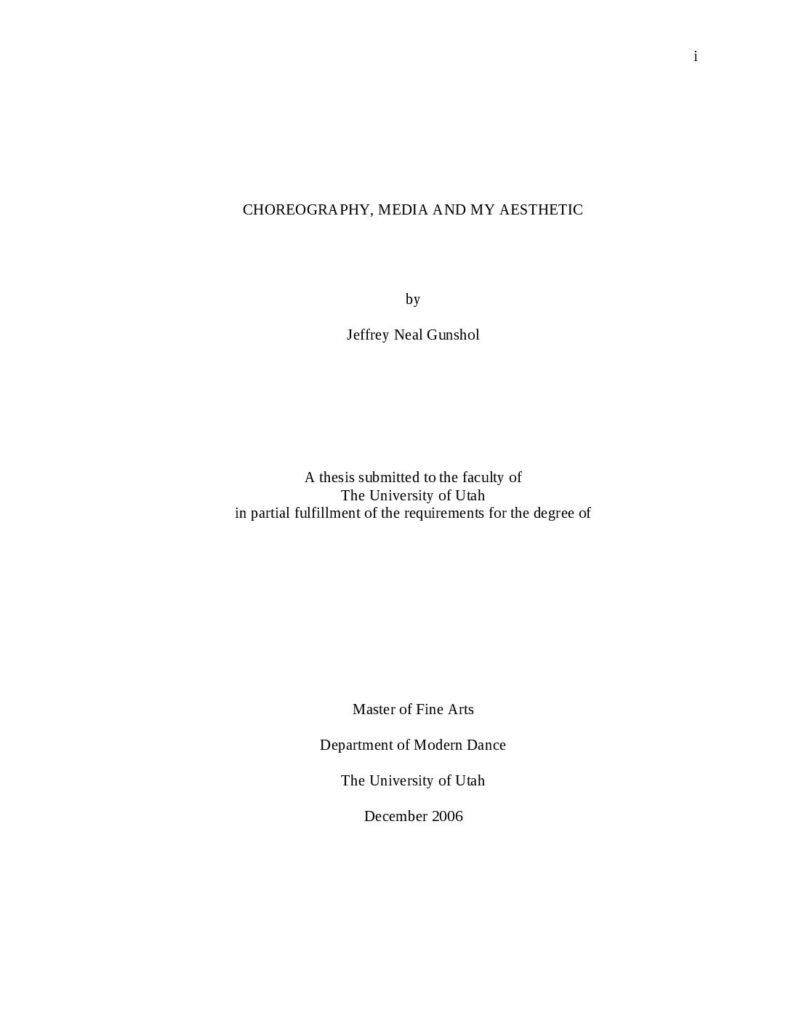
This MFA sample thesis by Jeffrey Neal Gunshol (University of Utah, 2006) explores how choreography can appropriate and manipulate elements from popular culture – television, cinema, and media – to create new meaning and broaden dance’s audience. The work culminates in THAT GIRL: a musical pastiche of one woman’s life, a choreoplay that fuses dance, theatre, and pop culture reference. Your browser does not support inline PDFs. Download the PDF here.
SAMPLE RESEARCH PROPOSAL: A case-study analysis of British Airways

Open the document in a new tab
The Influence of Childhood Brand Exposure on Adult Brand Loyalty

Open the document in a new tab
How to Choose a Master’s Dissertation Topic That Won’t Get Rejected

Choosing a successful Master’s Dissertation Topic is one of the most critical stages of your postgraduate academic journey. Whether you are aiming for a degree in nursing, education, business, or any other discipline, this major research project allows you to apply advanced theoretical frameworks to real-world problems. However, selecting a topic that is both feasible and academically valuable is essential to ensuring your proposal gets approved and avoids rejection by your supervisor. In this guide, we’ll explain how to choose a master’s dissertation topic that is more likely to gain approval and help you achieve strong academic results. 📚 Table of Contents Why Dissertation Topics Get Rejected Step 1: Start with Your Interests and Career Goals Step 2: Conduct Preliminary Research Step 3: Identify a Research Gap Step 4: Ensure the Topic is Researchable Step 5: Align with Your University’s Requirements Step 6: Narrow Your Topic Step 7: Discuss Your Ideas with Your Supervisor What Is the Best Topic for a Dissertation? Popular Master’s Dissertation Topic Areas Understanding the 3 Article Dissertation Format Using Dissertation Topic Lists Effectively How to Get 90% on Your Dissertation Common Mistakes to Avoid Final Thoughts Why Dissertation Topics Get Rejected Before discussing how to choose your Master’s Dissertation Topic, it’s important to understand why dissertation proposals are often rejected. Common reasons include: The topic is too broad or too narrow. There is insufficient academic literature available. The research question lacks clarity. The topic does not align with the course objectives. The research is not feasible within the available timeframe. Ethical or data access issues make the project impractical. The topic lacks originality or academic significance. Understanding these challenges can help you avoid costly mistakes from the beginning. Step 1 of 7 Start with Your Interests and Career Goals Your dissertation will require months of reading, writing, and research. Choosing a Master’s Dissertation Topic that genuinely interests you can make the process significantly easier. Ask yourself: Which modules did I enjoy most? What topics consistently capture my attention? What career path do I want to pursue after graduation? Are there industry problems I would like to explore? For example: A nursing student may focus on patient care outcomes. An education student may investigate digital learning strategies. A business student may examine consumer behaviour trends. When your topic aligns with your interests and future goals, maintaining motivation becomes much easier. Step 2 of 7 Conduct Preliminary Research Many students choose topics before checking whether enough research exists to support them. Before finalising your Master’s Dissertation Topic: Search academic databases. Review recent journal articles. Identify research gaps. Explore current debates in your field. This preliminary research helps determine whether your idea has sufficient academic support and whether it contributes something meaningful to existing knowledge. Many universities provide resources such as a Masters dissertation PDF repository containing previously approved dissertations. Reviewing these documents can provide valuable insight into topic selection and research design. Step 3 of 7 Identify a Research Gap One of the biggest misconceptions when choosing a Master’s Dissertation Topic is that you must discover a completely new area of study. In reality, academic research often builds upon existing studies by: Examining different populations. Using alternative methodologies. Investigating new geographical locations. Exploring recent developments. For example, rather than studying “Social Media Marketing” broadly, you might investigate: “The Impact of TikTok Marketing on Purchase Intentions Among Generation Z Consumers in the UK.” This focused approach demonstrates originality while remaining manageable. Step 4 of 7 Ensure the Topic is Researchable A strong Master’s Dissertation Topic must be practical and achievable. Ask yourself the following questions to test its feasibility: Can I Access the Data? If your study requires interviews with senior executives, can you realistically arrange them? Is the Sample Size Manageable? Avoid projects that require thousands of participants unless you have sufficient resources. Do I Have the Necessary Skills? Complex statistical techniques may require advanced analytical knowledge. Can I Complete It Within the Deadline? Ambitious topics often create unnecessary complications. A practical topic is usually more successful than an overly ambitious one. Master’s Dissertation Support Struggling to Define or Research Your Topic? Our UK academic writers and research specialists can help you refine your topic, identify clear research gaps, conduct preliminary literature reviews, and format your proposal to secure university approval. 📋 Send Your Details 💬 Contact Us on WhatsApp Step 5 of 7 Align with Your University’s Requirements Different universities have different expectations when it comes to a Master’s Dissertation Topic. Before submitting a proposal: Review dissertation guidelines. Check assessment criteria. Understand word count requirements. Review ethical approval procedures. Looking at Masters dissertation examples PDF files from your institution can help you understand the expected standard and structure. Similarly, students transitioning from undergraduate studies often benefit from reviewing undergraduate dissertation examples PDF documents to understand how postgraduate research differs in complexity and depth. Step 6 of 7 Narrow Your Topic One of the most common reasons for rejection is choosing a Master’s Dissertation Topic that is too broad. Consider the following progression: Too Broad “The Effects of Technology on Education” Better “The Impact of Artificial Intelligence Learning Tools on Student Engagement in Secondary Schools” Best “The Impact of AI-Powered Learning Platforms on Mathematics Engagement Among Secondary School Students in London” The more focused your topic becomes, the easier it will be to conduct meaningful research. Step 7 of 7 Discuss Your Ideas with Your Supervisor Before committing to your Master’s Dissertation Topic, your supervisor’s feedback can save you significant time and effort. When meeting with them: Prepare multiple topic ideas. Explain your research interests. Discuss feasibility concerns. Ask about available literature. Seek guidance on methodology. Supervisors often identify weaknesses that students may overlook. Early feedback can dramatically increase your chances of approval. What Is the Best Master’s Dissertation Topic? Students frequently ask: What is the best Master’s Dissertation Topic? The truth is that there is no universally perfect option. The best dissertation topic is one that: Interests you personally. Addresses a genuine research
How To Write An Outstanding Assignment In One Week
![How to Write an Outstanding Assignment in One Week [Day-by-Day Plan]](https://dissertationmaster.net/wp-content/uploads/2026/05/featured_image.jpg)
How to Write an Outstanding Assignment in One Week: Your Complete Day-by-Day Guide Learning how to write an outstanding assignment is one of the most valuable academic skills any student can develop. Whether you are staring at a brand-new brief with a seven-day deadline or trying to rescue a piece of writing you have been procrastinating on, one week is a perfectly workable timeframe. The key is having a structured, systematic plan rather than relying on a chaotic last-minute sprint. This guide walks you through every single day of that week, from decoding the assignment brief on Day 1 to submitting a polished, confident piece on Day 7. Most students approach assignments backwards. They open a blank document, start typing whatever comes to mind, and only consult the marking criteria after they have already written 800 words. The result is an essay that is well-written but answering the wrong question. Strong academic writing is less about literary talent and more about strategic execution. By treating your one-week timeline as a professional project, you will produce work that is thoughtful, well-argued, and genuinely impressive to your marker. 📚 Table of Contents Why One Week Is Enough (If You Plan It Right) The 7-Day Assignment Game Plan Days 1 and 2: Decode the Brief and Build Your Research Base Day 3: Build a Tight, Logical Outline Days 4 and 5: Write Your First Draft Without Stopping Day 6: Edit, Strengthen, and Cut the Excess Day 7: Final Proofread and Submission Checklist Common Assignment Mistakes and How to Avoid Them Final Thoughts Why One Week Is Enough (If You Plan It Right) The myth that excellent academic writing requires months of preparation is simply not true for the vast majority of undergraduate and postgraduate assignments. A 2,500-word essay, a structured report, or a reflective journal entry can all be completed to a high standard within seven days, provided you allocate those days intelligently. The students who struggle with short deadlines are not struggling because they lack intelligence. They are struggling because they treat every day of the week as “preparation” until suddenly it is Day 6 and they are writing the whole thing in one desperate session. The students who consistently excel break the process into distinct, non-negotiable phases and complete each phase fully before moving to the next. That discipline is the entire secret to how to write an outstanding assignment under time pressure. → Related Reading: How to write a strong research proposal for Phd dissertation or thesis The 7-Day Assignment Game Plan Before diving into the details of each phase, here is the high-level overview of how to distribute your week. Print this table out and stick it above your desk. Day Phase Primary Tasks Time Required Day 1 Decode the Brief Annotate the brief, identify command words, clarify the marking criteria, set your word count targets per section 1.5 – 2 hours Day 2 Research Find 8-12 credible academic sources, read strategically (abstract, intro, conclusion first), take structured notes with page numbers 3 – 4 hours Day 3 Outline Build a detailed paragraph-by-paragraph plan, map each source to the relevant section, write your thesis statement 2 – 3 hours Day 4 First Draft (Part 1) Write the introduction and the first 50% of the body paragraphs; focus on getting ideas down, not perfection 3 – 4 hours Day 5 First Draft (Part 2) Complete the remaining body paragraphs and write the conclusion; review for argument flow at a high level 3 – 4 hours Day 6 Edit and Strengthen Structural edit first, then paragraph-level edit; improve transitions, cut watered-down language, verify all citations 3 – 4 hours Day 7 Final Polish and Submit Proofread for grammar and spelling, run a plagiarism check, verify the reference list, format correctly, submit 2 hours Days 1 and 2: Decode the Brief and Build Your Research Base Day 1: Understand Exactly What Is Being Asked The single most common reason students receive disappointing marks on a well-written piece of work is that they answered a slightly different question from the one on the brief. Day 1 is entirely devoted to making absolutely certain that does not happen to you. Start by reading the assignment brief three times. On the first read, just absorb the general idea. On the second read, underline every “command word.” Command words are the action verbs that tell you exactly what intellectual operation your marker expects from you. These words include: analyse, evaluate, compare, discuss, critically assess, justify, and argue. Each one demands a fundamentally different type of response. If your brief says “evaluate” and you simply “describe,” you have answered the wrong question regardless of how eloquently you write. Key Command Words and What They Mean Describe: Give a detailed account of the features or characteristics of something. No judgment required. Analyse: Break the topic into its component parts and examine how each part works and relates to the whole. Evaluate / Critically Assess: Weigh up the evidence on multiple sides and reach a substantiated judgment. This is the highest-order command word and is the most commonly mishandled. Compare and Contrast: Identify both similarities and differences between two or more things, and explain why those similarities and differences matter. Argue / Justify: Take a clear position and defend it with logical reasoning and academic evidence. Once you have identified your command words, write your own plain-English version of the assignment question in one sentence. If you cannot explain what the assignment is asking you in simple language, you have not understood it yet. Visit your lecturer’s office hours or send a brief, specific email before you invest hours in research based on a misunderstanding. Day 2: Research Strategically, Not Exhaustively Many students make the mistake of treating research as an exercise in reading everything ever written about a topic. This approach guarantees that you run out of time before you start writing. Strategic research means finding the right sources, not the most sources. For a standard undergraduate
How to Write a Research Paper Fast: A Student’s Step-by-Step Guide

Every college student knows the feeling: the deadline is looming, the page is blank, and panic is starting to set in. If you’re staring at your syllabus, calculating the exact minimum grade you need to pass the class, and wondering how to write a research paper fast without sacrificing your GPA, you have come to the right place. The anxiety that comes with a blank document is universal, but it does not have to be inevitable. Writing an academic paper doesn’t have to be a multi-week agonizing process filled with sleepless nights and excessive caffeine consumption. In fact, many students who spend weeks on a single paper are not actually writing for weeks—they are procrastinating, getting lost in irrelevant research, and agonizing over perfect sentences that ultimately get deleted. By using a highly structured, strategic approach, you can cut your writing time in half while still producing a high-quality, thought-provoking essay that impresses your professors. In this comprehensive, deep-dive guide, we will break down the exact, step-by-step methodology you need to take to research efficiently, construct an unbreakable outline, draft your paper with record speed, and polish it to academic perfection. Whether you have three days or three hours left until submission, these strategies will fundamentally change the way you approach academic writing. The Hidden Psychology of Academic Procrastination Before we dive into the mechanics of how to write a research paper fast, we must address the elephant in the room: why do we wait until the last minute in the first place? Understanding the psychology behind academic procrastination is the first step to overcoming it. Psychologists have long established that procrastination is not a time-management problem; it is an emotion-regulation problem. When you are assigned a 15-page research paper, your brain perceives the task as a massive, overwhelming threat. The fear of failure, the anxiety of not knowing enough about the topic, and the sheer cognitive load of organizing thousands of words trigger a “fight or flight” response. Because you cannot fight a Microsoft Word document, your brain chooses flight—usually in the form of scrolling through TikTok, cleaning your room, or suddenly deciding it is the perfect time to do laundry. To write quickly, you must bypass this emotional roadblock. You do this by breaking the massive threat (a 15-page paper) into tiny, non-threatening micro-tasks (writing one outline bullet point, finding one source, typing for 10 minutes without stopping). Once you start viewing the writing process as a series of small, mechanical steps rather than a monumental test of your intelligence, the speed of your writing will increase exponentially. Step 1: Understand the Prompt and Pick a Micro-Niche Topic The single biggest time-waster in college writing is choosing a topic that is far too broad. If you try to write a 10-page paper about “The History of the Internet” or “The Causes of World War II,” you will instantly drown in millions of sources. You will spend hours reading contradictory information, and your final paper will read like a generic Wikipedia summary. To truly learn how to write a research paper fast, you must aggressively narrow your focus into a “micro-niche.” Deconstruct the rubric carefully: Do not just glance at the prompt. Highlight exactly what the professor is asking for. What is the central question? How many primary vs. secondary sources are required? What specific formatting style (APA, MLA, Chicago) must be used? Professors grade based on rubrics, not on how beautifully poetic your prose is. If you miss a rubric requirement, you lose points, no matter how good the writing is. Niche down aggressively: Instead of “The History of the Internet,” choose “How Early Social Media Platforms Influenced Adolescent Peer Pressures Between 2005 and 2010.” Instead of “The Causes of WWII,” choose “The Economic Impact of the Treaty of Versailles on the German Working Class in 1923.” A narrow topic writes itself because the parameters are so tight that you only have to make a few highly specific arguments. The 5-Minute Viability Test: Before committing to your micro-topic, ensure there is actually enough research available. Do a rapid 5-minute Google Scholar search. If you can instantly find 5-7 peer-reviewed articles directly related to your hyper-specific topic, you have a winner. If you find nothing, your topic is too narrow; widen it slightly. If you find two million results, it is still too broad. The Secret to an Unbreakable Thesis Statement A thesis statement is the steering wheel of your paper. If your thesis is weak, vague, or non-existent, your paper will veer off a cliff, and you will waste hours trying to figure out what you are actually trying to say. A strong thesis tells the reader exactly what you are arguing and how you plan to prove it. A weak thesis looks like this: “Social media has changed the way young people communicate.” This is a fact, not an argument. It offers no direction. A strong, fast-writing thesis uses a specific formula: [Specific Subject] + [Stance/Argument] + [Because/By] + [Three specific points of evidence]. A strong thesis looks like this: “While early social media platforms were designed to foster global connection, they fundamentally altered adolescent development by replacing physical community building with digital metrics of approval, exposing teenagers to unregulated targeted advertising, and disrupting traditional sleep cycles.” Notice how that thesis basically writes the paper for you? Body Paragraph 1 will be about digital metrics of approval. Body Paragraph 2 will be about targeted advertising. Body Paragraph 3 will be about sleep cycles. This level of clarity is mandatory if you want to know how to write a research paper fast. → Related Reading: How to Collect Reliable Data for Your UK Dissertation Study Step 2: Research Smart, Not Hard (Advanced Tactics) You do not need to read entire books to write a stellar academic paper. In fact, doing so is a massive mistake when you are on a tight deadline. Efficient research is the ultimate secret weapon of straight-A students. When figuring out how to
Best Technology Dissertation Topics for Computer Science Students
Choosing the best technology dissertation topics for computer science students is one of the most important steps in academic success. In 2026, technology is evolving at an unprecedented rate, making it both exciting and challenging for students to identify a topic that is relevant, innovative, and research-worthy. A well-chosen dissertation topic not only reflects your academic interests but also showcases your understanding of emerging trends such as artificial intelligence, cybersecurity, blockchain, and data science. The key to selecting the right topic lies in aligning your passion with current industry demands while ensuring there is enough research material available. This guide explores the best technology dissertation topics for computer science students, helping you make an informed decision that can enhance your academic performance and career prospects. Whether you are interested in software development, machine learning, or cloud computing, this comprehensive list will provide you with ideas that are both practical and impactful. This blog post is espcially helpful for. the students looking for msc dissertation help as it provides best dissertation topics related to their msc studies. Why Choosing the Right Technology Dissertation Topic Matters Academic and Career Impact Selecting the best technology dissertation topics for computer science students plays a crucial role in shaping your academic journey and future career. A strong topic demonstrates your ability to think critically, solve complex problems, and apply theoretical knowledge to real-world scenarios. Universities often evaluate dissertations based on originality, research depth, and practical application, which means your topic should stand out and contribute to existing knowledge. Moreover, employers in the tech industry are increasingly looking for candidates with hands-on research experience in trending areas such as AI, cybersecurity, and big data. Choosing the right topic can therefore open doors to internships, job opportunities, and further research. Keeping Up with Emerging Trends Technology is constantly evolving, and staying updated with the latest trends is essential when selecting a dissertation topic. In recent years, areas such as artificial intelligence, blockchain, and cloud computing have gained significant attention. By focusing on these fields, students can ensure their research remains relevant and valuable. The best technology dissertation topics for computer science students are those that address current challenges and propose innovative solutions. This not only enhances the quality of your dissertation but also increases its impact in both academic and professional settings. Top Categories for Technology Dissertation Topics Artificial Intelligence and Machine Learning Artificial intelligence and machine learning continue to dominate the field of computer science, making them one of the most popular areas for dissertation research. Students can explore topics such as natural language processing, deep learning algorithms, and AI in healthcare. For example, you might investigate how machine learning models can improve disease diagnosis or enhance customer experience in e-commerce platforms. These topics are not only relevant but also offer numerous opportunities for practical implementation. Cybersecurity and Data Protection With the rise in cyber threats, cybersecurity has become a critical area of research. The best technology dissertation topics for computer science students in this category include ethical hacking, network security, and data encryption techniques. You can also explore the role of artificial intelligence in detecting and preventing cyberattacks. As organizations continue to prioritize data security, research in this field is highly valuable and in demand. Blockchain and FinTech Blockchain technology has revolutionized industries such as finance, healthcare, and supply chain management. Dissertation topics in this area can focus on smart contracts, cryptocurrency security, or blockchain-based voting systems. These topics are particularly relevant for students interested in financial technology and decentralized systems. Exploring blockchain applications can provide insights into how this technology is transforming traditional business models. Cloud Computing and Big Data Cloud computing and big data analytics are essential components of modern technology infrastructure. Students can explore topics such as data storage optimization, cloud security, and real-time data processing. The best technology dissertation topics for computer science students in this category often involve analyzing large datasets to extract meaningful insights. This field offers a wide range of research opportunities and is highly relevant in today’s data-driven world. Best Technology Dissertation Topics for Computer Science Students (List) Artificial Intelligence Topics Intelligent chatbots using natural language processing AI-based predictive analytics for healthcare systems Machine learning algorithms for fraud detection Deep learning for image and speech recognition AI in autonomous vehicles: challenges and solutions Cybersecurity Topics Advanced encryption techniques for data protection Ethical hacking and penetration testing methods AI-based intrusion detection systems Cybersecurity challenges in IoT devices Blockchain for secure data sharing Software Engineering Topics Agile vs DevOps: A comparative study Software testing automation using AI Scalable web application development techniques Microservices architecture in modern applications Performance optimization in large-scale systems Data Science and Big Data Topics Big data analytics for business decision-making Data mining techniques for customer behavior analysis Predictive modeling using machine learning Real-time data processing frameworks Data visualization tools and techniques Cloud Computing Topics Cloud security challenges and solutions Serverless computing and its applications Multi-cloud strategies for enterprises Cloud-based AI services Edge computing vs cloud computing How to Choose the Best Technology Dissertation Topic Identify Your Interest The first step in choosing the best technology dissertation topics for computer science students is identifying your area of interest. Whether you are passionate about artificial intelligence, cybersecurity, or software development, selecting a topic that aligns with your interests will make the research process more engaging and enjoyable. Working on a topic you are genuinely interested in also increases your motivation and productivity. Evaluate Research Availability Before finalizing your topic, it is essential to evaluate the availability of research materials. A good dissertation topic should have sufficient academic resources, including journals, articles, and case studies. This ensures that you can conduct in-depth research and support your arguments effectively. Avoid topics that are too narrow or lack credible sources. You may also be interested to read: ROLE OF TECHNOLOGY EDUCATION IN EDUCATIONAL TRANSFORMATION Focus on Practical Application The best technology dissertation topics for computer science students often have practical applications. Consider how your research can solve real-world problems
Big Data Analytics Dissertation Topics for Beginners
Introduction to Big Data Analytics for Students Big Data Analytics Dissertation Topics for Beginners have become increasingly popular as universities and industries shift toward data-driven decision-making. In today’s digital era, massive volumes of structured and unstructured data are generated every second through social media, online transactions, sensors, and business operations. For beginners, selecting the right dissertation topic in big data analytics can feel overwhelming due to the wide range of subfields, tools, and methodologies available. However, understanding the core concepts of big data—such as volume, velocity, and variety—can help narrow down research areas. This post aims to guide students in identifying relevant, practical, and high-scoring dissertation topics while also providing clarity on how to approach research in this dynamic field. Whether you are an undergraduate or postgraduate student, choosing a topic that aligns with your interests and academic goals is essential for producing a meaningful dissertation. This is where professional services like Essay Writing Assignments become invaluable Understanding Big Data Analytics What is Big Data Analytics? Big data analytics refers to the process of examining large and complex datasets to uncover patterns, correlations, trends, and insights that can support better decision-making. It combines various technologies, including data mining, machine learning, statistical analysis, and predictive modeling. For beginners, it is important to grasp that big data analytics is not just about handling large datasets but also about extracting valuable information that can solve real-world problems. Importance of Big Data in Research The significance of big data analytics in academic research cannot be overstated. It enables researchers to analyze vast amounts of information efficiently, leading to more accurate conclusions and innovative discoveries. From healthcare to finance, and from education to marketing, big data analytics plays a crucial role in improving processes and outcomes. For dissertation students, working on Big Data Analytics Dissertation Topics for Beginners provides an opportunity to explore cutting-edge technologies while building valuable skills that are highly demanded in the job market. For students who need reliable and professional support, Online Essay Writing remains a trusted choice. How to Choose the Right Big Data Analytics Dissertation Topic Identify Your Area of Interest Selecting a dissertation topic begins with identifying your interests within big data analytics. Some students may prefer working with machine learning algorithms, while others may be more interested in data visualization or business intelligence. Choosing a topic that genuinely interests you will keep you motivated throughout the research process. Consider Available Resources and Tools Before finalizing your topic, ensure that you have access to the necessary tools, datasets, and software. Beginners should opt for topics that can be managed using accessible tools such as Python, R, or basic data visualization platforms. Avoid overly complex topics that require advanced technical expertise unless you have prior experience. Student also know the petrol diesel prices march 2026 Evaluate Research Scope and Feasibility It is essential to choose a topic that is neither too broad nor too narrow. A well-defined research question will make your dissertation more focused and manageable. Beginners should look for topics that have sufficient academic literature available while also leaving room for original contribution. Big Data Analytics Dissertation Topics for Beginners Easy and Practical Topics Analyzing Social Media Data to Understand User Behavior Predictive Analysis of Customer Buying Patterns Using Big Data Big Data Analytics in E-commerce: Trends and Insights Data Visualization Techniques for Large Datasets Role of Big Data in Improving Business Decision-Making Healthcare-Based Topics Big Data Analytics in Disease Prediction Use of Data Analytics in Improving Patient Care Predictive Modeling for Healthcare Outcomes Analysis of Electronic Health Records Using Big Data Business and Marketing Topics Customer Segmentation Using Big Data Analytics Impact of Big Data on Digital Marketing Strategies Sales Forecasting Using Predictive Analytics Role of Big Data in Enhancing Customer Experience Technology-Focused Topics Introduction to Machine Learning in Big Data Analytics Data Mining Techniques for Beginners Cloud-Based Big Data Analytics Solutions Real-Time Data Processing and Its Applications Social and Educational Topics Big Data Analytics in Education Systems Student Performance Analysis Using Data Analytics Role of Big Data in Public Policy Development Ethical Issues in Big Data Analytics Tools and Technologies for Beginners Popular Tools for Big Data Analytics For students working on Big Data Analytics Dissertation Topics for Beginners, understanding the basic tools is essential. Some of the most commonly used tools include Python for data analysis, R for statistical computing, and SQL for database management. Beginners can also explore visualization tools such as Tableau or Power BI to present their findings effectively. Learning Resources and Platforms There are numerous online resources available that can help beginners learn big data analytics. Tutorials, online courses, and academic journals provide valuable insights into different techniques and methodologies. Students should take advantage of these resources to strengthen their understanding and improve the quality of their dissertation. Challenges Faced by Beginners in Big Data Research Data Collection and Management One of the primary challenges in big data analytics is collecting and managing large datasets. Beginners may struggle with finding reliable data sources or handling complex data structures. It is important to start with smaller datasets and gradually move toward more complex data. Technical Complexity Big data analytics involves various technical concepts, including programming, algorithms, and statistical analysis. Beginners should focus on building a strong foundation before attempting advanced topics. Breaking down complex tasks into smaller steps can make the process more manageable. Time Management Completing a dissertation requires effective time management. Students must allocate sufficient time for research, data analysis, and writing. Planning and setting realistic deadlines can help ensure timely completion of the dissertation. Tips for Writing a High-Quality Dissertation Maintain Clear Structure A well-structured dissertation is easier to read and understand. Ensure that your work includes all essential sections, such as introduction, literature review, methodology, results, and conclusion. Each section should flow logically into the next. Focus on Originality Originality is a key factor in academic writing. Avoid copying existing research and strive to provide your own insights and analysis. Using proper referencing techniques will also
Impact of Artificial Intelligence on Dissertation Writing

The Impact of Artificial Intelligence on Dissertation Writing in 2026 is one of the most significant transformations in modern education. Artificial Intelligence (AI) has evolved from being a supportive tool to becoming a central component in academic research and writing. In 2026, students are no longer limited to traditional research methods; instead, they are leveraging advanced AI tools to streamline their dissertation process. From topic selection to final proofreading, AI technologies are reshaping how dissertations are conceptualized, structured, and completed. This shift has not only improved efficiency but also introduced new challenges related to ethics, originality, and academic integrity. As universities and institutions adapt to these changes, understanding the role of AI in dissertation writing has become essential for students aiming to succeed in a competitive academic environment. Students also read and search about how to write a dissertation from scratch. How AI is Transforming Dissertation Research AI-Powered Topic Selection and Idea Generation One of the most noticeable aspects of the Impact of Artificial Intelligence on Dissertation Writing in 2026 is its role in helping students generate ideas and choose relevant research topics. AI-driven platforms analyze current academic trends, research gaps, and published papers to suggest unique and viable dissertation topics. This eliminates the time-consuming process of brainstorming and allows students to focus on refining their ideas. Additionally, AI tools can align topics with industry demands, ensuring that dissertations remain practical and career-oriented. This capability is especially beneficial in fields like technology, business, and healthcare, where trends evolve rapidly. This is where professional services like Essay Writing Assignments become invaluable Advanced Literature Review Assistance Conducting a literature review is traditionally one of the most challenging parts of dissertation writing. In 2026, AI tools can scan thousands of academic journals, books, and articles within seconds to extract relevant information. These tools summarize key findings, identify patterns, and even highlight conflicting arguments. As a result, students can develop a comprehensive understanding of their research area without spending months reading and analyzing sources manually. The Impact of Artificial Intelligence on Dissertation Writing in 2026 is clearly evident in how it reduces workload while improving the depth and quality of literature reviews. AI in Writing and Structuring Dissertations Automated Content Generation AI writing assistants have become highly sophisticated, enabling students to draft sections of their dissertations quickly and effectively. These tools can generate coherent paragraphs, suggest transitions, and maintain a consistent academic tone. While AI does not replace human creativity, it significantly enhances productivity by providing a strong starting point for writing. Students can then refine and personalize the content to meet academic standards. The Impact of Artificial Intelligence on Dissertation Writing in 2026 is particularly visible in how it accelerates the writing process without compromising quality. Structuring and Formatting Support Proper structure and formatting are critical components of a successful dissertation. AI tools now offer automated formatting features that adhere to specific academic styles such as APA, MLA, or Harvard. They can organize chapters, create headings, and ensure consistency throughout the document. Furthermore, AI systems can suggest improvements in logical flow and coherence, helping students present their arguments more effectively. This reduces the likelihood of errors and ensures that dissertations meet institutional requirements. For students who need reliable and professional support, Online Essay Writing remains a trusted choice. Ethical Considerations and Academic Integrity Challenges of Plagiarism and Originality Despite its benefits, the Impact of Artificial Intelligence on Dissertation Writing in 2026 raises important ethical concerns. One of the primary issues is plagiarism, as AI-generated content may unintentionally replicate existing work. Universities are increasingly using advanced plagiarism detection tools to identify AI-generated text and ensure originality. Students must therefore use AI responsibly, treating it as a supportive tool rather than a replacement for their own ideas and analysis. Balancing AI Assistance with Human Effort Another ethical challenge is maintaining a balance between AI assistance and independent work. Over-reliance on AI can hinder critical thinking and reduce the authenticity of research. Academic institutions emphasize the importance of originality, encouraging students to use AI as a guide rather than a crutch. The Impact of Artificial Intelligence on Dissertation Writing in 2026 highlights the need for clear guidelines and policies to ensure that AI is used ethically and effectively. Benefits of AI in Dissertation Writing Increased Efficiency and Time Management One of the most significant advantages of AI is its ability to save time. Tasks that once took weeks, such as data analysis and literature reviews, can now be completed in a matter of hours. This allows students to focus on critical aspects of their research, such as analysis and interpretation. The Impact of Artificial Intelligence on Dissertation Writing in 2026 is evident in how it improves productivity and reduces stress among students. Enhanced Quality and Accuracy AI tools can identify grammatical errors, improve sentence structure, and ensure clarity in writing. They also provide suggestions for better word choice and academic tone, resulting in higher-quality dissertations. Additionally, AI-driven data analysis tools offer accurate and reliable results, enhancing the credibility of research findings. This combination of efficiency and quality makes AI an invaluable resource for dissertation writing. Limitations of Artificial Intelligence in Academic Writing Lack of Critical Thinking and Creativity While AI is highly efficient, it lacks the ability to think critically and creatively. It cannot generate original ideas or interpret complex concepts in the same way humans can. Students must therefore rely on their own intellectual abilities to develop unique arguments and insights. The Impact of Artificial Intelligence on Dissertation Writing in 2026 demonstrates that AI should complement, not replace, human intelligence. Dependence on Technology Another limitation is the growing dependence on AI tools. Students who rely too heavily on AI may struggle to develop essential research and writing skills. This dependence can also create challenges in situations where AI tools are not available. Therefore, it is important to strike a balance between using AI and maintaining traditional academic skills. The Future of Dissertation Writing with AI Integration of AI in Academic Institutions As AI continues
Blockchain Technology and Its Impact on Financial Systems

Blockchain Technology and Its Impact on Financial Systems has become one of the most discussed topics in the financial and technological world in recent years. Blockchain, at its core, is a decentralized digital ledger that records transactions across multiple systems in a secure, transparent, and immutable manner. Unlike traditional centralized financial systems controlled by banks and governments, blockchain operates on a peer-to-peer network, eliminating the need for intermediaries. This revolutionary technology has reshaped how financial transactions are conducted, verified, and recorded, making processes faster, more efficient, and highly secure. The growing adoption of blockchain in banking, payments, investments, and regulatory frameworks highlights its transformative potential. As financial institutions continue to face challenges such as fraud, inefficiency, and lack of transparency, blockchain emerges as a solution that addresses these issues while opening new opportunities for innovation. Understanding Blockchain Technology and Its Impact on Financial Systems is essential for students, researchers, and professionals aiming to stay ahead in the evolving financial landscape of 2026. H2: Understanding Blockchain Technology H3: What is Blockchain? Blockchain is a distributed ledger technology that stores data in blocks linked together in a chronological chain. Each block contains transaction data, a timestamp, and a cryptographic hash of the previous block, ensuring security and integrity. This structure makes it nearly impossible to alter past records, as changing one block would require modifying all subsequent blocks across the entire network. The decentralized nature of blockchain eliminates the need for a central authority, allowing participants to verify transactions collectively. This innovation forms the backbone of cryptocurrencies but extends far beyond digital currencies into broader financial applications. This is where professional services like Essay Writing Assignments become invaluable H3: Key Features of Blockchain Blockchain Technology and Its Impact on Financial Systems can be better understood by examining its key features. First, decentralization ensures that no single entity has control over the network, reducing the risk of manipulation. Second, transparency allows all participants to view transaction histories, enhancing trust. Third, immutability ensures that once data is recorded, it cannot be altered, which is crucial for financial record-keeping. Finally, security is achieved through advanced cryptographic techniques, protecting sensitive financial data from unauthorized access. H4: Types of Blockchain in Finance There are different types of blockchain networks used in financial systems, including public, private, and consortium blockchains. Public blockchains are open to everyone and are commonly used for cryptocurrencies. Private blockchains are restricted to specific participants, often used by banks for internal operations. Consortium blockchains are controlled by a group of organizations, making them ideal for collaborative financial processes such as interbank transactions. Each type plays a significant role in shaping Blockchain Technology and Its Impact on Financial Systems. H2: The Role of Blockchain in Financial Systems H3: Transforming Payment Systems One of the most significant contributions of Blockchain Technology and Its Impact on Financial Systems is the transformation of payment systems. Traditional payment methods often involve multiple intermediaries, resulting in delays and high transaction costs. Blockchain enables direct peer-to-peer transactions, reducing the need for intermediaries and lowering fees. Cross-border payments, which typically take days to process, can now be completed within minutes using blockchain technology. This efficiency is particularly beneficial for businesses and individuals engaged in international trade. For students who need reliable and professional support, Online Essay Writing remains a trusted choice. H3: Enhancing Security and Fraud Prevention Financial systems are highly vulnerable to fraud and cyberattacks, making security a top priority. Blockchain addresses these concerns by providing a secure and tamper-proof environment for transactions. Each transaction is verified by multiple nodes in the network, making it extremely difficult for malicious actors to manipulate data. The use of cryptographic algorithms further enhances security, ensuring that sensitive financial information remains protected. As a result, Blockchain Technology and Its Impact on Financial Systems significantly reduces the risk of fraud and enhances trust among users. H4: Improving Transparency and Accountability Transparency is a critical factor in financial systems, and blockchain excels in this area. All transactions recorded on a blockchain are visible to authorized participants, creating a transparent and auditable system. This level of transparency helps prevent corruption and ensures accountability, particularly in areas such as government spending and corporate finance. Blockchain Technology and Its Impact on Financial Systems promotes a more open and trustworthy financial environment. H2: Applications of Blockchain in Finance H3: Cryptocurrencies and Digital Assets Cryptocurrencies are the most well-known application of blockchain technology. These digital currencies operate independently of central banks, offering an alternative to traditional financial systems. Blockchain Technology and Its Impact on Financial Systems is evident in the rise of cryptocurrencies, which provide fast, secure, and low-cost transactions. In addition to cryptocurrencies, blockchain also supports digital assets such as tokens and stablecoins, which are increasingly used in financial markets. H3: Smart Contracts Smart contracts are self-executing contracts with terms directly written into code. These contracts automatically execute transactions when predefined conditions are met, eliminating the need for intermediaries. In financial systems, smart contracts are used for various purposes, including loan agreements, insurance claims, and trade settlements. Blockchain Technology and Its Impact on Financial Systems is enhanced by smart contracts, which improve efficiency and reduce operational costs. H4: Banking and Financial Services Banks and financial institutions are increasingly adopting blockchain to streamline operations and improve customer experiences. Blockchain is used for identity verification, loan processing, and transaction settlement, reducing processing times and costs. Additionally, it enables real-time auditing and compliance, helping institutions meet regulatory requirements. The integration of blockchain into banking highlights its growing influence on financial systems. H2: Challenges and Limitations of Blockchain in Finance H3: Regulatory and Legal Issues Despite its advantages, Blockchain Technology and Its Impact on Financial Systems faces several challenges, particularly in terms of regulation. Governments and regulatory bodies are still developing frameworks to govern blockchain and cryptocurrencies. The lack of clear regulations creates uncertainty for businesses and investors, potentially slowing adoption. Ensuring compliance with existing financial laws while accommodating the unique features of blockchain remains a significant challenge. H3: Scalability and Performance Scalability is