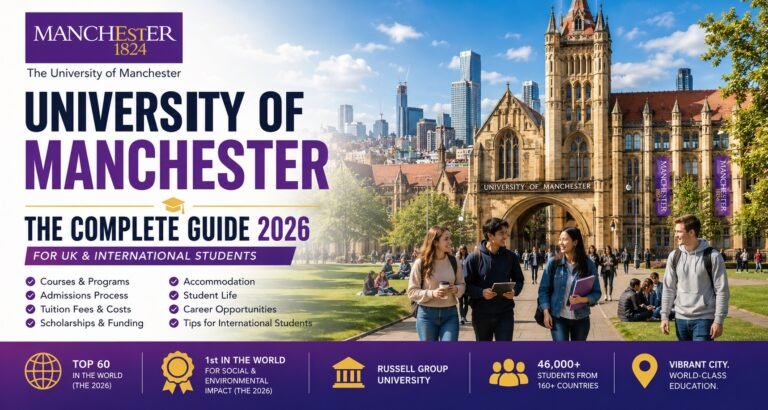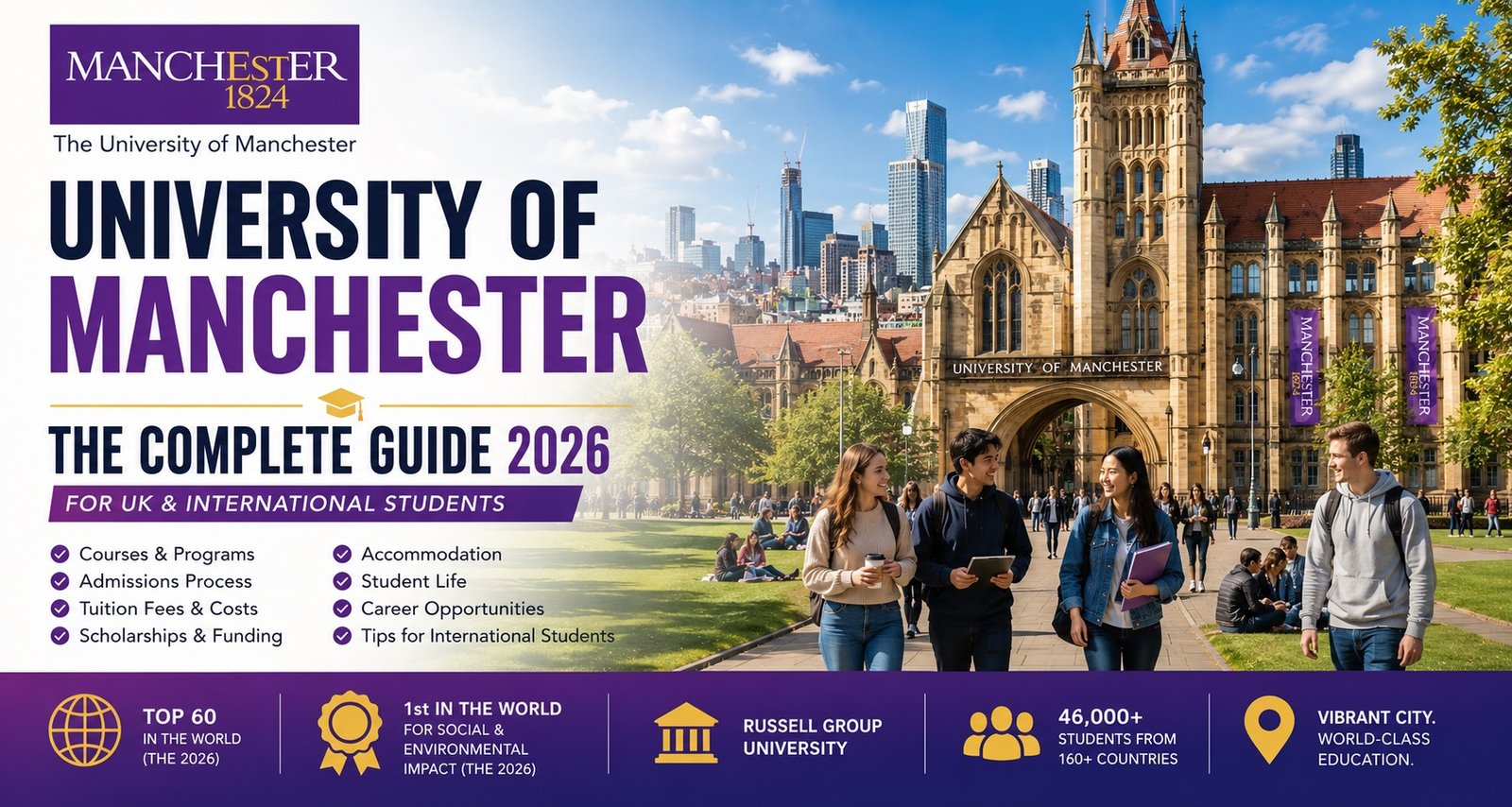
The University of Manchester is one of the United Kingdom’s most prestigious public research universities and a proud member of the Russell Group, representing the country’s leading research-intensive institutions. Located in the vibrant city of Manchester, England, the university is internationally recognised for its outstanding teaching, world-class research, innovation, and exceptional graduate employability.
Every year, thousands of students from across the UK and more than 160 countries choose the University of Manchester because of its excellent academic reputation, modern facilities, diverse community, and strong links with global employers. Whether you are planning to pursue an undergraduate degree, a master’s programme, or doctoral research, Manchester offers an inspiring environment where students can achieve both academic and personal success.
The university has played a significant role in shaping modern science, medicine, engineering, business, and the humanities. Its researchers have contributed to groundbreaking discoveries, including pioneering work in nuclear physics and the development of the world’s first stored-program electronic computer. Today, the University of Manchester continues to lead global research while preparing students for successful careers in an increasingly competitive world.
This comprehensive guide has been created specifically for prospective students and parents who want accurate, up-to-date, and easy-to-understand information about studying at the University of Manchester in 2026. You’ll learn about its history, global rankings, academic structure, admissions process, tuition fees, scholarships, student accommodation, campus life, career opportunities, and practical advice for both UK and international applicants.
Whether you’re comparing top UK universities or preparing your university application, this guide will help you make an informed decision.
Quick Facts About the University of Manchester
| Feature | Details |
|---|---|
| University Name | University of Manchester |
| Location | Manchester, England, United Kingdom |
| University Type | Public Research University |
| Founded | Institutional roots from 1824; current university established in 2004 |
| Russell Group Member | ✅ Yes |
| Total Students | Over 46,000 |
| International Students | Students from 160+ countries |
| Academic Faculties | 3 |
| Campus | Oxford Road & Sackville Street |
| Global Ranking | Among the world’s Top 60 universities |
| Known For | Research, Engineering, Business, Medicine, Computer Science |
| Official Website | https://www.manchester.ac.uk |
Table of Contents
- Brief History of the University of Manchester
- Why Choose the University of Manchester?
- Global Rankings and Reputation
- Campus and Academic Structure
- Courses and Teaching Style
- Admissions Process
- Tuition Fees and Living Costs
- Scholarships and Funding
- Student Accommodation
- Student Life
- International Student Guide
- Career Opportunities
- Frequently Asked Questions
Brief History of the University of Manchester
The history of the University of Manchester stretches back more than two centuries and reflects the city’s long-standing reputation for innovation, industry, and academic excellence.
Its origins date to 1824, when the Manchester Mechanics’ Institution was established to provide scientific and technical education to working people during Britain’s Industrial Revolution. As Manchester became one of the world’s leading industrial cities, the demand for higher education continued to grow.
In 1851, the Owens College was founded following a generous donation from textile merchant John Owens. The college quickly expanded its academic offerings and later became one of the founding members of the federal Victoria University in 1880.
Another important institution, the University of Manchester Institute of Science and Technology (UMIST), developed into one of Europe’s leading centres for engineering, science, and technology.
A major milestone came in 2004, when the Victoria University of Manchester and UMIST officially merged to create the modern University of Manchester. This merger formed one of the UK’s largest and most research-intensive universities.
Throughout its history, the university has been home to some of the world’s greatest scientists, researchers, economists, and innovators. Its academic community has included 26 Nobel Prize winners, highlighting its remarkable contribution to global knowledge and scientific advancement.
Among its many historic achievements are:
- Ernest Rutherford’s groundbreaking research that transformed our understanding of atomic structure.
- Development of the world’s first stored-program electronic computer, known as the Manchester Baby, in 1948.
- Nobel Prize-winning research in physics, chemistry, medicine, and economics.
- Pioneering work on graphene, an ultra-thin material first isolated by Manchester researchers, which has transformed modern materials science.
Today, the University of Manchester continues to invest heavily in research, innovation, sustainability, and global collaboration, maintaining its position as one of the world’s leading universities.
Why Choose the University of Manchester?
Choosing the right university is one of the most important decisions in a student’s academic journey. The University of Manchester stands out because it combines internationally recognised education with practical learning, cutting-edge research, excellent career opportunities, and a vibrant student experience.
Here are some of the biggest reasons why thousands of students choose Manchester every year.
1. Globally Recognised Academic Excellence
The University of Manchester consistently ranks among the world’s leading universities. Employers across the UK and internationally highly value Manchester graduates because of the university’s strong academic standards and emphasis on practical skills.
Its degrees are recognised worldwide, giving graduates excellent opportunities for employment, further study, and international careers.
2. Member of the Russell Group
Manchester belongs to the prestigious Russell Group, a collection of the UK’s leading research-intensive universities.
Russell Group universities are known for:
- Outstanding teaching
- High-quality research
- Strong employer reputation
- Excellent graduate outcomes
- Modern learning facilities
Studying at a Russell Group university can significantly enhance your academic profile and career prospects.
3. Outstanding Research
Research is at the heart of everything the University of Manchester does.
Students benefit from learning alongside internationally respected academics who are working on solutions to some of the world’s biggest challenges, including:
- Artificial Intelligence
- Climate Change
- Cancer Research
- Advanced Materials
- Biotechnology
- Engineering Innovation
- Digital Technologies
- Sustainable Development
This research-led approach ensures students receive an education that reflects the latest developments in their chosen field.
4. Excellent Graduate Employability
One of Manchester’s greatest strengths is its strong relationship with employers.
Many degree programmes include:
- Industrial placements
- Internship opportunities
- Live business projects
- Research collaborations
- Professional accreditation
Graduates go on to work for leading organisations across technology, finance, healthcare, engineering, government, and multinational companies.
5. Diverse International Community
The University of Manchester welcomes students from more than 160 countries, creating one of the UK’s most diverse and inclusive learning environments.
International students benefit from:
- Dedicated support services
- Cultural societies
- International orientation programmes
- English language support
- Career guidance
- Visa and immigration advice
This multicultural atmosphere helps students build lifelong friendships while developing valuable global perspectives.
6. A Vibrant Student City
Manchester is widely recognised as one of the UK’s best student cities.
Compared with London, students often enjoy:
- More affordable accommodation
- Lower daily living expenses
- Excellent public transport
- World-famous music scene
- International restaurants
- Premier League football
- Shopping centres
- Museums and galleries
- Green parks and recreational spaces
The city’s lively atmosphere provides an exciting balance between academic life and personal wellbeing.
7. Modern Facilities and Student Support
The university offers outstanding facilities designed to help students succeed academically and personally.
Students have access to:
- Modern libraries
- Advanced research laboratories
- Digital learning resources
- Study spaces
- Sports facilities
- Careers Service
- Wellbeing support
- Academic skills workshops
- Disability support services
These resources help create a supportive environment where students can thrive throughout their studies.

Global Rankings and Reputation
The University of Manchester has built a reputation as one of the world’s leading universities through decades of excellence in education, research, innovation, and graduate success.
It consistently performs well in internationally recognised university rankings and is respected by employers, researchers, and academic institutions around the world.
Some of its recent achievements include:
- Ranked among the Top 60 universities globally in major international rankings.
- Ranked No. 1 in the world in the Times Higher Education Impact Rankings 2026, recognising its contribution to the United Nations Sustainable Development Goals.
- Consistently recognised as one of the UK’s leading universities for research quality and graduate employability.
- Strong global reputation in engineering, business, medicine, computer science, life sciences, and social sciences.
- Home to internationally recognised researchers, innovators, and Nobel Prize winners whose work continues to influence science, technology, healthcare, and society.
Beyond rankings, the University of Manchester is respected for producing graduates who are highly valued by employers across the UK and around the world. Its combination of academic excellence, research leadership, and industry partnerships makes it one of the most attractive universities for students seeking a globally recognised degree.
Campus and Academic Structure
The University of Manchester offers one of the UK’s most impressive urban campuses, combining historic architecture with modern teaching and research facilities. Situated along the famous Oxford Road Corridor, the campus is just a short walk from Manchester city centre, allowing students to enjoy both academic life and everything the city has to offer.
Unlike universities spread across multiple distant locations, most of Manchester’s academic buildings, libraries, accommodation, cafés, and student services are within walking distance. This creates a connected and convenient learning environment where students can easily attend lectures, participate in extracurricular activities, and access university support services.
The university is home to more than 46,000 students, including a large international community representing over 160 countries. This diverse student population creates a welcoming and multicultural atmosphere where students gain valuable global perspectives alongside their academic studies.
Modern lecture theatres, research laboratories, collaborative study spaces, digital learning facilities, and social areas ensure students have access to everything they need for a successful university experience.
Main Campus Locations
The University of Manchester primarily operates across two major campus areas.
Oxford Road Campus
The Oxford Road Campus is the university’s main academic hub and one of the busiest university corridors in Europe.
Here you’ll find:
- Main teaching buildings
- University libraries
- Research institutes
- Student Union
- Whitworth Hall
- Alan Gilbert Learning Commons
- Engineering buildings
- Medical School
- Business School
- Modern cafés and study spaces
This area hosts most undergraduate and postgraduate teaching activities and is well connected by buses, cycling routes, and walking paths.
Sackville Street Campus
The historic Sackville Street Campus has traditionally been associated with engineering and science disciplines. While many departments have moved into the University’s modern engineering facilities, the campus remains an important part of Manchester’s academic heritage.
Students studying engineering, computing, and technology-related subjects may still access facilities connected with this area.
Faculties at the University of Manchester
To provide high-quality education across a wide range of disciplines, the university is organised into three major faculties, each comprising several specialist schools and departments.
Faculty of Biology, Medicine and Health
This faculty is internationally recognised for its contributions to healthcare, clinical research, and life sciences.
Popular subjects include:
- Medicine
- Dentistry
- Nursing
- Pharmacy
- Biomedical Sciences
- Public Health
- Psychology
- Life Sciences
Students benefit from close links with NHS hospitals and research centres, providing valuable practical experience alongside academic study.
Faculty of Science and Engineering
One of the university’s strongest academic divisions, this faculty is known worldwide for innovation and cutting-edge research.
Popular courses include:
- Computer Science
- Artificial Intelligence
- Data Science
- Mechanical Engineering
- Civil Engineering
- Aerospace Engineering
- Electrical & Electronic Engineering
- Chemical Engineering
- Mathematics
- Physics
- Chemistry
- Earth and Environmental Sciences
Students gain access to advanced laboratories, industry-standard equipment, and opportunities to work on real-world research projects.
Faculty of Humanities
The Faculty of Humanities offers a broad range of programmes that combine academic excellence with practical skills.
Popular subjects include:
- Business and Management
- Accounting and Finance
- Economics
- Law
- Education
- Politics
- International Relations
- Sociology
- Criminology
- History
- Languages
- Philosophy
- Social Sciences
Many programmes include placements, internships, and opportunities to study abroad.
Most Popular Courses at the University of Manchester
The University of Manchester offers hundreds of undergraduate, postgraduate, and research programmes, making it one of the UK’s most comprehensive universities.
Some of the most sought-after courses include:
Computer Science
Manchester has an outstanding reputation in computing, artificial intelligence, cybersecurity, software engineering, and data science. Students benefit from research-led teaching and strong industry links with leading technology companies.
Career opportunities include:
- Software Developer
- AI Engineer
- Cybersecurity Specialist
- Data Scientist
- Cloud Engineer
Engineering
Engineering has long been one of Manchester’s flagship strengths.
Students can specialise in:
- Mechanical Engineering
- Civil Engineering
- Aerospace Engineering
- Chemical Engineering
- Electrical & Electronic Engineering
- Materials Engineering
Many engineering programmes offer industrial placements that help students develop practical skills before graduation.
Business and Management
The Alliance Manchester Business School is internationally respected and attracts students from around the world.
Popular business subjects include:
- Business Management
- International Business
- Marketing
- Human Resource Management
- Accounting
- Finance
- Entrepreneurship
Graduates often pursue careers in multinational companies, consulting firms, banking, and public sector organisations.
Medicine and Health Sciences
Manchester is one of the UK’s leading centres for medical education and healthcare research.
Courses include:
- Medicine
- Dentistry
- Pharmacy
- Nursing
- Biomedical Sciences
- Public Health
Students gain valuable clinical experience through partnerships with NHS hospitals and healthcare providers.
Law
Manchester’s law programmes combine academic theory with practical legal training.
Students develop skills in:
- Criminal Law
- Commercial Law
- International Law
- Human Rights
- Corporate Law
Many graduates continue into legal practice, public service, or postgraduate study.
Teaching Style and Learning Experience
The University of Manchester follows a research-led teaching approach, ensuring students learn from academics actively contributing to developments in their fields.
Teaching methods vary depending on the course but commonly include:
- Lectures
- Small-group seminars
- Laboratory sessions
- Workshops
- Tutorials
- Independent research
- Group projects
- Practical assignments
- Online learning resources
This combination helps students build both theoretical knowledge and practical skills.
Students are encouraged to think critically, solve real-world problems, and develop strong communication and teamwork abilities.
Practical Learning and Industry Experience
Many courses offer opportunities to gain hands-on experience before graduation.
These may include:
- Industrial placements
- Year-in-industry programmes
- Internships
- Research projects
- Consultancy projects
- Study abroad opportunities
- Employer networking events
These experiences help students strengthen their CVs and improve graduate employability.
World-Class Research Excellence
Research is one of the defining strengths of the University of Manchester.
The university invests heavily in research across science, engineering, medicine, business, humanities, and environmental studies. Students often have opportunities to work alongside leading researchers, gaining experience with cutting-edge projects and technologies.
Research areas include:
- Artificial Intelligence
- Advanced Materials
- Biotechnology
- Cancer Research
- Digital Innovation
- Climate Change
- Sustainable Energy
- Health Sciences
- Robotics
- Nanotechnology
This commitment to innovation ensures that teaching remains current and closely connected to real-world challenges.
Graphene: A World-Changing Discovery
One of the university’s most celebrated scientific achievements is the isolation of graphene, an ultra-thin material consisting of a single layer of carbon atoms.
Researchers Sir Andre Geim and Sir Konstantin Novoselov carried out this groundbreaking work at the University of Manchester, earning the 2010 Nobel Prize in Physics.
Today, graphene continues to influence research in:
- Electronics
- Medical technology
- Aerospace
- Renewable energy
- Advanced manufacturing
The university remains a global leader in graphene research through its specialist research institutes and collaborations with industry.
Libraries and Learning Resources
Students have access to one of the UK’s largest academic library systems.
Facilities include:
- Millions of printed and digital resources
- Quiet study zones
- Group study rooms
- Computer clusters
- Online journals
- Research databases
- Academic skills support
One of the most popular study spaces is the Alan Gilbert Learning Commons, which provides extended opening hours, collaborative workspaces, and modern learning technology.
Famous Alumni and Notable Figures
The University of Manchester has educated and inspired many individuals who have made significant contributions in science, business, politics, literature, and the arts.
Notable people associated with the university include:
- Sir Andre Geim – Nobel Prize-winning physicist known for graphene research.
- Sir Konstantin Novoselov – Nobel Prize-winning physicist and co-discoverer of graphene.
- Brian Cox – Physicist, science communicator, and former musician.
- Irene Khan – International human rights advocate and former Secretary General of Amnesty International.
- Benedict Cumberbatch – Studied at the University of Manchester as part of an Erasmus exchange programme before completing his degree elsewhere.
The university’s global alumni network spans business, science, government, healthcare, media, and technology, providing valuable networking opportunities for graduates.
Why Manchester Stands Out for Innovation
Innovation is deeply embedded in the University’s culture. From pioneering discoveries in atomic physics to breakthroughs in materials science and artificial intelligence, Manchester has consistently shaped the future through research and collaboration.
Students benefit from this innovative environment by engaging with leading academics, accessing advanced facilities, and participating in projects that address real-world challenges. Combined with strong industry partnerships and an entrepreneurial ecosystem, the University of Manchester provides an excellent foundation for those aiming to make a meaningful impact in their chosen careers.
Admissions Process for UK and International Students
The University of Manchester attracts over 90,000 undergraduate applications each year, making it one of the UK’s most popular universities. While admission is competitive, students with strong academic records, a well-prepared application, and a genuine interest in their chosen subject have a good chance of receiving an offer.
The admissions process differs slightly for undergraduate and postgraduate applicants, but both focus on academic achievement, potential, and suitability for the chosen course.
Undergraduate Admissions (UCAS)
Students applying for an undergraduate degree must submit their application through UCAS (Universities and Colleges Admissions Service).
The application process generally includes the following steps:
1. Choose Your Course
Before applying, carefully compare different courses and review:
- Entry requirements
- Course modules
- Career opportunities
- Placement options
- Accreditation
- Tuition fees
Choosing the right course is essential because entry requirements vary by programme.
2. Prepare Your UCAS Application
Your UCAS application normally includes:
- Personal details
- Academic qualifications
- Predicted grades (if applicable)
- Personal Statement
- School or college reference
- Employment history (if relevant)
Take time to review your application carefully before submitting it, as accuracy is important.
3. Submit Before the Deadline
Most undergraduate courses follow the standard UCAS deadline, while courses such as Medicine and Dentistry have earlier deadlines.
Submitting your application well before the deadline gives you more time to resolve any issues and demonstrates good preparation.
4. Receive Your Offer
The University of Manchester may send one of the following:
- Conditional Offer – You must achieve the required grades.
- Unconditional Offer – You have already met all entry requirements.
- Unsuccessful Application – Your application has not been accepted.
5. Accept Your Offer
Once you receive offers from universities, you will normally choose:
- Firm Choice
- Insurance Choice
You must then meet any conditions before enrolment.
Postgraduate Admissions
Applications for postgraduate taught and research programmes are usually submitted directly through the University of Manchester’s online application system.
Applicants are generally required to provide:
- Degree transcripts
- Degree certificates
- CV or résumé (for some courses)
- Personal Statement or Statement of Purpose
- Academic references
- English language test results (if required)
Certain programmes, particularly MBA or research degrees, may also require interviews or relevant professional experience.
Entry Requirements
Admission requirements vary depending on the course, but the university expects applicants to demonstrate strong academic ability.
Undergraduate Requirements
Typical qualifications include:
- A Levels
- International Baccalaureate (IB)
- Scottish Highers
- Foundation programmes (for eligible students)
- Recognised international qualifications
Some competitive courses may require:
- Higher grade requirements
- Admissions tests
- Interviews
- Portfolio submissions (for selected creative programmes)
Always review the specific requirements for your chosen programme before applying.
Postgraduate Requirements
Applicants usually need:
- A recognised bachelor’s degree (or international equivalent)
- Good academic performance
- Relevant background in the subject area
- Supporting documents
- English language proficiency (where applicable)
Some programmes also consider relevant work experience.
English Language Requirements
If English is not your first language, you may need to demonstrate your English proficiency before starting your studies.
The University of Manchester accepts several recognised English language qualifications, including:
- IELTS Academic
- TOEFL iBT
- Pearson PTE Academic
- Cambridge English qualifications
The required score depends on the course, and some programmes—particularly in medicine, healthcare, or education—may require higher levels of English proficiency.
If you do not yet meet the required standard, the university may offer pre-sessional English language courses to help prepare you for degree-level study.
Personal Statement Tips
A strong Personal Statement can make a significant difference, especially for competitive courses.
Include:
- Why you want to study the subject.
- Relevant academic achievements.
- Work experience or volunteering (if applicable).
- Skills and interests related to the course.
- Career goals.
- Why the University of Manchester is a good fit for you.
Avoid copying templates or using generic statements. Admissions tutors value authenticity and evidence of genuine motivation.
Tuition Fees (2026/27)
Tuition fees vary depending on your course and fee status (Home or International).
Home (UK) Students
For most undergraduate programmes, tuition fees are expected to be:
£9,790 per year (subject to UK Government confirmation).
Eligible students may be able to access student finance through the relevant UK funding body.
International Students
International tuition fees vary considerably by subject.
Typical undergraduate tuition fees range from approximately:
- £20,000–£30,000 per year for many humanities and social science courses.
- £30,000–£40,000+ per year for laboratory-based subjects such as engineering and science.
- Higher fees may apply to Medicine, Dentistry, and certain specialist programmes.
Always check the official course page for the latest fee information before applying.
Additional Study Costs
Besides tuition fees, students should budget for other academic expenses such as:
- Books and study materials
- Printing and stationery
- Laboratory or fieldwork costs (where applicable)
- Laptop or computer equipment
- Graduation fees (if applicable)
These costs vary depending on the course and individual needs.
Living Costs in Manchester
One of Manchester’s biggest advantages is that it is generally more affordable than London, while still offering an excellent student experience.
Although individual spending habits vary, students should prepare a realistic budget before arriving.
Estimated Monthly Living Costs
| Expense | Estimated Monthly Cost |
|---|---|
| Accommodation | £650–£1,000 |
| Food & Groceries | £180–£300 |
| Transport | £40–£80 |
| Mobile Phone | £10–£30 |
| Study Materials | £20–£60 |
| Entertainment & Personal Expenses | £100–£250 |
A typical student may spend around £1,000–£1,500 per month, depending on accommodation, lifestyle, and personal choices.
Planning a budget early can help reduce financial stress during your studies.
Scholarships and Funding
The University of Manchester offers a variety of scholarships and financial support to help students from different backgrounds pursue higher education.
Scholarships may be based on:
- Academic excellence
- Financial need
- Country of residence
- Subject area
- Leadership achievements
- Sporting or extracurricular success
Because scholarship availability can change each year, applicants should regularly check the official funding pages for the latest opportunities.
Scholarships for International Students
International applicants may be eligible for scholarships that help reduce tuition costs.
These may include:
- Merit-based awards
- Country-specific scholarships
- Faculty scholarships
- Master’s scholarships
- Research funding opportunities
Competition for these awards is often high, so applying early and submitting a strong application can improve your chances.
UK Student Financial Support
Eligible Home students may also benefit from financial support such as:
- Student loans
- Bursaries
- Hardship funds
- Emergency financial assistance
- Subject-specific awards
The university also provides financial advice services to help students manage their budgets and access available support.
Tips to Improve Your Chances of Admission
Competition for places can be strong, especially for popular programmes. These practical tips can strengthen your application:
- Achieve the highest grades possible in your current studies.
- Write a genuine and well-structured Personal Statement.
- Demonstrate your passion for the subject through relevant activities or experience.
- Submit your application well before the deadline.
- Ensure all supporting documents are complete and accurate.
- Meet the English language requirements early if applicable.
- Research scholarship opportunities before applying.
A carefully prepared application not only increases your chances of receiving an offer but also shows admissions tutors that you are committed and well organised.
Why Planning Early Matters
Many students begin preparing their applications 6–12 months before the start of their course. Early planning gives you enough time to:
- Research universities and courses.
- Prepare for English language tests if needed.
- Gather academic documents and references.
- Apply for scholarships and funding.
- Arrange accommodation.
- Complete visa requirements (for international students).
Starting early reduces stress and helps you avoid last-minute mistakes that could delay your application.
Student Accommodation
Finding the right accommodation is an important part of your university experience. The University of Manchester offers a variety of accommodation options designed to suit different budgets, lifestyles, and study preferences. Whether you prefer living close to your lectures or enjoy a more social student environment, there are several choices available.
Many first-year students choose university-managed accommodation because it provides a safe, supportive, and convenient environment while helping them settle into university life.
University Halls of Residence
The University of Manchester offers accommodation in three main areas.
City Campus
City Campus accommodation is ideal for students who want to live within walking distance of lectures, libraries, cafés, and university facilities. It is particularly popular with postgraduate students and those who prefer a quieter lifestyle.
Benefits include:
- Short walk to teaching buildings
- Modern rooms
- Good transport connections
- Easy access to Manchester city centre
Fallowfield Campus
Fallowfield is one of the UK’s most famous student residential areas and is especially popular with first-year undergraduate students.
Students enjoy:
- A lively student community
- Numerous cafés and restaurants
- Sports facilities
- Student events
- Excellent bus links to the university
Fallowfield offers an exciting social atmosphere, making it a favourite choice for students looking to make new friends.
Victoria Park
Victoria Park provides a quieter residential environment with beautiful green spaces while remaining close to the university.
It is suitable for students who prefer a more peaceful place to study while still enjoying convenient access to campus.
Types of Accommodation
Students can choose from different room styles depending on their budget and preferences.
Ensuite Rooms
- Private bedroom
- Private bathroom
- Shared kitchen
Ideal for students who value privacy.
Standard Rooms
- Private bedroom
- Shared bathroom
- Shared kitchen
Usually a more affordable option.
Studio Apartments
- Private bedroom
- Private bathroom
- Private kitchen
Popular among postgraduate and mature students seeking greater independence.
Catered and Self-Catered Options
Some residences provide catered meal plans, while many offer self-catered accommodation with shared kitchens, giving students flexibility over their meals and budgets.
Accommodation Costs
Accommodation prices vary depending on the residence, room type, and contract length.
Typical costs may range from approximately:
- £130–£220 per week for standard rooms.
- £180–£300+ per week for ensuite rooms and studio apartments.
Students should check the university’s accommodation website for current prices before applying.
Student Life at the University of Manchester
The University of Manchester offers much more than academic excellence. Students become part of a vibrant community where learning, personal development, and social activities go hand in hand.
Manchester consistently ranks among the UK’s best student cities because it combines excellent education with exciting cultural experiences.
Students’ Union
The University of Manchester Students’ Union is one of the largest and most active in the UK.
Students can:
- Join clubs and societies
- Attend workshops
- Participate in elections
- Volunteer in community projects
- Receive academic advice
- Access wellbeing support
The Students’ Union also organises events throughout the year, helping new students make friends and settle into university life.
Clubs and Societies
With hundreds of student societies and sports clubs, there is something for almost every interest.
Popular categories include:
- Academic societies
- Cultural societies
- Religious groups
- Technology clubs
- Entrepreneurship societies
- Music and drama
- Photography
- Gaming
- Debate
- Volunteering
- Environmental organisations
Joining societies is an excellent way to develop leadership skills, meet people from different backgrounds, and enhance your university experience.
Sports and Fitness
Students interested in sports have access to excellent facilities.
Activities include:
- Football
- Cricket
- Basketball
- Tennis
- Rugby
- Swimming
- Gym facilities
- Yoga
- Badminton
- Athletics
Whether you are a beginner or a competitive athlete, there are opportunities to stay active throughout the academic year.
Libraries and Study Spaces
The university provides extensive study facilities, including:
- Quiet study areas
- Group study rooms
- Computer labs
- Digital learning resources
- Research databases
- Printing and scanning services
Many study spaces remain open for extended hours during examination periods, helping students prepare effectively.
Health and Wellbeing Support
The University of Manchester offers a wide range of student support services, including:
- Mental health support
- Counselling services
- Disability support
- Academic skills advice
- Financial guidance
- Wellbeing workshops
These services are designed to help students manage both academic and personal challenges.
International Student Guide
The University of Manchester welcomes thousands of international students every year and provides dedicated support before arrival and throughout their studies.
Before You Arrive
International students should prepare well in advance by:
- Accepting their university offer.
- Obtaining a Confirmation of Acceptance for Studies (CAS).
- Applying for a UK Student visa.
- Arranging accommodation.
- Purchasing health insurance or paying the Immigration Health Surcharge if required.
- Booking travel to Manchester.
Preparing early helps avoid unnecessary delays before the start of your course.
Opening a UK Bank Account
Many international students choose to open a UK bank account after arrival.
A local bank account can make it easier to:
- Pay rent
- Receive part-time wages
- Manage everyday spending
- Avoid unnecessary international banking fees
Students should check the documents required by their chosen bank before applying.
Working While Studying
Many international students are permitted to work part-time during their studies, subject to the conditions of their visa.
Part-time work can help students:
- Gain valuable work experience
- Improve communication skills
- Build professional networks
- Earn extra income to support living expenses
Students should always ensure they comply with UK visa regulations regarding working hours.
Healthcare
Students studying in the UK generally have access to healthcare services through the National Health Service (NHS), depending on their immigration status and payment of the required health surcharge.
Registering with a local GP (doctor) after arrival is strongly recommended.
Safety Tips for International Students
Manchester is generally considered a welcoming student city, but it is always sensible to follow basic safety precautions.
Helpful tips include:
- Keep valuables secure.
- Use well-lit routes at night.
- Save important emergency numbers.
- Stay aware of your surroundings.
- Follow university safety guidance.
- Register with your embassy if recommended.
Career Services and Employability
One of the University of Manchester’s greatest strengths is its strong focus on graduate employability.
The university’s Careers Service supports students from their first year until after graduation.
Services include:
- Career advice
- CV reviews
- Mock interviews
- Career fairs
- Employer networking events
- Internship support
- Placement guidance
- Graduate job applications
Students are encouraged to develop practical skills alongside their academic studies.
Placement Opportunities
Many degree programmes include:
- Industrial placements
- Year-in-industry opportunities
- Summer internships
- Research placements
- International exchange programmes
These experiences allow students to apply classroom knowledge in professional settings while building valuable industry contacts.
Top Graduate Employers
Graduates from the University of Manchester are employed by organisations across the UK and internationally.
Examples include companies in sectors such as:
- Technology
- Engineering
- Healthcare
- Finance
- Consulting
- Government
- Education
- Scientific research
Many graduates secure roles with globally recognised employers, reflecting the university’s strong reputation among recruiters.
Living in Manchester
Manchester is one of the UK’s most popular student cities, offering an excellent balance between academic opportunities and an enjoyable lifestyle.
Students benefit from:
- Excellent public transport
- Diverse international food
- Shopping centres
- Museums
- Art galleries
- Live music venues
- Sporting events
- Beautiful parks
- Affordable entertainment compared with many other major UK cities
The city’s welcoming atmosphere and multicultural community make it an attractive destination for students from around the world.
Why Students Love Manchester
Students often choose Manchester because it offers:
- A globally recognised degree.
- Excellent teaching and research.
- A multicultural campus community.
- Strong graduate employment opportunities.
- Modern facilities and support services.
- An exciting student lifestyle.
- Convenient transport links across the UK.
- A wide variety of accommodation options.
- Opportunities to build valuable personal and professional networks.
For many students, the University of Manchester provides not only a high-quality education but also an unforgettable university experience that prepares them for future success.
Pros and Cons of the University of Manchester
Every university has its strengths and challenges. Understanding both can help you decide whether the University of Manchester is the right choice for your academic and career goals.
Advantages
World-Class Reputation
The University of Manchester is consistently ranked among the world’s leading universities and is recognised internationally for academic excellence and research.
Russell Group University
As a member of the prestigious Russell Group, students benefit from high-quality teaching, excellent research facilities, and strong employer recognition.
Outstanding Career Opportunities
The university has excellent links with employers across various industries, helping students secure internships, placements, and graduate jobs.
Diverse Student Community
Students from more than 160 countries study at Manchester, creating a welcoming and multicultural learning environment.
Excellent Research Facilities
Students have access to advanced laboratories, modern libraries, research centres, and innovative learning spaces.
Vibrant Student City
Manchester is famous for its music, sports, shopping, culture, and student-friendly atmosphere. It also offers a lower cost of living than London.
Challenges
Competitive Admissions
Popular programmes such as Medicine, Dentistry, Law, Business, and Computer Science can be highly competitive.
High Demand for Accommodation
University-managed accommodation is popular, so applying early increases your chances of securing your preferred residence.
Weather
Manchester experiences frequent rainfall throughout the year. Students should be prepared for changing weather conditions.
Busy Campus
With more than 46,000 students, some facilities can become particularly busy during peak periods such as the beginning of term and examination seasons.
Application Timeline
Starting your application early can make the entire process smoother and reduce unnecessary stress.
| Timeline | What You Should Do |
|---|---|
| September–October | Research courses and check entry requirements. |
| October–December | Prepare your Personal Statement and gather references. |
| Before the UCAS deadline | Submit your undergraduate application. |
| January–April | Receive and respond to university offers. |
| May–July | Meet offer conditions and prepare required documents. |
| July–August | Apply for accommodation and arrange finances. |
| August–September | International students apply for their Student visa after receiving a CAS. |
| September | Attend orientation events and begin your studies. |
Always check the official University of Manchester and UCAS websites for the latest deadlines, as some courses (such as Medicine and Dentistry) follow different application timelines.
Documents Required
Preparing your documents in advance can save time during the application process.
Undergraduate Applicants
- Passport or other valid identification
- Academic transcripts
- Examination certificates
- UCAS application
- Personal Statement
- Academic reference
- English language test results (if required)
Postgraduate Applicants
- Bachelor’s degree certificate
- Academic transcripts
- Curriculum Vitae (CV), where required
- Statement of Purpose or Personal Statement
- Academic or professional references
- English language test results (if required)
- Portfolio (for applicable courses)
Expert Tips for a Successful Application
Students who receive offers often prepare well before submitting their applications.
Here are some practical tips:
- Research your chosen course carefully before applying.
- Aim for the strongest grades possible.
- Write an original Personal Statement that reflects your interests and achievements.
- Gain relevant work experience or volunteering experience if possible.
- Apply well before deadlines to avoid last-minute issues.
- Regularly check your email for updates from the university.
- Keep digital and printed copies of important documents.
- Apply for scholarships as early as possible.
- Plan your accommodation and finances in advance.
- Stay informed about visa requirements if you are applying from outside the UK.
Is the University of Manchester Right for You?
The University of Manchester is an excellent choice for students who want:
- A globally recognised degree
- Strong research opportunities
- High graduate employability
- A multicultural learning environment
- Modern teaching facilities
- Access to industry placements
- A vibrant student city
- Excellent student support services
If you are looking for a university that combines academic excellence with practical career preparation, Manchester deserves serious consideration.
Final Verdict
The University of Manchester has earned its reputation as one of the United Kingdom’s leading universities through nearly two centuries of academic excellence, innovation, and research. Its membership of the Russell Group, strong international reputation, and commitment to high-quality teaching make it an attractive destination for students from around the world.
Beyond academics, the university offers a vibrant campus experience, excellent student support, modern facilities, and strong links with employers across a wide range of industries. From engineering and computer science to medicine, business, law, and the humanities, students have access to diverse programmes that prepare them for successful careers.
Manchester itself adds to the experience with its rich culture, excellent transport links, lively student community, and comparatively affordable living costs. Whether you are a UK applicant or an international student, studying at the University of Manchester provides opportunities for academic growth, personal development, and global career prospects.
Before submitting your application, always review the latest course information, tuition fees, scholarships, and admissions requirements on the official university website to ensure you have the most up-to-date information.

Frequently Asked Questions (FAQs)
1. Is the University of Manchester a Russell Group university?
Yes. The University of Manchester is a proud member of the Russell Group, which represents leading research-intensive universities in the UK.
2. Is the University of Manchester difficult to get into?
Admission can be competitive, especially for programmes such as Medicine, Dentistry, Law, Computer Science, and Business. Meeting the published entry requirements does not automatically guarantee an offer.
3. How many international students study at the University of Manchester?
The university welcomes students from more than 160 countries, creating one of the UK’s largest and most diverse international student communities.
4. What are the most popular courses?
Some of the most popular programmes include:
- Computer Science
- Artificial Intelligence
- Business and Management
- Engineering
- Medicine
- Law
- Psychology
- Economics
5. Does the University of Manchester offer scholarships?
Yes. A variety of scholarships, bursaries, and funding opportunities are available for eligible UK and international students. Availability depends on the course and the applicant’s circumstances.
6. Can international students work while studying?
Many international students can work part-time during their studies, subject to the conditions of their UK Student visa.
7. Is Manchester an expensive city for students?
Manchester is generally considered more affordable than London, although living costs depend on accommodation, lifestyle, and personal spending habits.
8. Does the university provide student accommodation?
Yes. The University of Manchester offers a range of university-managed accommodation, including standard rooms, ensuite rooms, and studio apartments.
9. When should I apply?
You should begin researching courses several months before the application deadline. Undergraduate applicants should follow the UCAS timeline, while postgraduate applicants should check deadlines for their specific programme.
10. Where can I find the latest official information?
The most reliable source is the official University of Manchester website, where you can find up-to-date information about courses, admissions, fees, scholarships, and student life.