Food Waste Management in the UK Bakery Industry: A Lean Manufacturing Approach
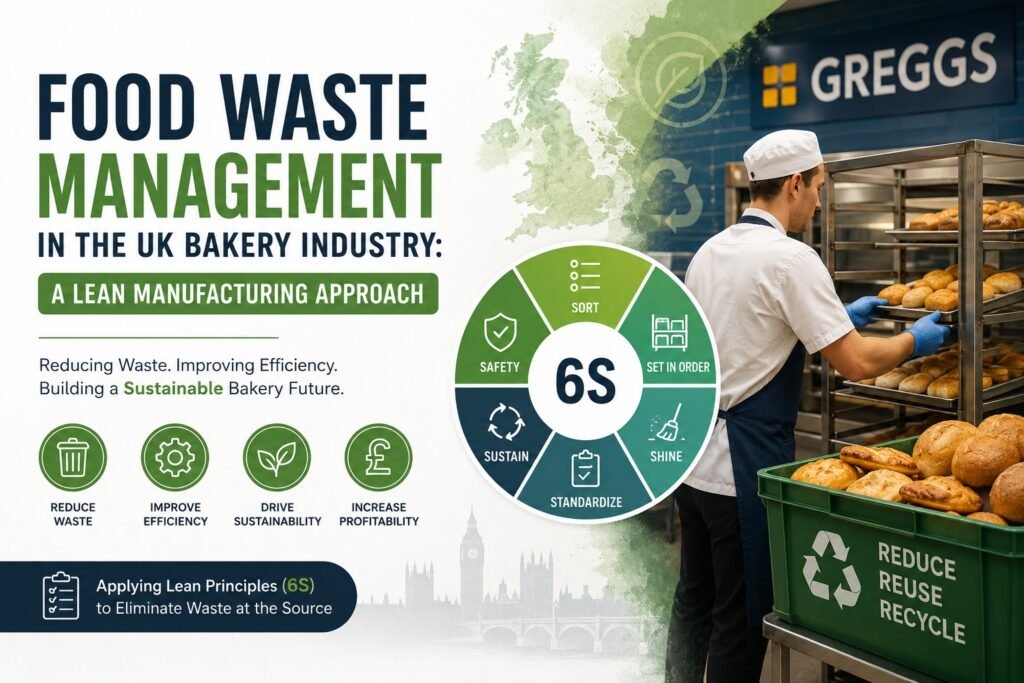
food waste management

Abstract Food waste represents one of the most significant operational and environmental challenges facing the global food industry. In the United Kingdom alone, an estimated 17 million tonnes of food are produced annually, yet between 30 and 40 per cent of this output is wasted — much of it before it ever reaches the consumer. This paper examines food waste management in the UK bakery industry, with particular reference to Greggs Bakery plc, one of the country’s largest food retail chains. Drawing on secondary sources including peer-reviewed literature, government statistics, and industry reports, the paper evaluates two principal approaches to managing food waste: traditional disposal methods (landfill, composting, and animal feed) and the principles of Lean Manufacturing — specifically, the Six S (6S) methodology. The paper concludes that while conventional disposal methods address the consequences of food waste, Lean Manufacturing principles offer a more strategically effective framework for reducing waste at source, maximising operational efficiency, and improving profitability. 1. Introduction The production of food items in the United Kingdom amounts to over 17 million tonnes each year. However, between 30 and 40 per cent of total food production is wasted and discarded — an estimated £20 billion worth of food that is sent to landfill annually, despite 25 per cent of it being safely edible by humans or animals, or suitable for recycling. The cost of transporting this waste alone exceeds £175 million per year (Environment Agency, 2008). The environmental consequences of excessive food waste have prompted significant legislative attention. The National Restaurant Association (2000) estimated that approximately 50 billion meals are consumed in restaurants, schools, and workplace cafeterias in the United States each year. Research by Almanza, Hiemstra, and Ghiselli (1993), conducted across 27 schools in Indiana, found that combined production and service waste totalled 8,613 pounds — equivalent to approximately 20,176 gallons — highlighting the scale of the problem even within a single institutional context. You may also read Free Research Proposal on : A case-study analysis of British Airways In Great Britain, landfill accounts for approximately 64 per cent of the 34 million tonnes of waste disposed of annually, with 27 per cent recycled or composted, and 9 per cent incinerated with energy recovery (Environment: Recycling increases across all regions, 2008). Against this backdrop, food industry organisations are under growing pressure from regulators, consumers, and shareholders to develop credible strategies for reducing waste at source. This paper investigates how Greggs Bakery — one of the UK’s leading food retailers — can address food waste more effectively, drawing on both traditional disposal methods and the principles of Lean Manufacturing. The paper argues that a preventative approach, grounded in Lean thinking and the 6S methodology, offers a more sustainable and cost-effective solution than reactive disposal alone. 2. Research Methodology This study employs a qualitative research design, drawing on primary and secondary data from multiple sources. Secondary data was gathered from peer-reviewed academic journals, government publications, industry reports, and online library databases. Primary data was collected by means of a structured questionnaire administered to managers, executives, and front-line staff at a UK food retail organisation, aimed at understanding current attitudes towards food waste management and familiarity with Lean Manufacturing principles. Content analysis served as the dominant methodological approach for synthesising the literature and interpreting findings across both data sources. 3. Statement of the Problem Government policy in the United Kingdom requires all organisations operating in the food sector to manage waste responsibly, in accordance with the principles of sustainable resource use (Parfitt and Barthel, 1999). The food industry presents a particularly complex waste management challenge, characterised by a high ratio of product-specific waste generation that is, in many instances, structurally unavoidable. The biological properties of food products — including high water content, susceptibility to rapid oxidation, potential for pathogenic contamination, and pronounced enzymatic activity — make effective post-production utilisation extremely difficult (Russ and Schnitzer, 2004). According to Ward (1998), the core challenge for food industry professionals lies in balancing the cost of waste disposal against the investment required to develop infrastructure for recycling, reduction, and reuse. Landfilling and in-sink disposal remain the most prevalent methods of food waste management in commercial foodservice settings, despite growing regulatory and economic disincentives (Hackes and Shanklin, 1999; Su, Mason, and Shanklin, 1997). Factors that inform disposal method decisions include the local availability of composting or recycling facilities, applicable state and municipal regulations, available storage space, labour requirements, utility and supply costs, and sanitation standards (Su et al., 1997). Shanklin (1998) argues that the most critical components of any food waste management plan are: identifying the most cost-effective disposal alternative, and assessing the operational policies and practices that drive waste generation in the first place. Effective food waste management — encompassing source reduction, resource recovery, and responsible disposal — should therefore be a strategic priority for all organisations operating in the food sector. 4. Implications for the Industry: The Case of Greggs Bakery The bakery sector occupies an important position within the UK food industry. Greggs plc, founded in Newcastle in 1939, is among the UK’s largest food-to-go retailers, operating over 1,100 stores nationally and serving in excess of five million customers per week (Greggs: still Number One, 2008). The company specialises in sandwiches, savouries, pastries, and other freshly prepared foods, all of which have a limited shelf life. At the end of each trading day, unsold products are removed from shelves and returned to the central manufacturing facility as waste. Greggs has acknowledged the operational and environmental implications of this surplus and has taken steps to address it. In one reported initiative, the company donated approximately 80 per cent of food past its sell-by date to farmers for use as animal feed — representing around 2 per cent of total food output (Greggs boss vows action to reduce landfill waste, 2008). The company has also invested in abrasive drying technology, which enables the processing of surplus bakery products and sandwich waste into reusable material — a method that has demonstrated considerable success in

