From First Draft to Final Submission: A Realistic Masters Dissertation Timeline

Dissertation

Completing a master’s dissertation is one of the most intellectually demanding stages of postgraduate study. For many students across the UK, the dissertation represents not only a major academic challenge but also the bridge between university life and professional or research careers. Yet one of the most common questions students ask is: How long does it take to do a master’s dissertation? The answer is rarely straightforward. Some students complete their work efficiently within four to six months, while others struggle for nearly a year due to poor planning, unclear research direction, or balancing employment alongside study. This guide explores From First Draft to Final Submission: A Realistic Masters Dissertation Timeline in a practical and honest way. Rather than offering an unrealistic “perfect schedule”, this article breaks down what genuinely happens during the dissertation process in UK universities, what challenges students commonly face, and how you can stay on track without sacrificing quality or well being. Whether you are studying at a Russell Group institution, a modern UK university, or completing an online postgraduate degree, understanding a realistic timeline can dramatically improve both your marks and your stress levels. Students learn about how many words use in dissertation writing: How Many Words Should a Master’s Dissertation Be? By the end of this article, you will understand how to structure your dissertation journey, avoid common time-management mistakes, and create a workflow that aligns with academic expectations in higher education. Why a Realistic Dissertation Timeline Matters Many postgraduate students underestimate the scale of dissertation work. A typical UK master’s dissertation ranges from 12,000 to 20,000 words and requires independent research, critical analysis, academic writing, and consistent communication with supervisors. According to guidance from the Quality Assurance Agency, postgraduate students are expected to demonstrate advanced critical thinking, originality, and subject mastery. These expectations naturally require substantial time and intellectual effort. Students get dissertation help: MSC Dissertation Help Unfortunately, students often begin with unrealistic assumptions. Some believe the writing stage is the most difficult part, only to discover that research design, literature review development, and data analysis consume far more time than expected. Others delay work until after taught modules finish, leaving themselves only a few weeks before submission. A structured timeline helps you: Reduce last-minute pressure Maintain research quality Avoid burnout Meet supervisor expectations Improve academic confidence Produce a stronger final dissertation As we discussed in our guide to choosing a dissertation topic, planning is often the difference between a high distinction and a rushed pass-grade dissertation. Stage One: Topic Selection and Initial Planning (2–4 Weeks) The dissertation journey begins long before the first chapter is written. Selecting a topic can take several weeks, especially if your research area is broad or interdisciplinary. Students frequently make the mistake of choosing topics that are either too ambitious or too narrow. A successful dissertation topic should be manageable within the available time frame, academically relevant, and genuinely interesting to you. Remember, you will spend months researching this subject. In UK universities, supervisors often expect students to arrive with preliminary ideas before approval meetings. During this stage, you should begin reading journal articles, identifying research gaps, and reviewing current debates in your field. Students get masters dissertation help: Masters dissertation help For example, a business management student researching remote working trends may initially propose a broad topic such as “The Impact of Hybrid Work on Organisations”. After initial reading, they may refine it to “The Impact of Hybrid Working on Employee Productivity in UK Marketing Agencies”. This refinement process is essential because clarity at the start saves enormous amounts of time later. During this stage, students should also begin building a research calendar. Realistically, many master’s students balance employment, internships, or family commitments alongside study. Your dissertation timeline must reflect your real-life schedule rather than an idealised academic routine. Stage Two: Literature Review and Proposal Development (4–6 Weeks) The literature review is often the first major challenge students encounter. Many underestimate the depth of reading required for postgraduate-level work. A strong literature review does not simply summarise sources. It critically evaluates theories, identifies contradictions, highlights methodological trends, and establishes the academic context for your own research. UK markers increasingly expect evidence of independent critical thinking rather than descriptive writing. At this stage, students often ask: How long does it take to do a master’s dissertation if the literature review alone takes over a month? The reality is that the literature review forms the intellectual foundation of the entire project. Rushing it almost always weakens later chapters. Most students spend several weeks: Searching academic databases Reading peer-reviewed journals Organising references using tools such as Reference management software Identifying research gaps Developing conceptual frameworks This stage is also where many students in dissertation writing UK programmes experience their first major delay. Reading often reveals flaws in the original research question, requiring further refinement. One effective strategy is to write small sections continuously rather than waiting until all reading is complete. Dissertation supervisors across UK universities frequently recommend drafting thematic paragraphs while researching to save time later. Stage Three: Research Methodology and Ethics Approval (2–5 Weeks) Once your literature review establishes the research direction, the next stage involves methodology planning. This section explains how you will answer your research question. Depending on your discipline, this may involve interviews, surveys, case studies, experiments, textual analysis, or statistical modelling. In many UK universities, ethics approval is mandatory before data collection begins. Students often overlook how long this process can take. Ethics committees may request revisions, clarification, or additional participant protections. For example, psychology and healthcare dissertations often require more detailed ethical documentation than humanities subjects. Students conducting interviews with vulnerable groups may face particularly lengthy approval timelines. At this point, your UK dissertation structure begins taking clearer shape. Most master’s dissertations follow a format similar to: IntroductionLiterature ReviewMethodologyFindingsDiscussionConclusion Understanding this structure early makes the writing process more manageable later. Stage Four: Data Collection and Research Execution (4–8 Weeks) Data collection is one of the most unpredictable phases of the dissertation

How Many Words Should a Master’s Dissertation Be?

How Many Words Should a Master’s Dissertation Be?

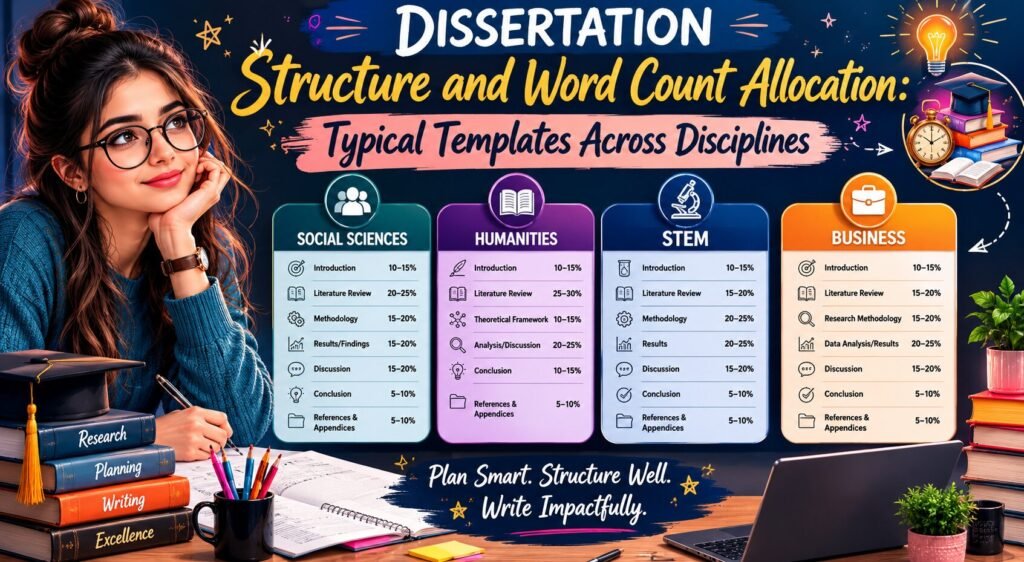
How Many Words Should a Master’s Dissertation Be? Writing a master’s dissertation is one of the most important academic challenges postgraduate students face during their university journey. Alongside researching, structuring, and referencing the project properly, one of the most common concerns students have is understanding the required dissertation word count. Many students worry about whether their dissertation is too short, too long, or incorrectly balanced across different sections. As a result, questions such as “How many words should a master’s dissertation be?” are extremely common among postgraduate students in the UK and internationally Master’s Dissertation. The length of a dissertation matters because universities use word count guidelines to assess the depth, clarity, and academic quality of a student’s research. A dissertation that is significantly under the required word count may appear incomplete or lacking sufficient analysis, while an overly long dissertation can lose focus and reduce readability. Understanding how dissertation word counts work helps students plan their research, structure their chapters properly, and avoid unnecessary stress close to submission deadlines Master’s Dissertation. Fortunately, dissertation word count requirements are not as confusing as they initially seem. While exact expectations vary depending on the university, subject, and programmers level, most master’s dissertations follow fairly standard academic guidelines. This complete guide explains how many words a master’s dissertation should be, how word counts are divided between chapters, what universities expect from postgraduate research projects, and how students can manage their writing effectively without sacrificing quality Master’s Dissertation. Understanding Master’s Dissertation Word Count Requirements Most UK universities require master’s dissertations to fall between 10,000 and 20,000 words. However, the exact length depends on the subject area, department guidelines, and research methodology used in the project. For example, humanities and social science dissertations are often longer because they involve extensive critical discussion and literature analysis. In contrast, science and engineering dissertations may contain shorter written sections because research findings are presented through tables, experiments, graphs, and technical data. According to postgraduate guidance from the University of Oxford and University of Manchester, students should always check department-specific dissertation requirements before beginning the writing process Master’s Dissertation. How Many Words Should a Master’s: master thesis help Typical master’s dissertation word count ranges include: 10,000–12,000 words for smaller taught master’s programmers 15,000–18,000 words for most UK postgraduate degrees 20,000 words or more for research-intensive programmers Although these ranges are common, students should never assume all universities follow identical standards. Why Dissertation Word Count Matters Dissertation word counts are designed to ensure students demonstrate sufficient academic depth and critical thinking. Universities expect postgraduate dissertations to show evidence of independent research, analytical ability, and engagement with academic literature. A dissertation that is too short may indicate limited research or weak analysis. On the other hand, excessively long dissertations often include repetition, unnecessary detail, or poor organization. The purpose of the word count is not simply to measure quantity but to encourage focused, meaningful academic discussion. Strong dissertations communicate ideas clearly and efficiently without unnecessary filler content. As explained in our guide to choosing a dissertation topic, successful dissertations are usually well-planned from the beginning, including realistic writing targets for each section. Typical Word Count Breakdown by Dissertation Chapter One of the best ways to manage a dissertation successfully is by dividing the total word count across individual chapters. This prevents students from spending too many words on one section while neglecting another. Although structures vary slightly between disciplines, a typical 15,000-word master’s dissertation may look like this: Introduction – 10% The introduction usually accounts for around 1,500 words. This section introduces the research topic, explains the aims and objectives, outlines the research question, and briefly describes the dissertation structure. A strong introduction provides clear direction without becoming overly detailed. Literature Review – 30% The literature review is often the longest chapter, typically around 4,000–4,500 words in a 15,000-word dissertation. This section critically evaluates previous academic studies, theories, and debates related to the topic. Students are expected to identify research gaps and demonstrate understanding of existing scholarship. A weak literature review often summarises sources without sufficient analysis, while a strong review compares arguments and evaluates evidence critically. Methodology – 15% The methodology chapter generally contains 2,000–2,500 words. This section explains how the research was conducted, including research design, data collection methods, ethical considerations, and limitations. Students should justify why they selected particular methods rather than simply describing what they did. How to Write a Literature Review for Your Masters Dissertation (With Examples Findings and Analysis – 30% The findings and analysis section typically includes around 4,000–4,500 words. Here, students present research results and analyses them in relation to the research question and literature review. This chapter often determines the overall academic quality of the dissertation because it demonstrates independent critical thinking. Conclusion – 10% The conclusion is usually around 1,000–1,500 words. This section summarise the main findings, answers the research question, discusses limitations, and may suggest areas for future research. Strong conclusions avoid introducing entirely new arguments. References and Appendices References and appendices are generally excluded from the official dissertation word count, although students should always confirm this with university guidelines. Appendices may include interview transcripts, surveys, tables, charts, or supplementary research material. Do All Universities Have the Same Dissertation Word Count? No university follows exactly the same dissertation requirements. Even within the same university, departments may have different expectations depending on the subject area and assessment criteria. For example, a business management dissertation may require 15,000 words, while an engineering dissertation at the same university might require only 10,000 words due to the technical nature of the project. Students should carefully read official dissertation handbooks and module guidelines. Most universities provide detailed instructions about: Universities Tightening Rules on AI Content in Assignments Recommended word counts Formatting requirements Referencing style Chapter structure Submission guidelines Reliable academic guidance can also be found through resources such as Quality Assurance Agency for Higher Education and Purdue OWL Academic Writing Resources. What Happens If You Exceed the Word Limit? Many universities allow a small

How to Write a Literature Review for Your Masters Dissertation (With Examples)

Literature Review

If you are beginning your postgraduate dissertation, learning How to Write a Literature Review for Your Masters Dissertation (With Examples) is one of the most important academic skills you will develop. For many students in the UK, the literature review is also the most intimidating part of the entire dissertation process. It requires deep reading, critical analysis, academic structure, and the ability to engage confidently with scholarly debate. Unlike undergraduate assignments, a master’s dissertation demands far more than summarising journal articles. UK universities expect postgraduate students to evaluate research critically, identify gaps in existing knowledge, and demonstrate independent academic thinking. A strong literature review forms the intellectual backbone of your dissertation and directly influences the quality of your research questions, methodology, and conclusions. Students get information how to find dissertation idea: How to Find Unique Dissertation Ideas That Impress Supervisors  Whether you are studying business management at the University of Manchester, education at King’s College London, or psychology at the University of Birmingham, your literature review shows supervisors and examiners that you understand the wider academic landscape surrounding your topic. In this guide, you will learn exactly how to write a literature review for a master’s dissertation, how to structure it effectively, practical examples you can follow, common mistakes to avoid, and proven strategies used by successful UK postgraduate students. What Is a Literature Review in a Master’s Dissertation? A literature review is a critical evaluation of published academic research related to your dissertation topic. It analyses existing theories, debates, findings, and methodologies while identifying gaps your own research aims to address. Many students mistakenly believe a literature review is simply a collection of summaries. In reality, it is a carefully structured academic discussion that demonstrates your ability to think analytically and engage with scholarly arguments. Students get help how to write  university level easy:How to Write a University Essay in 24 Hours (When You’re Cramming) For example, if your dissertation focuses on remote working in UK organisations, your literature review might explore themes such as: Employee productivity Mental health and well being Leadership communication Organisational culture Technology adoption Rather than discussing sources individually, you compare findings, highlight contradictions, evaluate strengths and weaknesses, and explain how your research contributes to ongoing academic debate. This is precisely why mastering How to Write a Literature Review for Your Masters Dissertation (With Examples) is essential for achieving high postgraduate marks. Students get help about master dissertation:master thesis help Why Literature Reviews Matter in UK Higher Education UK universities place significant emphasis on literature reviews because they reflect postgraduate-level academic standards. According to guidance from the Quality Assurance Agency , master’s students are expected to demonstrate “systematic understanding” and “critical awareness” within their subject area. Your literature review proves that you can: Engage with complex academic material Evaluate competing viewpoints Identify research gaps Build coherent arguments Justify your research aims In many dissertation writing UK programmes, the literature review can account for a substantial proportion of the overall assessment criteria. Supervisors often identify the quality of a dissertation early based on how critically and coherently the literature review is written. A weak review suggests limited reading or superficial understanding, while a strong review immediately establishes academic credibility. How to Write a Literature Review for a Master’s Dissertation Understanding how to write a literature review for a master’s dissertation begins with adopting a structured and strategic approach. Successful postgraduate students rarely begin writing immediately. Instead, they focus first on planning, reading, and organising ideas carefully. Start with a Focused Research Topic One of the biggest mistakes students make is choosing a topic that is too broad. Your literature review should revolve around a clear research problem or question. For example, instead of exploring “social media and education”, a more focused dissertation topic might be: “The impact of TikTok usage on academic engagement among UK university students.” A narrower focus helps you identify relevant research and maintain coherence throughout the review. As we discussed in our guide to choosing a dissertation topic, clarity at the beginning saves enormous time later in the dissertation process. Conducting Effective Academic Research Once your research question is clear, the next step is gathering credible academic sources. UK universities expect postgraduate students to rely primarily on peer-reviewed journals, scholarly books, and reputable institutional publications. Useful databases include: Google Scholar JSTOR Science Direct Emerald Insight Sage Journals ProQuest Your university library portal will also provide access to subscription-based academic resources. When selecting sources, focus on: Recent peer-reviewed studies Highly cited academic papers Foundational theories UK-based research where relevant Government or institutional reports Avoid relying heavily on blogs, generic websites, or outdated material unless historically relevant to your topic. Organising Your Literature Review Properly A well-organised literature review improves readability and strengthens your academic argument. In UK dissertation structure guidelines, literature reviews are usually organised thematically rather than source-by-source. Thematic Structure This is the most common approach for master’s dissertations. Research is grouped into themes or recurring topics. For example, a dissertation on online learning might include sections on: Student engagement Accessibility and inclusion Technology challenges Academic performance This approach allows you to synthesise multiple studies together. Methodological Structure Some dissertations compare research methods used in previous studies. This is common in psychology, business, sociology, and education research. You might compare: Quantitative vs qualitative methods Interview-based research Case studies Survey methodologies Chronological Structure In certain disciplines, it makes sense to explore how research has evolved over time. However, this structure should still remain analytical rather than descriptive. Example of Strong Literature Review Writing One of the best ways to understand How to Write a Literature Review for Your Masters Dissertation (With Examples) is by comparing weak and strong academic writing. Weak Example “Smith (2021) found that social media affects student performance. Jones (2022) also discussed social media use in education.” This simply describes studies without analysis. Strong Example “Recent studies indicate growing concern regarding the influence of social media on academic performance among university students. Smith (2021) argues that excessive social media

How to Find Unique Dissertation Ideas That Impress Supervisors

How to Find Unique Dissertation Ideas That Impress Supervisors

How to Find Unique Dissertation Ideas That Impress Supervisors Choosing a dissertation topic is one of the most important decisions students make during university. A strong dissertation idea can shape the entire research journey, influence motivation levels, improve academic performance, and even support future career goals. However, many students struggle to find dissertation ideas that feel original, relevant, and academically valuable. Some choose topics that are too broad, while others select subjects that lack enough research potential or fail to impress supervisors. MSc dissertation help Finding unique dissertation ideas is not about choosing the most complicated topic possible. Supervisors are usually more impressed by clear, focused, well-researched ideas that demonstrate curiosity, originality, and academic relevance. A successful dissertation topic should balance personal interest, available research material, practical feasibility, and contribution to existing knowledge. The challenge is that thousands of students search for dissertation ideas every year, making it difficult to identify topics that feel fresh and meaningful. Many students worry that their ideas are either overused or too weak to stand out academically. Fortunately, there are proven strategies that can help students discover dissertation topics that are both unique and supervisor-approved. Unique Dissertation Ideas. This guide explains how to generate original dissertation ideas, avoid common topic-selection mistakes, impress supervisors with strong research proposals, and choose a dissertation topic that remains engaging throughout the entire research process. Why Choosing the Right Dissertation Topic Matters Your dissertation topic influences nearly every part of your academic experience. A good topic makes research more enjoyable, keeps motivation high, and allows you to demonstrate genuine expertise in your field. A poor topic, on the other hand, can lead to frustration, lack of direction, research difficulties, and lower academic performance. Supervisors often evaluate dissertation proposals based on clarity, originality, research potential, and relevance to current academic discussions. Students who choose thoughtful and focused topics usually receive stronger guidance and better academic feedback. A dissertation topic also affects career opportunities. Many employers and postgraduate programmes value research special isations and independent academic work. Choosing a topic connected to your future goals can strengthen your professional profile and provide valuable subject expertise. Start With Subjects You Genuinely Enjoy One of the biggest mistakes students make is selecting topics purely because they seem easy or popular. Dissertation projects require months of reading, research, analysis, and writing. If you choose a topic that does not genuinely interest you, maintaining motivation becomes extremely difficult. Universities Tightening Rules on AI Content in Assignments Start by thinking about modules, lectures, or assignments you previously enjoyed. Ask yourself which academic discussions captured your attention most strongly. Reflect on classroom debates, research articles, or industry trends that made you curious. Students often produce stronger dissertations when they research subjects they genuinely care about. Passion improves focus, creativity, and critical thinking throughout the dissertation process. For example, a business management student interested in digital marketing might explore how artificial intelligence influences customer trust in online shopping. An education student passionate about mental health may investigate the impact of remote learning on student wellbeing. Interest creates long-term motivation, which is essential for dissertation success. Explore Current Trends in Your Academic Field Supervisors are often impressed by dissertation topics connected to current developments, emerging technologies, or modern social challenges. Researching recent trends can help students identify fresh dissertation opportunities with strong academic relevance. Reading academic journals, university publications, industry reports, and research blogs can reveal gaps in existing literature. Many students discover unique ideas by analysing modern issues that researchers are only beginning to explore. Some popular modern dissertation themes include: Artificial intelligence in education Remote learning challenges Social media marketing strategies Sustainability and business ethics Mental health in universities Digital consumer behaviour Cybersecurity and data privacy Online learning technologies Choosing a current issue demonstrates awareness of evolving academic and professional discussions. Identify Research Gaps in Existing Literature One of the best ways to find unique dissertation ideas is by identifying gaps in existing research. Academic research constantly evolves, meaning no subject is ever completely finished. When reading journal articles, pay attention to phrases such as: “Further research is needed” “Limited studies exist” “Future studies should examine” “This area remains underexplored” These statements often reveal opportunities for new dissertation topics. For example, if several studies examine remote learning in universities but very few focus specifically on international students, you may identify a valuable research gap. Supervisors appreciate topics that contribute something new to academic discussions rather than simply repeating old ideas. Use Real-World Problems as Inspiration Many strong dissertation topics begin with practical problems rather than purely theoretical questions. Universities increasingly encourage research that has real-world relevance and practical application. Think about challenges affecting industries, education systems, businesses, healthcare organisations, or society generally. Ask yourself: What problems need better solutions? What current debates exist in your field? What changes are influencing your industry? Which topics are receiving media attention? Practical research questions often create more engaging dissertations because they connect theory with real-world impact. For instance, a dissertation exploring how universities detect AI-generated assignments combines technology, education, ethics, and academic policy into one relevant research area. Talk to Supervisors Early Many students wait too long before discussing dissertation ideas with supervisors. Early conversations can save time and improve topic quality significantly. Supervisors have experience identifying strong research ideas and recognising weak proposals. They can help students narrow broad topics, improve research focus, and suggest useful academic sources. When meeting supervisors, prepare several possible ideas rather than relying on one topic only. This demonstrates initiative and flexibility. A supervisor may help transform a weak idea into a much stronger research project by refining the research question or narrowing the scope appropriately. Avoid Topics That Are Too Broad One common reason dissertations fail to impress supervisors is that the topic is too broad. Large subjects become difficult to manage within university word limits and research timelines. For example, a topic such as “Social Media Marketing” is far too broad for a dissertation. However, narrowing it to “The Impact of

How to Choose a Master’s Dissertation Topic That You Won’t Regret

How to Choose a Master’s Dissertation Topic That You Won’t Regret

How to Choose a Master’s Dissertation Topic That You Won’t Regret Choosing a dissertation topic is one of the most important decisions you will make during your postgraduate studies. Your dissertation is not just another academic assignment; it represents months of research, analysis, writing, and critical thinking. The topic you choose will influence your motivation, academic performance, stress levels, and even future career opportunities. This is why selecting the right master’s dissertation topic requires careful thought rather than a rushed decision. Many students begin their dissertation journey feeling overwhelmed by endless possibilities. Some choose topics that are too broad, while others select subjects that quickly become boring or impossible to research properly. In many cases, students regret their topic halfway through the project because they failed to evaluate its practicality, relevance, or personal interest at the beginning. Students get information about dissertation: masters dissertation help The good news is that choosing a dissertation topic does not have to be stressful. With the right strategy, you can identify a topic that is academically strong, personally interesting, and realistic to complete within your university’s timeframe. This guide explains how to choose a master’s dissertation topic that you will remain confident about from the initial proposal to the final submission Master’s Dissertation Topic. Why Your Dissertation Topic Matters More Than You Think A dissertation topic is more than a title on the front page of your research project. It shapes every stage of your academic journey, from literature review and methodology to data collection and final conclusions. A well-chosen topic keeps you motivated and focused, while a poor topic choice can create months of frustration and confusion. Students get fast and professional guide:Fast and Professional Dissertation Help Services in the UK Many UK universities expect postgraduate students to demonstrate originality, critical thinking, and independent research skills in their dissertations. According to guidance from leading institutions such as the Quality Assurance Agency for Higher Education, postgraduate research projects should contribute meaningful analysis within a chosen academic field. This does not mean students must discover something completely new, but their topic should allow for thoughtful investigation and discussion. A strong dissertation topic can also improve future career prospects. Employers often value dissertation projects because they demonstrate research ability, problem-solving skills, and subject expertise. For students planning to pursue doctoral studies, the dissertation may even become the foundation for future research Master’s Dissertation Topic. Understanding What Makes a Good Dissertation Topic Before choosing a topic, it is important to understand what separates a strong dissertation idea from a weak one. Many students mistakenly believe a topic must sound extremely complicated or highly technical to impress supervisors. In reality, the best dissertation topics are usually clear, focused, research able, and relevant. A good dissertation topic should genuinely interest you. Since you will spend several months researching and writing about it, choosing a subject you enjoy makes the process far easier and more rewarding. Students who select topics purely because they seem easy or trendy often lose motivation later. The topic should also be realistic. Some research ideas may sound exciting but require data, equipment, or access that students cannot realistically obtain. For example, researching confidential corporate data or conducting large-scale international surveys may be impractical within a master’s programme. Academic relevance is equally important. Universities expect dissertations to engage with current debates, theories, or issues within the field. This means your topic should connect to existing academic literature while still allowing space for original analysis. Students get information about dissertation :Affordable Dissertation Help for Undergraduate UK Students Start With Your Interests and Strengths One of the best ways to begin choosing a dissertation topic is by reflecting on your academic interests. Think about the modules, lectures, assignments, or discussions you enjoyed most during your degree programme. Perhaps you found digital marketing fascinating during your business management course. Maybe educational psychology captured your attention during teacher training modules. These areas of genuine curiosity often lead to stronger dissertation ideas because they naturally motivate deeper research. It is also helpful to consider your strengths. Students who perform well in quantitative analysis may prefer research involving statistics and surveys, while others may feel more comfortable with qualitative interviews or case studies. For example, a student studying business management might explore: The impact of social media marketing on consumer behaviour Leadership styles in remote working environments Employee motivation in hybrid workplaces Meanwhile, a student in education could focus on: The effectiveness of online learning in UK universities Classroom behaviour management strategies The impact of AI tools on student learning Choosing a topic connected to your interests makes it easier to stay engaged during long research and writing sessions. Students get information about dissertation: MSC Dissertation Help Research Current Trends in Your Field A common mistake students make is selecting outdated or overused topics that lack originality. While classic research areas are still valuable, universities increasingly encourage students to engage with current developments and emerging trends. Reading recent journal articles, university publications, and academic conferences can help you identify modern research gaps. Many students find inspiration by exploring contemporary issues affecting their field today. For instance, current dissertation trends in UK universities include artificial intelligence in education, sustainability in business, remote work culture, mental health support, digital transformation, and ethical concerns surrounding technology. Researching trending areas does not mean chasing fashionable topics without interest. Instead, it means understanding where current academic conversations are happening and finding a meaningful angle within them. As discussed in our guide to academic research strategies, combining personal interest with contemporary relevance often produces the strongest dissertation topics. Avoid Choosing a Topic That Is Too Broad One of the biggest reasons students regret their dissertation topics is because the research area becomes unmanageably broad. Broad topics create confusion, weak analysis, and difficulties during literature review and methodology stages. For example, a topic such as “The Impact of Technology on Education” is far too broad for a master’s dissertation. Technology includes countless tools, educational settings, age groups, and

Affordable Dissertation Help for Undergraduate UK Students

Affordable Dissertation Help

Introduction Writing a dissertation is one of the most important academic milestones for undergraduate students in the United Kingdom. It is often the final opportunity to demonstrate research ability, subject knowledge, critical thinking, and academic writing skills before graduation. Yet for many students, this major project can also become one of the most stressful parts of university life. Balancing lectures, part-time work, personal responsibilities, and deadlines can make the dissertation process feel overwhelming. This is why many students begin searching for Affordable Dissertation Help that offers dependable guidance without stretching a limited student budget. Undergraduate students frequently face pressure from multiple directions. They must choose a suitable topic, build a strong research question, conduct a literature review, collect evidence, analyse findings, and present everything in a clear academic structure. For students who are completing a dissertation for the first time, these expectations can seem intimidating. The demand for Affordable Dissertation Help has therefore grown rapidly because students need practical support that improves confidence, saves time, and strengthens the quality of academic work. Students get information how to collect reliable data about dissertation :How to Collect Reliable Data for Your UK Dissertation Study A dissertation is not simply another assignment. It is a long-form piece of academic research that requires planning, consistency, and careful attention to detail. Many students are capable and hardworking, but they may struggle because they lack guidance rather than ability. With the right Affordable Dissertation Help, students can understand the process more clearly and avoid mistakes that often affect grades. Why Undergraduate Students Need Dissertation Support University life in the UK is demanding. Undergraduate students are expected to develop independent research skills while also meeting academic standards that are often higher than previous coursework. Many students enter their final year with enthusiasm but quickly realise that dissertation writing involves a completely different level of commitment. One of the biggest difficulties is time management. Students often juggle seminars, coursework, exams, internships, and employment. Managing a large research project across several months can become difficult without a structured plan. In such situations, Affordable Dissertation Help provides essential direction by helping students organise tasks, set realistic goals, and stay focused. Students get information about the dissertation :dissertation online help Another challenge is academic uncertainty. Students may have a broad subject area but struggle to narrow it down into a clear, research able topic. Some may not know how to frame research objectives or formulate a strong research question. Others may be unsure how to select appropriate methods or evaluate sources critically. Reliable Affordable Dissertation Help can bridge these gaps and turn confusion into clarity. Confidence also plays a major role. Many undergraduates worry whether their writing is academic enough, whether their arguments are strong enough, or whether they are meeting university expectations. Expert guidance can help students move forward with greater assurance and a stronger understanding of what examiners expect. Students get dissertation help: MSC Dissertation Help Choosing the Right Dissertation Topic The foundation of every strong dissertation is a carefully selected topic. A topic should be relevant, interesting, manageable, and supported by enough academic material. Unfortunately, many students choose topics that are too broad, too narrow, or too difficult to research within the available time. The right topic often comes from combining personal academic interest with practical research possibilities. Students should ask whether the topic allows them to answer a focused question, whether reliable sources are available, and whether the research can be completed within the word limit and deadline. This is where Affordable Dissertation Help becomes particularly valuable. Experienced academic support can help students evaluate topic ideas, identify workable directions, and refine broad interests into precise research questions. A strong start reduces later complications and makes the entire writing process more efficient. A well-chosen topic also increases motivation. Dissertation writing is easier when students are genuinely interested in what they are investigating. Interest encourages deeper reading, better analysis, and more thoughtful conclusions. Building a Strong Dissertation Proposal Before writing the full dissertation, many UK universities require a proposal. The proposal acts as a road map. It outlines the research aim, objectives, research question, significance of the study, and intended methodology. A strong proposal does more than describe an idea. It shows that the project is realistic, academically worthwhile, and carefully planned. Many students underestimate the importance of this stage. A weak proposal can create confusion later, while a clear proposal provides direction for every chapter. Professional Affordable Dissertation Help can be highly effective during this stage. Students can learn how to define objectives clearly, justify their research, and present a realistic plan. This early support often saves significant time during the later writing stages. A convincing proposal also demonstrates academic maturity. It shows supervisors that the student understands the topic, has identified relevant literature, and has a practical strategy for carrying out the research. Conducting Effective Research Research is the heart of a dissertation. Strong research gives credibility to arguments and forms the basis of meaningful academic discussion. However, many undergraduate students find the research stage challenging because they are not sure where to begin. Effective research requires identifying relevant journal articles, books, academic reports, and reliable databases. Students must read critically rather than simply collecting large quantities of information. They need to recognise patterns, debates, gaps, and contrasting perspectives. Using Affordable Dissertation Help can improve research quality because it encourages smarter strategies rather than simply more reading. Students can learn how to search academic databases effectively, assess source quality, organise reading notes, and connect evidence directly to research objectives. Good research also requires discipline. It is easy to become overwhelmed by too much information. A focused approach helps students gather only the most relevant material and avoid wasting time. Writing a Powerful Literature Review The literature review is often one of the most demanding sections of an undergraduate dissertation. Many students mistakenly believe it is simply a summary of sources. In reality, it is a critical discussion of existing knowledge. A strong literature review compares ideas,

How to Collect Reliable Data for Your UK Dissertation Study

How to Collect Reliable Data

A successful dissertation depends on the quality of the evidence behind it. Even the most impressive topic, a clear research question, and a well-structured argument can lose academic value if the information collected is weak, inconsistent, or biased. This is why many UK university supervisors repeatedly highlight one essential principle: strong research begins with strong data. Understanding How to Collect Reliable Data is therefore not simply a research skill but the foundation of academic credibility. Students often spend weeks refining their literature review and planning methodology, yet many underestimate the importance of collecting trustworthy evidence. Reliable data allows you to build persuasive arguments, test assumptions, evaluate relationships, and reach meaningful conclusions. In contrast, poor-quality information can damage your findings and reduce the overall impact of your dissertation. When examiners review a dissertation, they do not only assess what you discovered. They also carefully evaluate how the evidence was gathered, whether the process was transparent, and whether the chosen methods were appropriate. For UK undergraduate, master’s, and doctoral students, research standards are particularly important. Universities expect academic integrity, clear methodological reasoning, ethical awareness, and analytical precision. Learning How to Collect Reliable Data helps you satisfy those expectations while strengthening your confidence throughout the dissertation journey. Students get help about thesis:help with master thesis This guide explains the most important principles, practical methods, and strategic decisions involved in gathering trustworthy information for your dissertation study. Why Reliable Data Matters in a UK Dissertation Reliable data forms the backbone of a high-quality dissertation. It creates the evidence base from which you answer research questions, test hypotheses, and develop academic arguments. Without dependable information, even well-written dissertations can appear weak and unconvincing. The main purpose of research is not merely to collect information. It is to gather accurate evidence that reflects reality as closely as possible. Understanding How to Collect Reliable Data ensures that the conclusions you present are grounded in trustworthy findings rather than assumptions. Students get information about dissertation:Undergraduate Dissertation: A Complete Guide for Students UK universities place particular value on methodological strength. Dissertation examiners want to know whether your sample was appropriate, whether your collection tools were carefully designed, and whether the gathered evidence genuinely addresses your research objectives. If the data collection process is flawed, the validity of the entire study may be questioned. Reliable data also improves academic confidence. When students know their evidence is robust, they can write analysis chapters with greater authority, discuss findings more persuasively, and defend their decisions more effectively during supervisor meetings. In short, learning How to Collect Reliable Data allows you to produce a dissertation that is credible, rigorous, and academically powerful. Begin with a Clear Research Question Before collecting any information, define exactly what your study aims to investigate. Many students rush into surveys, interviews, or secondary reading before clearly establishing their research direction. This often results in collecting large amounts of irrelevant material. A strong research question acts as a road map. It tells you what information is needed, who should provide it, and which method is most suitable. If your question is unclear, your data collection will likely become unfocused. Students get expert custom dissertation writing help:Expert Custom Dissertation Writing Assistance for UK Academic Students For example, a broad topic such as social media and consumer behaviour is difficult to manage. A more focused research question such as How does Instagram creator marketing affect purchasing decisions among UK university students aged 18–24? provides direction and makes evidence collection more manageable. One of the most practical ways to understand How to Collect Reliable Data is to align every stage of collection with the research question. Every survey item, interview question, observation, or dataset should directly support your objectives. A sharply defined research question saves time, improves consistency, and helps ensure that your final analysis remains relevant and academically coherent. Choose the Right Type of Data An essential part of understanding How to Collect Reliable Data is knowing what type of evidence best fits your research problem. Dissertation studies generally rely on two major forms of data: primary data and secondary data. Primary data refers to original information collected directly by the researcher. This includes surveys, interviews, focus groups, observations, and experiments. Primary evidence is valuable because it is tailored specifically to your research objectives. It allows you to explore fresh perspectives and generate original findings. Secondary data refers to information already collected by other researchers, institutions, government departments, journals, or professional databases. Examples include published reports, academic articles, official statistics, market reports, and archived datasets. The best choice depends on your topic, time, access, and academic aims. Some dissertations use one type, while others combine both. Many UK students benefit from mixed methods because they provide richer evidence and stronger triangulation. Selecting the right data type is not merely a technical choice. It directly affects the reliability, depth, and usefulness of your research outcomes. Understand Reliability and Validity Students often confuse reliability with validity, but both are essential in dissertation research. Reliability refers to consistency. If the same study were repeated under similar conditions, would the results be similar? If the answer is yes, the data is considered reliable. Validity refers to accuracy. Does the method actually measure what it claims to measure? A survey can be consistent but still fail to capture the intended concept. When learning How to Collect Reliable Data, you must consider both factors. For example, if you are studying student satisfaction, vague or ambiguous questions may reduce validity. If your sample is too small or biased, reliability may also be weakened. Researchers improve reliability by using clear procedures, carefully structured instruments, uniform wording, and transparent documentation. Validity improves when research tools align directly with objectives and theoretical concepts. A dissertation with both reliable and valid evidence carries far greater academic weight. Designing Effective Surveys Surveys are among the most common data collection methods in UK dissertations because they are practical, and efficient. However, poorly designed surveys often generate weak evidence. To understand How to Collect

Expert Custom Dissertation Writing Assistance for UK Academic Students

Dissertation Writing Assistance

Introduction In the modern academic landscape of the United Kingdom, students are required to meet exceptionally high standards of education, especially when it comes to research-based academic writing. Among all academic tasks, the dissertation stands as one of the most complex, demanding, and important requirements for undergraduate, postgraduate, and doctoral students. It is not just an assignment; it is a comprehensive research project that demonstrates a student’s ability to think critically, conduct independent research, and present findings in a structured academic format. However, many students face serious challenges when working on dissertations. These challenges include lack of time, limited research skills, difficulty in understanding methodologies, language barriers, and pressure to achieve high grades. Because of these issues, many students find themselves overwhelmed and stressed. This is exactly where Dissertation Writing Assistance becomes a crucial academic support system. It provides structured, reliable, and expert guidance that helps students complete their dissertations effectively. Unlike simple writing help, Dissertation Writing Assistance focuses on the entire academic journey, from topic selection to final submission. You want to write strong dissertation to visit this site: How to Write a Strong Dissertation Proposal That Gets Approved In today’s highly competitive UK education system, Dissertation Writing Assistance is not just a support option—it has become an essential academic tool that helps students succeed, improve their skills, and achieve academic excellence. Understanding Custom Dissertation Writing Assistance Dissertation Writing Assistance refers to a professional academic support system designed to help students complete their dissertations with clarity, accuracy, and confidence. It includes every stage of dissertation development, such as research planning, literature review, methodology design, data analysis, writing, editing, and proofreading. Unlike basic writing services, it focuses on academic learning and skill development. It does not simply provide written content; instead, it guides students step-by-step through the entire dissertation process. This ensures that students not only complete their work but also understand the academic principles behind it. One of the most powerful aspects of Dissertation Writing Assistance is Modification. Every student has different academic needs, subject areas, and university guidelines. Therefore, Dissertation Writing Assistance is tailored specifically to match these requirements, ensuring originality, relevance, and academic integrity. Another key feature is clarity improvement. Many students struggle to express their ideas in a structured academic format. Dissertation Writing Assistance helps them Arrange their thoughts logically and present arguments in a professional manner. Overall, Dissertation Writing Assistance acts as both a guide and a support system that enhances academic performance and builds long-term research skills. You get master dissertation help visit this site: masters dissertation help Why Dissertation Writing Assistance is Essential in UK Universities UK universities are globally manage for their strict academic standards and high expectations. Students are required to produce original research that demonstrates deep understanding and critical analysis. This level of academic demand often creates significant pressure. One of the main reasons students require Dissertation Writing Assistance is time pressure. Many students in the UK balance studies with part-time jobs, internships, and personal responsibilities. This leaves limited time for detailed dissertation research and writing. Another major reason is the complexity of academic requirements. A dissertation involves multiple stages such as literature review, research methodology, data analysis, and discussion. Without proper guidance, these tasks can become overwhelming. Dissertation Writing Assistance helps simplify each stage and provides structured direction. International students also heavily rely on Dissertation Writing Assistance due to language barriers. Even if they understand their subject well, academic writing in English can be challenging. This assistance improves grammar, sentence structure, academic tone, and clarity. Additionally, the pressure to achieve high grades pushes students toward seeking expert academic guidance. Dissertation Writing Assistance ensures better quality output, which significantly improves academic performance. Students get information how to complete dissertation: Undergraduate Dissertation A Complete Guide for Students Detailed Process of Dissertation Writing Assistance One of the strongest advantages of Dissertation Writing Assistance is its structured step-by-step process. It ensures that students are guided throughout their academic journey. 1. Topic Selection and Research Direction The first and most critical step is choosing a suitable research topic. it helps students identify topics that are relevant, research able, and aligned with academic guidelines. A strong topic is the foundation of a successful dissertation. 2. Proposal Writing Support A dissertation proposal defines the research objectives, questions, and methodology. Dissertation Writing Assistance ensures that students create strong and clear proposals that meet university approval standards. 3. Literature Review Development The literature review is one of the most important sections of a dissertation. Dissertation Writing Assistance helps students examine existing studies, identify research gaps, and build strong theoretical foundations. 4. Research Methodology Guidance Understanding research methods is often difficult for students.it provides detailed guidance on qualitative, quantitative, and mixed research methods, helping students choose the right approach. 5. Data Collection and Analysis This stage involves gathering and interpreting data.it helps students understand statistical tools, data interpretation techniques, and presentation methods to ensure accurate analysis. 6. Dissertation Writing and Structuring Writing a dissertation requires clarity and logical flow. Dissertation Writing Assistance ensures proper structure, including introduction, literature review, methodology, results, discussion, and conclusion. 7. Editing, Proofreading, and Final Submission The final stage is refinement. Dissertation Writing Assistance improves grammar, removes errors, enhances readability, and ensures proper formatting according to university guidelines. Advanced Features of Dissertation Writing Assistance High-quality Dissertation Writing Assistance includes several advanced academic features that ensure success. One of the most important features is expert academic guidance. Professional writers with subject expertise provide accurate and high-quality academic support. Another key feature is originality. Every dissertation is written from scratch and is completely plagiarism-free. Confidentiality is also a major feature. Students’ personal and academic data is kept secure and private. Formatting accuracy is another essential feature. it ensures proper citation styles such as Harvard, APA, MLA, and Chicago. Timely delivery is also guaranteed. Students receive their work within deadlines without compromising quality. Major Benefits of Dissertation Writing Assistance The benefits of Dissertation Writing Assistance are extensive and highly valuable for UK students. One of the most important benefits

How to Write a Strong Dissertation Proposal That Gets Approved

Strong Dissertation Proposal

A dissertation proposal is more than a formal academic requirement. It is the blueprint that shapes your entire research journey. A well-prepared proposal demonstrates that you understand your subject, know how to investigate it, and can deliver meaningful academic value. For many master’s and PhD students, getting the proposal approved is often the first major milestone toward completing a successful dissertation. You may also be interested to read: master thesis help Many students have strong ideas but struggle to turn them into a clear academic plan. That is where a Strong Dissertation Proposal becomes essential. It communicates your research aims, explains the importance of the study, and convinces supervisors that your project is practical, relevant, and worthy of approval. A weak proposal often fails because it lacks direction, contains vague research questions, or does not explain the methodology clearly. In contrast, a carefully structured Strong Dissertation Proposal presents a focused topic, logical argument, and realistic research plan. Supervisors want to see evidence of preparation, critical thinking, and academic discipline. This guide explains how to write a proposal that stands out. From choosing a topic to building research questions, writing the literature review, and presenting methodology, you will learn how to create a persuasive and professional document. Best research methods of dissertation writing provide in this site to visit this site and get information about dissertation writing Best Research Methodology for UK Masters Dissertations What Is a Dissertation Proposal? A dissertation proposal is a formal academic document submitted before the full dissertation. It outlines what you intend to research, why the topic matters, and how you plan to carry out the study. It acts as a road map that guides the later stages of your project. In simple terms, the proposal answers three key questions: What are you researching? Why is the research important? How will the research be conducted? A Strong Dissertation Proposal shows supervisors that your topic is academically valuable and manageable within the available time and resources. It demonstrates that you have already begun exploring relevant literature and understand the research process. Although universities may have slightly different requirements, most proposals contain an introduction, research aims, research questions, literature review, methodology, timeline, and references. Students write a great dissertation to visit this How to Write a First-Class Undergraduate Dissertation: Step-by-Step Why Dissertation Proposal Approval Matters Proposal approval is not a minor formality. It gives you official permission to move forward with your research. Without approval, students may waste weeks or months working on unsuitable topics. A carefully written Strong Dissertation Proposal helps you avoid this problem. It ensures that your research direction is clear from the beginning and provides a framework that keeps your project focused. Approval matters because it: Confirms that the topic is relevant and academically suitable Shows that your research methods are practical Helps supervisors assess whether the project is achievable Reduces the chances of major revisions later Students who invest time in building a Strong Dissertation Proposal often find the dissertation writing process more structured, less stressful, and more efficient. Step 1: Choose a Clear and Focused Topic The first step in writing a successful proposal is selecting the right topic. This decision will shape every other section of your work. Many students choose topics that are too broad. Broad subjects often lead to weak arguments and confusing research questions. Instead, choose a topic that is specific, research able, and relevant to your academic discipline. A Strong Dissertation Proposal begins with a manageable topic that can be explored in depth rather than one that attempts to cover too much. Ask yourself the following questions: Does the topic genuinely interest me? Is there enough academic literature available? Can the topic be researched within the word limit and time frame? Does it address a meaningful academic issue? For example, “digital marketing” is far too broad. A stronger version might be: “The impact of social media creator marketing on purchasing decisions among UK university students.” This narrower focus creates a more effective foundation for a Strong Dissertation Proposal. Step 2: Define the Research Problem After selecting a topic, identify the research problem. The research problem explains the specific issue your study aims to address. A strong proposal does not simply describe a topic. It identifies a gap, limitation, inconsistency, or unresolved question within existing research. For example, many studies may discuss social media marketing generally, but fewer may examine its impact on a particular age group or geographical region. That gap becomes your research problem. A clearly defined problem strengthens your Strong Dissertation Proposal because it shows academic purpose. It demonstrates that your study is not merely repeating previous work. When writing the research problem, explain: What is already known What remains unclear Why the gap matters academically or practically This section should be concise but convincing. Step 3: Write Powerful Research Aims and Objectives Research aims and objectives provide direction. They explain what the study intends to achieve. The research aim is broad. Objectives break that aim into smaller practical steps. Example Research aim:To examine the impact of social media creator marketing on purchasing decisions among university students in the United Kingdom. Research objectives: To review existing literature on creator marketing To examine factors affecting consumer trust To investigate purchasing attitude among students To evaluate the influence of social media platforms on buying decisions A Strong Dissertation Proposal uses objectives that are clear, realistic, and aligned with the research problem. Avoid vague statements such as “to understand” or “to explore everything.” Use precise academic verbs like read, evaluate, investigate, compare, or assess. Step 4: Develop Strong Research Questions Research questions guide your entire investigation. They determine what data you collect and how you interpret findings. Good research questions are focused, specific, and answerable. Examples: How does creator credibility affect purchasing decisions among UK university students? Which social media platforms have the strongest influence on student buying attitude? What factors shape trust in social media marketing? A Strong Dissertation Proposal normally includes two to four carefully

Best Research Methodology for UK Masters Dissertations

UK Masters Dissertations, writing a successful master’s dissertation requires more than a strong topic and excellent writing skills. The real foundation of academic success lies in choosing the right research methodology. For many postgraduate students, this chapter can feel challenging because it demands clear academic reasoning, logical planning, and evidence-based decisions. In UK Masters Dissertations, the methodology chapter is one of the most important sections because it explains how the research was designed, conducted, and analysed. A well-structured methodology not only strengthens the credibility of your research but also demonstrates academic maturity. Supervisors and examiners want to see whether the methods you selected are appropriate for your research objectives. When students understand methodology properly, they create a stronger dissertation that is persuasive, insightful, and academically valuable. Masters students get information and visit this site Trusted UK Dissertation Writing Service for Masters and PhD Students. This article provides a practical guide to the best research methodology for UK Masters Dissertations. It explains research designs, data collection methods, sampling strategies, data analysis, and common mistakes to avoid. Why Research Methodology Matters Research methodology is the blueprint of your dissertation. It describes how you will answer your research questions and justify your academic choices. In UK Masters Dissertations, this section is essential because it proves that your findings are not based on assumptions but on a carefully planned academic process. A powerful methodology chapter helps you: Explain how your research was carried out Show why your chosen methods are suitable Demonstrate reliability and validity Build confidence in your findings Present a logical academic structure Without a clear methodology, even an excellent topic may lose academic strength. A strong methodology transforms ideas into credible research. Students get information about dissertation writing How to Format Your Dissertation to UK University Standards (Oxford, Harvard, APA). Understanding Research Methodology Research methodology refers to the overall strategy used to conduct research. It includes the philosophical approach, research design, methods of collecting data, and methods of analysing findings. In UK Masters Dissertations, methodology is not simply about stating that you used interviews or surveys. It is about explaining why you selected these methods, how participants were chosen, and how the data was interpreted. The methodology chapter usually includes: Research philosophy Research approach Research design Data collection methods Sampling strategy Data analysis Ethical considerations Limitations Each part plays a vital role in creating a high-quality academic study. Research Philosophy in Masters Dissertations Research philosophy refers to the beliefs about how knowledge is created and interpreted. In UK Masters Dissertations, students are often expected to identify their philosophical stance because it shapes the direction of the study. Positivism Positivism focuses on objective reality. Researchers using this philosophy rely on measurable facts and statistical analysis. It is common in business, economics, marketing, and management research. For example, if a student investigates the effect of social media advertising on consumer behaviour using numerical data, positivism is often appropriate. Interpretive Perspective Interpretive perspective focuses on understanding human experiences, meanings, and perceptions. It is common in social sciences, education, and qualitative studies. For example, exploring how students experience online learning through interviews would fit an interpretivist. approach. Pragmatism Pragmatism combines both qualitative and quantitative approaches. It focuses on practical solutions rather than strict philosophical boundaries. Many students choose pragmatism because it provides flexibility in UK Masters Dissertations. Research Approaches The research approach explains how theory and data interact in the study. Deductive Approach A deductive approach starts with theory and tests it using data. Researchers develop hypotheses and then gather evidence to confirm or reject them. This approach is widely used in quantitative research and is very common in UK Masters Dissertations in business and management. Inductive Approach An inductive approach begins with observations and builds theory from collected data. It is often used in qualitative research. Students exploring experiences, opinions, and social behaviour often use an inductive approach. Choosing the Right Research Design Research design is the practical framework of the study. It determines how data will be collected and analysed. Choosing the correct design is critical for successful UK Masters Dissertations. Exploratory Research Exploratory research investigates a topic that has limited previous study. It helps researchers gain new understanding and identify patterns. Descriptive Research Descriptive research explains characteristics, trends, or relationships within a population. Explanatory Research Explanatory research investigates causes and effects. It examines why something happens. Selecting the right design depends on your research questions, objectives, and subject area. Qualitative Research Methods Qualitative research focuses on meanings, opinions, experiences, and social realities. It helps students gain deeper understanding of complex issues. In UK Masters Dissertations, qualitative research is popular in education, sociology, psychology, and human resource management. Interviews Interviews provide detailed personal insights. They can be structured, semi-structured, or unstructured. Semi-structured interviews are especially useful because they allow flexibility while maintaining direction. Focus Groups Focus groups involve discussion among several participants. They help researchers understand collective opinions and interactions. Observation Observation involves watching behaviours or situations in real environments. Advantages of Qualitative Research Rich and detailed insights Strong contextual understanding Flexibility during data collection Useful for exploring complex human experiences Limitations Smaller sample sizes Greater risk of researcher bias Time-consuming analysis Qualitative methods are extremely valuable when the aim of UK Masters Dissertations is depth rather than measurement. Quantitative Research Methods Quantitative research focuses on measurable data, numbers, and statistical analysis. It allows researchers to test hypotheses and identify patterns. This method is very common in UK Masters Dissertations in business, finance, economics, healthcare, and marketing. Surveys Surveys are one of the most widely used quantitative methods. They gather data from large groups of participants through questionnaires. Experiments Experiments examine cause-and-effect relationships by controlling variables. Secondary Numerical Data Students may also use existing datasets from government reports, academic databases, or company records. Advantages of Quantitative Research Larger sample sizes Objective measurement Easier comparison of findings Statistical reliability Limitations Less depth of explanation Limited flexibility May not fully capture human experiences For many students, quantitative methods offer a powerful framework for UK