Introduction to the University of Cambridge
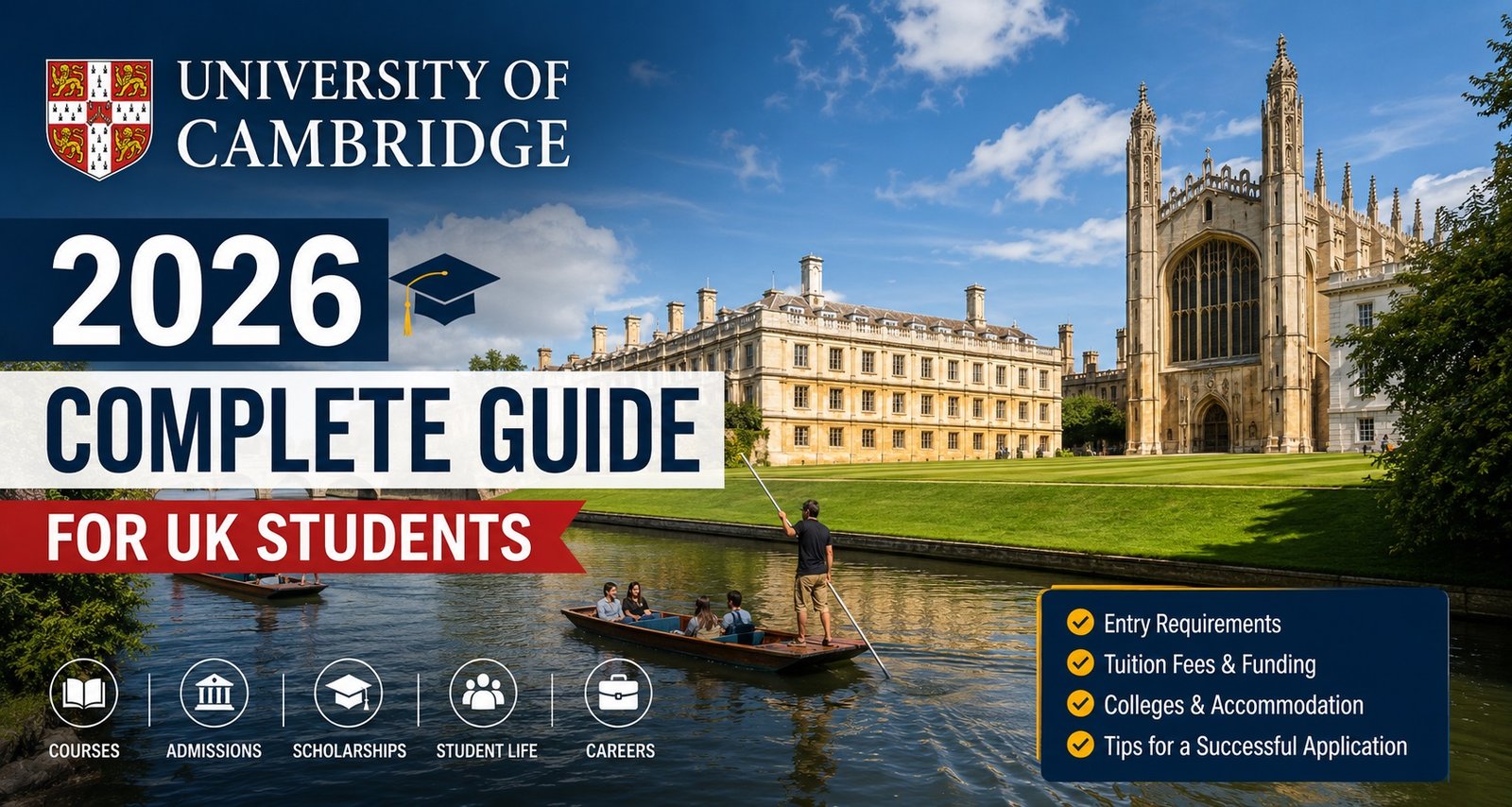
The University of Cambridge is one of the world’s oldest, most respected, and academically prestigious universities. Established in 1209, Cambridge has spent more than 800 years shaping the future through exceptional teaching, groundbreaking research, and the development of some of history’s greatest thinkers. Located in the beautiful and historic city of Cambridge, England, the university attracts talented students from every corner of the world and consistently ranks among the top universities globally.
For UK students planning their university journey in 2026, Cambridge represents much more than a degree. It offers an educational experience built around academic excellence, independent thinking, innovation, and personal development. Whether your ambition is to become a scientist, engineer, lawyer, doctor, entrepreneur, economist, teacher, or researcher, Cambridge provides an environment where talented students can reach their full potential.
One of the university’s most distinctive features is its collegiate system. Every student belongs to one of the university’s colleges, creating a close-knit community while also benefiting from the resources of a world-leading research university. This unique combination allows students to receive individual academic support, participate in vibrant college life, and build lifelong friendships alongside students from diverse backgrounds.
Cambridge is particularly well known for its small-group supervision system, where students regularly meet with academic experts to discuss their work in depth. This personalised teaching approach encourages critical thinking, independent learning, and intellectual confidence—qualities highly valued by employers and postgraduate institutions worldwide.
Beyond academics, Cambridge offers an outstanding student experience. The city itself is safe, historic, and student-friendly, with beautiful architecture, world-famous libraries, museums, theatres, cafés, green spaces, and the iconic River Cam. Students enjoy a balance between challenging academic study and a rich social, cultural, and sporting life.
Whether you are considering undergraduate study straight after sixth form or planning postgraduate education after completing your bachelor’s degree, the University of Cambridge remains one of the most rewarding destinations for ambitious students seeking a world-class education.
Quick Facts About the University of Cambridge (2026)
Here are some key facts every prospective student should know:
- Established: 1209
- Location: Cambridge, England, United Kingdom
- University Type: Public Collegiate Research University
- Number of Colleges: 31
- Students: Approximately 25,000+
- International Students: More than 9,000 from over 140 countries
- Academic & Professional Staff: Over 13,000
- Living Alumni: More than 330,000 worldwide
- Nobel Prize Winners: More than 120 associated with Cambridge
- University Motto: Hinc lucem et pocula sacra (“From this place, we gain enlightenment and precious knowledge.”)
- Global Reputation: Consistently ranked among the world’s leading universities for teaching, research, innovation, and graduate employability.
These achievements demonstrate why Cambridge continues to attract some of the brightest students and researchers from around the globe.
History of the University of Cambridge
The story of Cambridge began in 1209, when a group of scholars left Oxford following disputes with local townspeople and established a new centre of learning in Cambridge. What started as a relatively small academic community gradually evolved into one of the most influential universities in history.
In 1231, King Henry III granted the university a Royal Charter, officially recognising Cambridge as a centre of higher education. This royal recognition laid the foundation for centuries of academic growth and international prestige.
Early Development
The university’s first college, Peterhouse, was founded in 1284, introducing the collegiate model that still defines Cambridge today. Over time, additional colleges were established, each developing its own traditions, architecture, student community, and academic identity.
During the Middle Ages, Cambridge became one of Europe’s most important centres for theology, philosophy, mathematics, and classical studies. Scholars travelled from across the continent to study and teach within its walls.
Scientific Revolution
Cambridge played a defining role in the Scientific Revolution. Many of history’s greatest discoveries emerged from the university, transforming our understanding of mathematics, astronomy, medicine, and physics.
Among the most influential figures associated with Cambridge are:
- Sir Isaac Newton, whose work on gravity and motion revolutionised science.
- Charles Darwin, who developed the theory of evolution through natural selection.
- James Clerk Maxwell, whose discoveries shaped modern physics.
- Lord Kelvin, a pioneer of thermodynamics.
- Stephen Hawking, whose research transformed cosmology and black hole physics.
- Alan Turing, one of the founding fathers of modern computer science and artificial intelligence.
The influence of these scholars extends far beyond academia, affecting technology, healthcare, engineering, economics, and everyday life.
Growth During the Modern Era
Throughout the nineteenth and twentieth centuries, Cambridge expanded rapidly. New scientific laboratories, libraries, museums, and research centres were established, allowing the university to become a global leader in innovation.
A significant milestone came in 1869 with the founding of Girton College, the first residential college for women in Cambridge. This marked the beginning of greater educational opportunities for women, who are now fully integrated into every aspect of university life.
Following the Second World War, Cambridge experienced substantial growth in scientific research, international collaboration, and technological innovation. Today, the university works closely with governments, hospitals, charities, and leading global companies to solve some of the world’s biggest challenges, including climate change, public health, artificial intelligence, renewable energy, and sustainable development.
More than eight centuries after its foundation, Cambridge continues to combine historic traditions with cutting-edge research, making it one of the world’s most respected universities.
Global Rankings and International Reputation
One of the main reasons students choose Cambridge is its outstanding international reputation.
Year after year, Cambridge appears among the top universities in the world across major global ranking systems. It consistently performs exceptionally well in teaching quality, academic reputation, employer reputation, research output, citations, sustainability, and graduate employability.
Cambridge is particularly recognised for excellence in:
- Computer Science
- Artificial Intelligence
- Engineering
- Mathematics
- Physics
- Medicine
- Law
- Economics
- Business
- Architecture
- Psychology
- Natural Sciences
- History
- English Literature
- Politics and International Relations
Its graduates are highly sought after by employers because Cambridge develops not only subject knowledge but also analytical thinking, communication, leadership, and problem-solving skills.
Many graduates secure careers with leading organisations such as multinational technology companies, investment banks, healthcare institutions, law firms, government departments, research organisations, and international NGOs. Others continue into postgraduate research or establish successful businesses of their own.
Another major strength is Cambridge’s location within the internationally recognised Silicon Fen, one of Europe’s most successful technology clusters. Hundreds of innovative companies operate nearby, providing excellent internship opportunities, research partnerships, and graduate employment for students interested in science, technology, engineering, and entrepreneurship.
Academic Structure: How Cambridge Works
Unlike most universities in the UK, Cambridge follows a unique collegiate structure that combines personalised support with world-class academic resources.
The university consists of 31 independent colleges, alongside more than 150 faculties, departments, schools, and research institutes. Every student is a member of both a college and an academic department.
The Role of Colleges
Your college becomes your academic home throughout your studies.
A college provides:
- Student accommodation
- Dining facilities
- Academic tutors
- Welfare and wellbeing support
- Libraries and study spaces
- Sports facilities
- Student societies
- Career guidance
- Social events
- Small-group supervisions
Although colleges differ in size, age, traditions, and architecture, every student receives the same Cambridge degree regardless of which college they attend.
Some of the most well-known colleges include:
- Trinity College
- King’s College
- St John’s College
- Jesus College
- Emmanuel College
- Gonville & Caius College
- Pembroke College
- Clare College
- Churchill College
- Corpus Christi College
Each college has its own unique atmosphere, history, and community. Prospective students are encouraged to explore different colleges before submitting their application to find the environment that best suits their interests and preferences.
Faculties and Departments
While colleges provide pastoral care and supervision, lectures, practical classes, examinations, and research are organised by the university’s academic departments and faculties.
Cambridge currently operates through six major academic schools:
- School of Arts and Humanities
- School of Biological Sciences
- School of Clinical Medicine
- School of Humanities and Social Sciences
- School of Physical Sciences
- School of Technology
This dual structure ensures students benefit from both personalised academic mentoring and access to world-class teaching, laboratories, libraries, and research facilities.
The University of Cambridge Supervision System
One of Cambridge’s greatest strengths is its famous supervision system, which is considered among the best teaching methods in higher education.
Instead of relying solely on large lectures, students regularly meet in very small groups—often just one to three students—with leading academics or subject specialists.
During these sessions, students discuss essays, solve complex problems, analyse research papers, receive personalised feedback, and explore ideas in far greater depth than is possible in traditional classroom settings.
This teaching approach develops confidence, independent thinking, critical analysis, and communication skills, helping Cambridge graduates excel in both further study and professional careers.
For many students, the supervision system becomes the most rewarding and memorable part of their university experience.
Undergraduate Courses, Admissions, and Student Experience at the University of Cambridge (2026)
Undergraduate Courses at the University of Cambridge
Choosing the right university course is one of the most important decisions a student will make, and the University of Cambridge offers an exceptional range of undergraduate programmes designed to prepare students for successful careers and further academic study. With more than 30 undergraduate courses covering over 65 subject areas, Cambridge combines academic depth with flexibility, allowing students to explore their interests while developing specialist knowledge.
Unlike many universities where students specialise immediately, some Cambridge courses—such as Natural Sciences and Engineering—allow students to study a broad range of topics during their first year before choosing a specific area of specialisation. This approach helps students make informed decisions about their future careers and gives them a wider understanding of their discipline.
Teaching at Cambridge is internationally recognised for its quality. Students learn through lectures, seminars, laboratory sessions, workshops, practical classes, independent research, and the university’s famous supervision system, where small groups meet regularly with academic experts to discuss coursework and solve challenging problems. This personalised learning experience helps students build confidence, critical thinking, and analytical skills that employers value highly.
Most Popular Courses at Cambridge
Although every course maintains extremely high academic standards, several programmes consistently attract thousands of applications each year.
Computer Science
Computer Science at Cambridge is regarded as one of the finest programmes in Europe. Students study both the theoretical and practical aspects of computing while gaining experience in programming, algorithms, artificial intelligence, machine learning, cybersecurity, software engineering, and computer architecture.
Graduates frequently secure positions with leading technology companies, research organisations, financial institutions, and innovative start-ups. Many also pursue postgraduate research or launch successful technology businesses of their own.
Engineering
Engineering is among Cambridge’s largest and most respected departments. During the first two years, students develop a strong foundation in mathematics, mechanics, electronics, materials science, and computing before choosing a specialist pathway.
Available specialisations include:
- Civil Engineering
- Mechanical Engineering
- Electrical and Electronic Engineering
- Aerospace Engineering
- Information Engineering
- Bioengineering
- Manufacturing Engineering
This flexible structure ensures graduates possess both broad engineering knowledge and specialist expertise.
Medicine
The Cambridge Medicine course combines world-class scientific teaching with clinical experience. Students benefit from advanced laboratories, research hospitals, and opportunities to work alongside internationally recognised medical researchers.
The programme develops future doctors who are not only clinically skilled but also capable of contributing to medical innovation and research.
Law
Cambridge Law encourages students to think critically about legal systems, public policy, and justice. Rather than simply memorising legislation, students learn to analyse legal arguments, interpret complex cases, and develop persuasive reasoning skills.
Graduates often continue into careers as barristers, solicitors, judges, legal advisers, policymakers, or academics.
Economics
Economics remains one of Cambridge’s most competitive courses because of its strong mathematical focus and excellent career outcomes.
Students explore topics such as:
- Microeconomics
- Macroeconomics
- Behavioural Economics
- International Trade
- Public Finance
- Econometrics
- Economic Development
Many graduates work in investment banking, consulting, government, economic research, and multinational organisations.
Other Highly Ranked Subjects
Cambridge is equally respected for:
- Mathematics
- Physics
- Chemistry
- Architecture
- History
- English Literature
- Philosophy
- Geography
- Psychology
- Veterinary Medicine
- Modern Languages
- Education
- Politics and International Relations
Regardless of the subject you choose, every Cambridge course is designed to develop intellectual curiosity, research skills, communication, and independent thinking.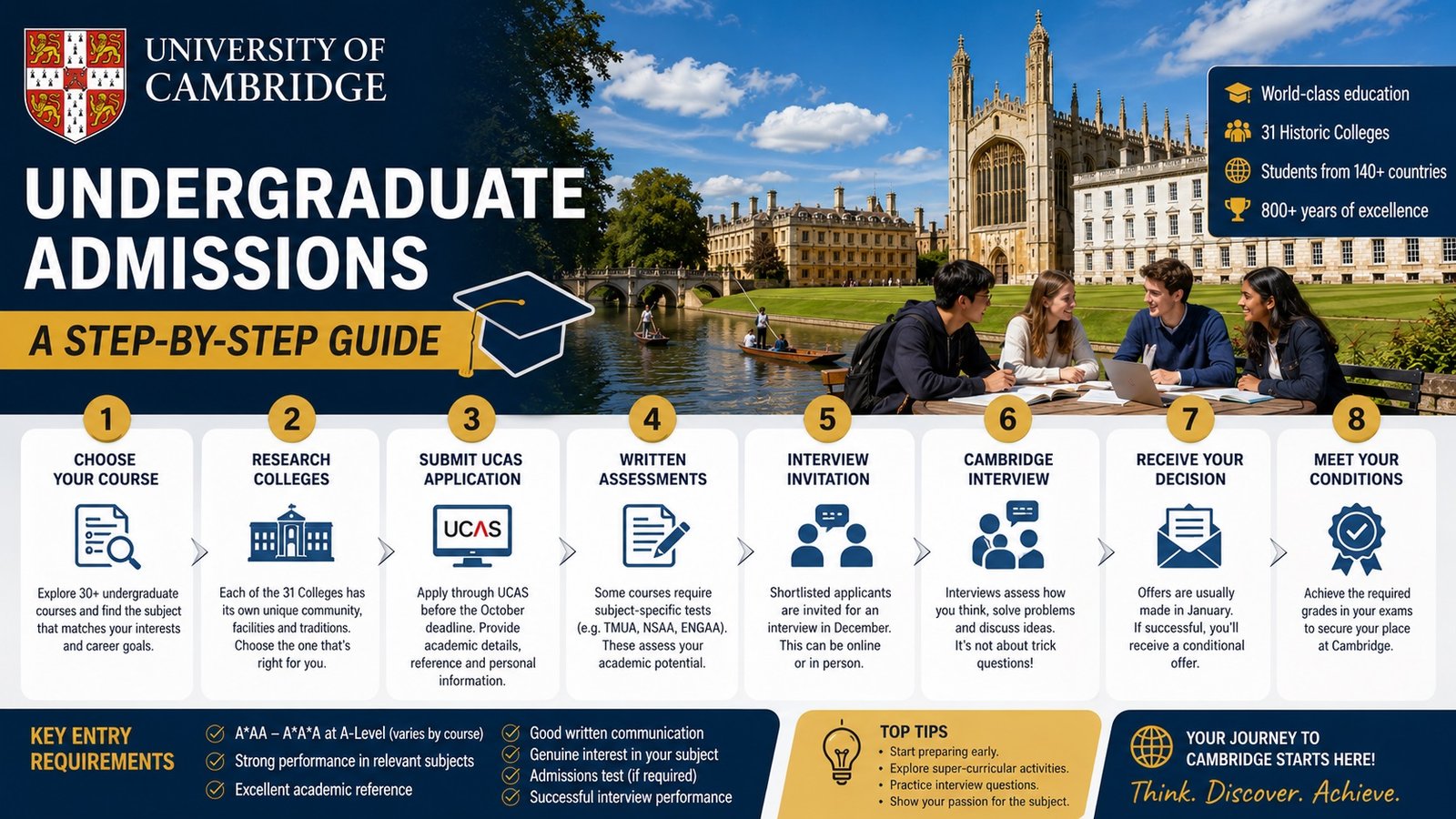
University of Cambridge Undergraduate Admissions: A Step-by-Step Guide
Admission to Cambridge is highly competitive, but understanding the application process can significantly improve your chances of success.
Step 1: Choose the Right Course
Your first decision should be selecting a course that genuinely matches your interests and strengths.
Before applying, ask yourself:
- Which subjects do I enjoy the most?
- What career do I hope to pursue?
- Does this course include practical work, research, or placements?
- What grades are typically required?
Choosing a course simply because it is prestigious is rarely a good strategy. Admissions tutors look for applicants who demonstrate genuine enthusiasm for their chosen subject.
Step 2: Research the Colleges
Every undergraduate student belongs to one of Cambridge’s 31 colleges.
While all colleges provide the same degree, each has its own traditions, accommodation, facilities, student community, and extracurricular opportunities.
When comparing colleges, consider:
- Accommodation availability
- Location within Cambridge
- College size
- Student support services
- Sports facilities
- Societies and clubs
- Historic atmosphere
If you cannot decide, you may submit an Open Application, allowing the university to allocate a college for you.
Step 3: Submit Your UCAS Application
Applications are made through UCAS, but Cambridge has an earlier application deadline than most UK universities.
A competitive application should include:
- Outstanding predicted grades
- Strong academic reference
- Accurate educational history
- Well-prepared application materials
Do not leave your application until the final day. Early preparation gives you more time to review every section carefully.
Step 4: Admissions Assessments
Several Cambridge courses require applicants to complete subject-specific admissions assessments.
These assessments evaluate qualities such as:
- Mathematical reasoning
- Scientific understanding
- Critical thinking
- Logical analysis
- Problem-solving ability
Rather than testing memorisation, these assessments examine how effectively applicants apply their knowledge to unfamiliar situations.
Preparing in advance by practising sample questions can make a significant difference.
Step 5: Cambridge Interview
The Cambridge interview is one of the most distinctive parts of the admissions process.
Many students feel nervous beforehand, but interviews are designed to explore how you think—not to catch you out.
During the interview, tutors may ask you to:
- Explain your reasoning.
- Solve unfamiliar problems.
- Analyse information.
- Interpret diagrams or data.
- Discuss ideas related to your subject.
- Think aloud while working through challenging questions.
Interviewers are interested in your curiosity, willingness to learn, and ability to think logically under guidance. Even if you cannot immediately find the correct answer, demonstrating clear reasoning and responding positively to hints often creates a strong impression.
Entry Requirements for UK Students
Cambridge expects applicants to achieve exceptional academic results.
Typical offers for many undergraduate programmes are around:
- AAA
- A*AA
depending on the course.
Applicants studying the International Baccalaureate generally require very high overall scores with excellent Higher Level results.
Some subjects also recommend Further Mathematics or additional science qualifications.
Remember that meeting the minimum academic requirements does not guarantee admission. Successful applicants usually combine outstanding grades with strong interview performance and genuine passion for their chosen subject.
Tips to Strengthen Your Cambridge Application
Every year, thousands of academically capable students apply to Cambridge. The strongest applications usually demonstrate much more than excellent examination results.
To improve your chances:
- Read books beyond your school syllabus.
- Attend public lectures and academic events.
- Complete relevant online courses.
- Follow developments in your chosen subject.
- Listen to educational podcasts.
- Read research articles and reputable journals.
- Participate in essay competitions or Olympiads where appropriate.
- Reflect on what you have learned rather than simply listing achievements.
Admissions tutors are looking for evidence that you enjoy learning for its own sake and are genuinely excited by your chosen subject.
Student Life at Cambridge
Although Cambridge has a reputation for academic intensity, student life is surprisingly diverse, welcoming, and rewarding.
Students quickly become part of a supportive college community where they live, study, dine, and socialise together.
There are over 700 student societies, covering interests including entrepreneurship, debating, music, drama, volunteering, technology, photography, languages, politics, gaming, and cultural activities.
Sports also play an important role. Whether you are interested in rowing, football, rugby, athletics, swimming, tennis, cricket, or simply staying active for fun, Cambridge provides excellent facilities and opportunities for students of all abilities.
The city itself is one of the safest and most beautiful student cities in the UK. Cycling is the most popular way to travel, making it easy to move between colleges, libraries, lecture halls, and cafés.
Students also enjoy access to world-famous museums, historic buildings, green parks, the River Cam, theatres, concerts, and countless cultural events throughout the year.
Despite its demanding academic environment, Cambridge places a strong emphasis on student wellbeing. Colleges provide welfare tutors, mental health support, disability services, careers advice, and peer mentoring programmes to ensure students receive help whenever they need it.
Ultimately, studying at Cambridge is about much more than earning a prestigious degree. It is an opportunity to challenge yourself academically, build lifelong friendships, learn from world-leading experts, and become part of a global community of scholars whose impact extends far beyond the university itself.
Top Universities in the UK 2026
Tuition Fees, Scholarships, Career Opportunities, and Why Choose the University of Cambridge
Tuition Fees at the University of Cambridge
One of the most important factors when choosing a university is understanding the cost of studying. While Cambridge is known for its academic excellence, students should also plan carefully for tuition fees and living expenses before applying.
Tuition Fees for UK Students
For students from the UK who are eligible for Home fee status, undergraduate tuition fees are regulated by the UK Government. For the 2026 entry, students should check the official Cambridge website for the latest confirmed figures, as fees may change each academic year.
Most eligible UK students can apply for a Student Finance England tuition fee loan, meaning they usually do not have to pay their tuition fees upfront. Repayments begin only after graduation and once earnings exceed the repayment threshold set by the UK Government.
Tuition Fees for International Students
International tuition fees vary depending on the course because some programmes require specialist facilities, laboratories, or clinical placements.
Courses such as Medicine, Veterinary Medicine, Engineering, and Natural Sciences generally have higher tuition fees than classroom-based subjects.
Before submitting your application, carefully review the fee information for your chosen course and calculate the total cost of studying for the full duration of your degree.
Cost of Living in Cambridge
Although Cambridge is generally less expensive than central London, students should still budget carefully for everyday expenses.
Typical costs may include:
- Accommodation
- Food and groceries
- Books and study materials
- Local transport
- Mobile phone and internet
- Clothing
- Personal expenses
- Entertainment and social activities
Many colleges provide accommodation for undergraduate students, helping to simplify the process of finding housing.
Cambridge is also a compact and cycle-friendly city, meaning many students save money by walking or cycling instead of relying on public transport.
Creating a realistic monthly budget before arriving at university can help reduce financial stress and allow students to focus on their studies.
Scholarships, Bursaries, and Financial Support
One of the biggest misconceptions about Cambridge is that only wealthy students can afford to study there.
In reality, the university offers a wide range of financial support to ensure that talented students are not prevented from studying because of financial circumstances.
Cambridge Bursary Scheme
Eligible UK undergraduate students from lower-income households may receive non-repayable bursaries to help cover living costs.
These bursaries do not need to be paid back and can make a significant difference during your studies.
Cambridge Trust Scholarships
The Cambridge Trust offers numerous scholarships for international students studying undergraduate and postgraduate courses.
Funding opportunities vary depending on:
- Nationality
- Academic achievement
- Financial need
- Course
- Level of study
College Scholarships
Many individual Cambridge colleges also provide:
- Academic scholarships
- Travel grants
- Research funding
- Hardship funds
- Prize awards
- Sports and music bursaries
Students are encouraged to explore the financial support offered by both the university and their chosen college.
Research and Innovation
Cambridge is recognised as one of the world’s leading research universities.
Researchers at Cambridge work on projects that have a direct impact on society, including:
- Artificial Intelligence
- Climate Change
- Renewable Energy
- Cancer Research
- Genomics
- Robotics
- Quantum Computing
- Sustainable Agriculture
- Public Health
- Space Science
Students often benefit from learning alongside internationally recognised researchers who are contributing to major scientific discoveries.
The university collaborates with governments, charities, hospitals, and global businesses to develop practical solutions to some of the world’s biggest challenges.
Careers and Graduate Employability
A University of Cambridge degree is respected by employers around the world.
Graduates develop valuable skills including:
- Critical thinking
- Communication
- Leadership
- Research
- Teamwork
- Problem solving
- Data analysis
- Independent learning
These transferable skills make Cambridge graduates highly employable across a wide range of industries.
Many graduates begin careers in:
- Technology
- Engineering
- Medicine
- Finance
- Banking
- Consulting
- Law
- Education
- Government
- Scientific Research
- Entrepreneurship
- Media
The University Careers Service provides students with support throughout their studies.
Services include:
- CV reviews
- Mock interviews
- Internship opportunities
- Careers fairs
- Employer networking events
- Graduate recruitment guidance
- Career planning workshops
Students also benefit from Cambridge’s extensive alumni network, which includes professionals working across every major industry worldwide.
University of Cambridge and Silicon Fen
Cambridge is located at the heart of Silicon Fen, one of Europe’s leading technology and innovation clusters.
The region is home to thousands of knowledge-based businesses working in areas such as:
- Software Development
- Artificial Intelligence
- Biotechnology
- Healthcare
- Electronics
- Pharmaceuticals
- Clean Energy
- Advanced Manufacturing
This creates valuable opportunities for internships, research collaborations, graduate employment, and entrepreneurship.
Students interested in innovation and technology often find Cambridge to be one of the best places in Europe to begin their careers.
Famous Alumni
The University of Cambridge has produced some of the most influential people in history.
Notable alumni include:
- Sir Isaac Newton
- Charles Darwin
- Stephen Hawking
- Alan Turing
- Francis Crick
- John Maynard Keynes
- Sylvia Plath
- Emma Thompson
- Sacha Baron Cohen
Cambridge has also educated:
- Numerous Nobel Prize winners
- Heads of state
- Scientists
- Business leaders
- Judges
- Authors
- Inventors
- Entrepreneurs
Their achievements demonstrate the university’s long tradition of developing leaders who have made significant contributions to society.
Contact Us On : Whatsapp
Why Choose the University of Cambridge?
Choosing a university is one of the biggest decisions you’ll make, and Cambridge continues to stand out for many reasons.
1. World-Class Teaching
Cambridge’s supervision system provides personalised academic support that is rarely available elsewhere.
2. Outstanding Academic Reputation
A Cambridge degree is recognised and respected by employers and universities around the world.
3. Exceptional Research Opportunities
Students learn from leading academics and gain access to cutting-edge laboratories, libraries, and research facilities.
4. Strong Graduate Employment
Cambridge graduates enjoy excellent career prospects across a wide range of industries.
5. Diverse Student Community
Students from more than 140 countries create an inclusive and internationally connected learning environment.
6. Historic Yet Innovative
Cambridge combines more than 800 years of academic tradition with modern research and technological innovation.
7. Excellent Student Support
From academic tutoring and mental health services to careers advice and financial guidance, students have access to comprehensive support throughout their studies.
Tips for Students Applying to Cambridge
If you are hoping to secure a place at Cambridge, consider the following advice:
- Aim for the highest possible grades in relevant subjects.
- Read beyond your school curriculum to deepen your understanding of your chosen subject.
- Attend university open days or virtual events.
- Practise explaining your ideas clearly, as this is valuable for interviews.
- Keep up to date with developments in your subject area through books, journals, lectures, and reputable educational resources.
- Prepare well in advance for any admissions assessments required for your course.
- Submit your application before the UCAS deadline and ensure all information is accurate.
Remember, Cambridge is looking for students with genuine academic curiosity and the potential to thrive in a challenging learning environment.
Frequently Asked Questions (FAQs)
Is University of Cambridge harder to get into than other UK universities?
Yes. Cambridge is one of the UK’s most competitive universities, with thousands of highly qualified applicants competing for a limited number of places each year
Do I need straight A* grades?
While many successful applicants achieve outstanding grades, admissions tutors also consider academic potential, interview performance, admissions assessments, and evidence of enthusiasm for the subject.
Can students from state schools apply?
Absolutely. Cambridge actively encourages applications from talented students from all educational backgrounds and works with schools across the UK to widen participation.
Does University of Cambridge accept international students?
Yes. Cambridge welcomes students from more than 140 countries and provides dedicated support for international applicants, including visa guidance and English language requirements.
Is accommodation guaranteed?
Many undergraduate students are offered college accommodation for a significant part of their degree, although arrangements vary between colleges.
Are scholarships available?
Yes. Cambridge offers bursaries, scholarships, hardship funds, and college-specific financial support for eligible UK and international students.
Is University of Cambridge worth it?
For students who enjoy academic challenges, independent learning, and access to world-class teaching and research, Cambridge is widely regarded as one of the best higher education choices in the world.
Final Thoughts
The University of Cambridge remains one of the world’s most prestigious universities, combining centuries of academic tradition with cutting-edge research and innovation. Its unique collegiate system, personalised supervision model, outstanding teaching, and global reputation provide students with an exceptional educational experience.
For UK students planning their university applications in 2026, Cambridge offers far more than a highly respected degree. It provides opportunities to develop intellectually, build lifelong professional networks, participate in world-leading research, and prepare for successful careers across a wide range of industries.
Although gaining admission is highly competitive, students who demonstrate academic excellence, genuine curiosity, and strong preparation have every opportunity to succeed. By researching your chosen course carefully, preparing thoroughly for admissions assessments and interviews, and making full use of the university’s financial support and student services, you can significantly strengthen your application.
Whether your ambition is to become a doctor, engineer, scientist, lawyer, entrepreneur, researcher, or future leader, the University of Cambridge provides an inspiring environment where talent, dedication, and ambition can flourish.
If you are looking for a university that combines history, innovation, academic excellence, and exceptional career prospects, the University of Cambridge deserves a place at the very top of your shortlist.