For many university students in the UK, understanding the undergraduate dissertation structure and word count can feel almost as challenging as the research itself. Whether you are studying Business Management, English Literature, Psychology, Engineering, or Sociology, one of the most common concerns is how to organise thousands of words into a coherent, academically rigorous dissertation that meets university expectations.
Students regularly search for a dissertation structure and word count example, wondering how chapters should be divided, how much detail belongs in the literature review, and whether their methodology chapter is too short or too long. These questions are entirely valid. UK universities often provide only broad guidance, leaving students to interpret the best structure for their specific discipline and research topic.
Students get help about survey design and questionnaire development: Survey Design and Questionnaire Development: Best Practices, Likert Scales, Validity, Reliability, and Common Pitfalls
In this guide, you will learn how dissertation structures differ across Social Sciences, Humanities, STEM subjects, and Business degrees. We will also explore realistic dissertation word count breakdowns for 6,000, 10,000, 12,000, and 15,000-word projects, alongside practical examples, common mistakes, and expert advice based on current UK academic standards.
By the end of this article, you should feel much more confident about planning your dissertation strategically rather than guessing your way through each chapter.
Why Dissertation Structure Matters More Than Most Students Realise
A dissertation is not simply a long essay. It is a carefully organised academic investigation that demonstrates your ability to conduct independent research, evaluate evidence critically, and communicate findings professionally.
According to guidance from the Quality Assurance Agency for Higher Education in the UK, dissertations are designed to assess a student’s ability to engage in sustained inquiry, independent thinking, and structured academic argument. That means your structure is not just presentation — it directly affects marks.
Even excellent research can lose marks if chapters are unbalanced or poorly organised. A dissertation with a weak methodology section or an overly descriptive literature review may appear academically immature, regardless of the quality of the ideas.
This is why understanding dissertation word count breakdown 10000 or dissertation word count breakdown 12,000 is so important. Word allocation reflects academic priorities. The distribution of words shows examiners where you have focused your analytical effort.
Undergraduate Dissertation Structure and Word Count: The Standard Template
Although structures vary slightly between universities, most UK undergraduate dissertations follow a broadly similar framework.
A traditional dissertation usually includes:
- Introduction
- Literature Review
- Methodology
- Findings/Results
- Discussion
- Conclusion
- References and Appendices
The exact balance depends heavily on the discipline.
For example, Humanities dissertations often emphasise analysis and argumentation, while STEM dissertations prioritise methodology, results, and technical precision.
Students frequently ask: How many chapters are in a 10,000 word dissertation? In most UK universities, a 10,000-word undergraduate dissertation contains five to seven core chapters excluding references and appendices.
Students get dissertation help: Masters dissertation help
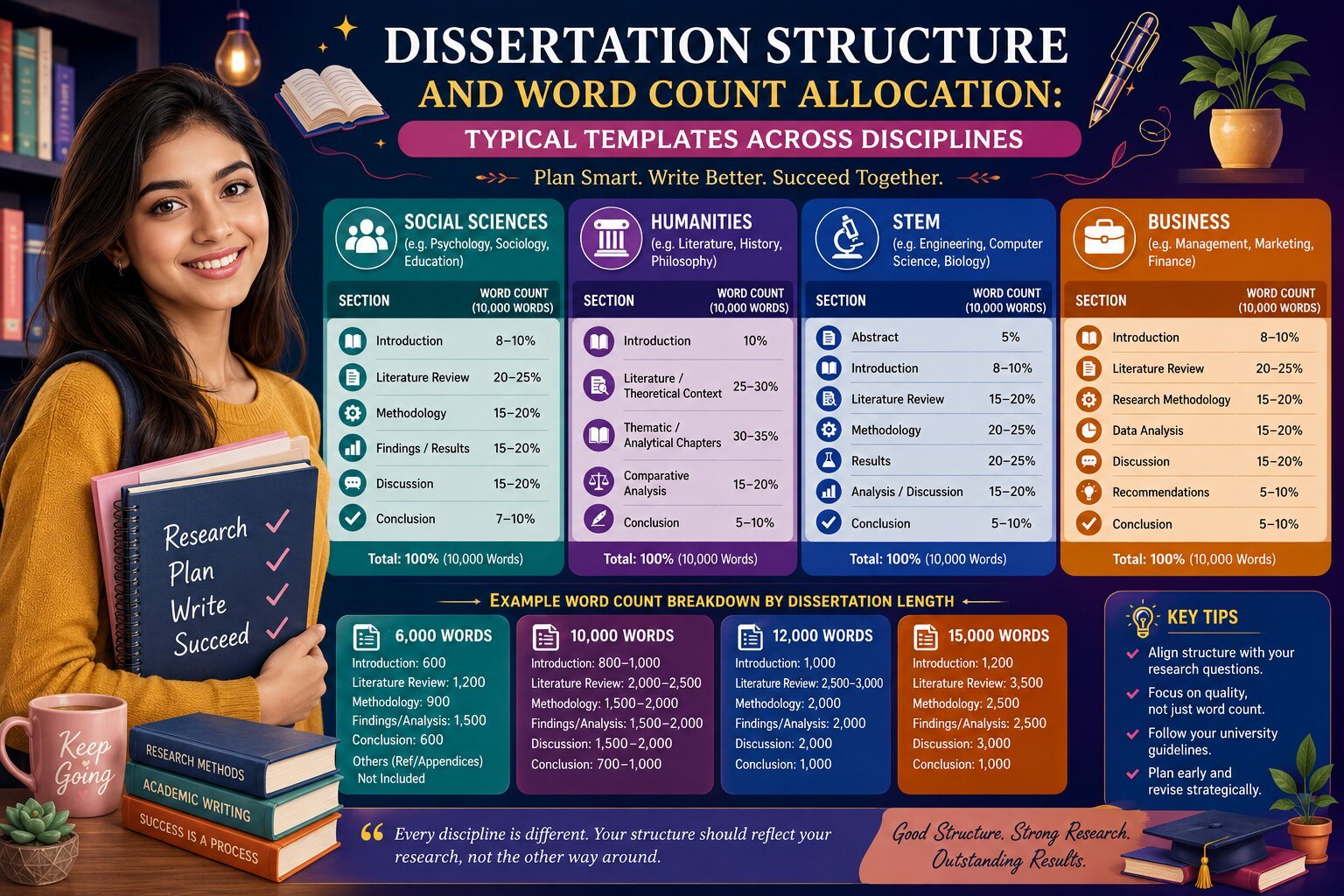
Dissertation Word Count Breakdown 10000: A Realistic Example
One of the most searched queries among final-year students is dissertation word count breakdown 10000. While no universal formula exists, the following structure works well for many UK undergraduate programmes.
Example Structure for a 10,000-Word Dissertation
| Section | Approximate Word Count |
|---|---|
| Introduction | 800–1,000 |
| Literature Review | 2,000–2,500 |
| Methodology | 1,500–2,000 |
| Findings/Results | 1,500–2,000 |
| Discussion | 1,500–2,000 |
| Conclusion | 700–1,000 |
This structure is especially common in Social Sciences and Business subjects.
The literature review often becomes the largest section because universities expect students to demonstrate extensive engagement with academic research. However, many students mistakenly make the literature review too descriptive rather than analytical.
As we discussed in our guide to critical literature reviews, examiners are looking for synthesis, comparison, and evaluation — not simply summaries of journal articles.
Dissertation Word Count Breakdown 12,000: How to Structure a Larger Project
Students also commonly ask: How to structure a 12000 word dissertation?
A 12,000-word dissertation gives you greater flexibility for detailed analysis and deeper methodological discussion. In many UK universities, this length is common for Business, Psychology, Education, and mixed-methods research projects.
Suggested Dissertation Word Count Breakdown 12,000
| Section | Approximate Word Count |
|---|---|
| Introduction | 1,000 |
| Literature Review | 2,500–3,000 |
| Methodology | 2,000 |
| Findings | 2,000 |
| Discussion | 2,000 |
| Conclusion | 1,000 |
The additional words should not simply create longer chapters. Instead, they should allow for stronger critical engagement, richer evidence, and more nuanced interpretation.
For example, a Business dissertation exploring remote work productivity may include:
- Broader theoretical frameworks
- More detailed primary data analysis
- Comparative case studies
- Deeper discussion of limitations
This additional depth often distinguishes high first-class dissertations from average submissions.
Dissertation Word Count Breakdown 15,000: Expectations at Advanced Undergraduate and Master’s Level
A dissertation word count breakdown 15,000 typically applies to longer undergraduate projects, integrated master’s degrees, or postgraduate dissertations.
At this level, universities expect substantially more originality, methodological sophistication, and critical depth.
A realistic structure might look like this:
| Section | Approximate Word Count |
|---|---|
| Introduction | 1,200 |
| Literature Review | 3,500 |
| Methodology | 2,500 |
| Findings | 2,500 |
| Discussion | 3,000 |
| Conclusion | 1,000 |
Longer dissertations often include:
- Multiple research questions
- Comparative frameworks
- Larger datasets
- Advanced theoretical discussion
- More extensive referencing
Students sometimes assume that writing more automatically improves quality. In reality, conciseness and clarity remain essential. Examiners reward focused analysis rather than unnecessary repetition.
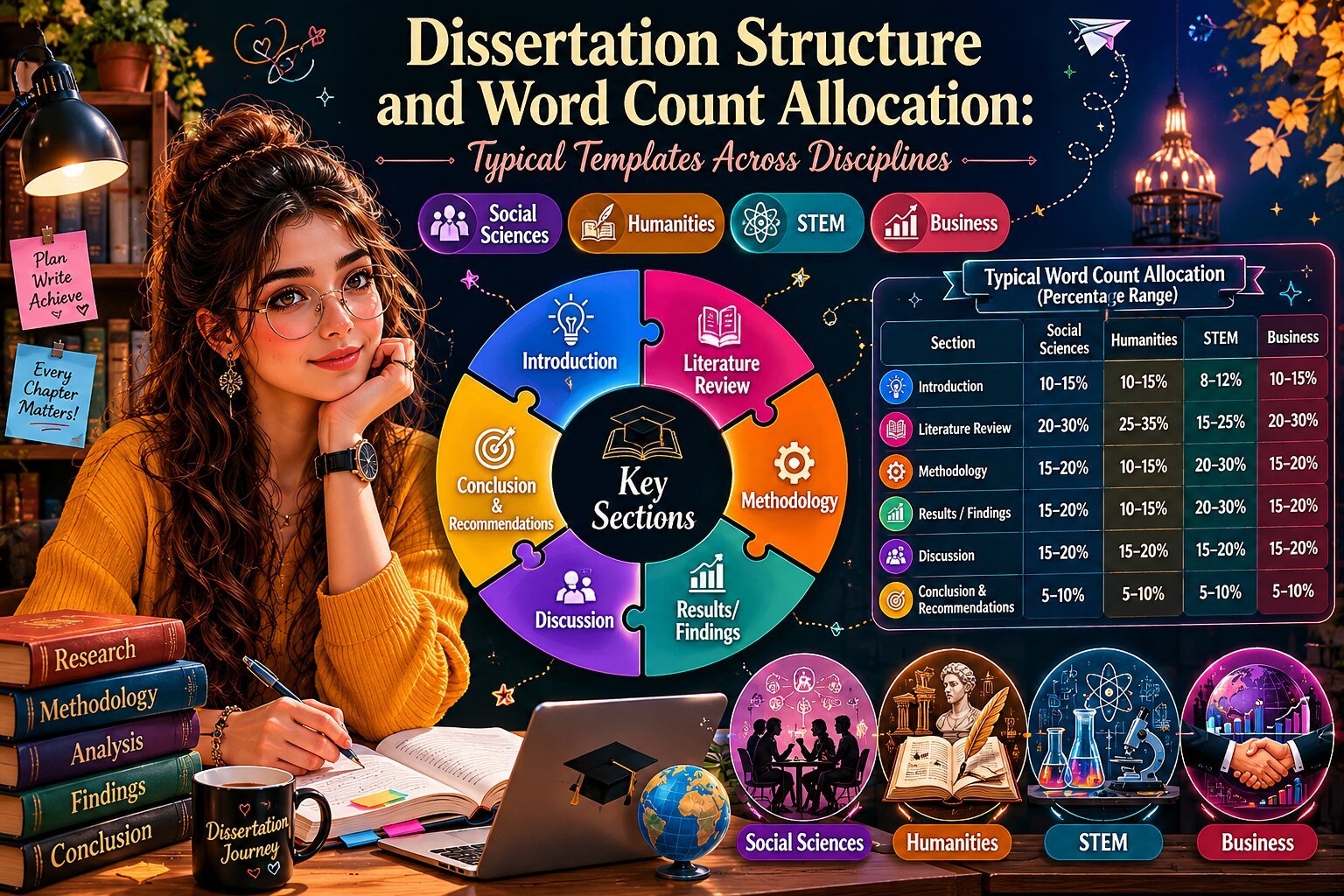
Dissertation Structures Across Different Disciplines
One of the biggest mistakes students make is copying dissertation structures from unrelated subjects.
A History dissertation and an Engineering dissertation may both contain 10,000 words, yet their structures can differ dramatically.
Social Sciences Dissertation Structure
Subjects such as Sociology, Psychology, Education, and Politics usually follow empirical research structures.
These dissertations often include:
- Introduction
- Literature Review
- Methodology
- Findings
- Discussion
- Conclusion
Primary research plays a central role. Students may conduct interviews, surveys, or focus groups.
If you are wondering how many references are in a 8000 word dissertation, Social Sciences dissertations commonly contain between 50 and 90 references depending on the complexity of the research.
Quality matters more than quantity. UK universities increasingly expect students to use peer-reviewed journals rather than relying heavily on websites or textbooks.
Humanities Dissertation Structure
Humanities dissertations are typically more argumentative and interpretive.
Subjects include:
- English Literature
- History
- Philosophy
- Cultural Studies
Rather than presenting “findings” in the scientific sense, Humanities dissertations often build a sustained analytical argument.
A Humanities structure may look like this:
- Introduction
- Literature/Theoretical Context
- Thematic Chapters
- Comparative Analysis
- Conclusion
For example, an English Literature dissertation may dedicate separate chapters to themes, historical contexts, or textual analysis.
Humanities dissertations usually contain extensive referencing and close textual engagement. Critical thinking and originality of interpretation are especially important.
STEM Dissertation Structure
STEM dissertations are generally more technical and data-driven.
Subjects include:
- Engineering
- Computer Science
- Biology
- Physics
- Mathematics
These projects prioritise methodology, experimentation, and results.
A STEM dissertation commonly includes:
- Abstract
- Introduction
- Literature Review
- Methodology
- Results
- Analysis
- Conclusion
In STEM subjects, the results and methodology chapters often carry the greatest weighting.
Students sometimes underestimate the importance of explaining technical decisions clearly. Examiners want transparency, Repeatability, and logical justification.
Business Dissertation Structure
Business and Management dissertations usually combine theoretical analysis with practical application.
Common topics include:
- Marketing strategy
- Consumer behaviour
- Leadership
- Finance
- Human resource management
Business dissertations frequently use case studies, questionnaires, and market analysis.
A typical structure includes:
- Introduction
- Literature Review
- Research Methodology
- Data Analysis
- Discussion
- Recommendations
- Conclusion
Recommendations are especially important in Business research because universities value practical relevance alongside academic analysis.
How Many Words Is a Dissertation Undergraduate?
A common question among UK students is: How many words is a dissertation undergraduate?
The answer varies by university and course.
Typical undergraduate dissertation lengths include:
- 5,000–8,000 words for smaller research projects
- 8,000–12,000 words for standard undergraduate dissertations
- 12,000–15,000 words for advanced or integrated programmes
Russell Group universities sometimes expect longer and more research-intensive dissertations, particularly in research-heavy disciplines.
However, quality matters far more than word count alone. A concise, well-structured 8,000-word dissertation can outperform a poorly organised 15,000-word submission.
How to Split a 6000 Word Dissertation Effectively
Students working on shorter projects often ask: How to split a 6000 word dissertation?
The key is maintaining proportional balance without oversimplifying chapters.
A practical structure could include:
| Section | Word Count |
|---|---|
| Introduction | 600 |
| Literature Review | 1,500 |
| Methodology | 1,000 |
| Findings/Analysis | 1,500 |
| Conclusion | 600–800 |
With shorter dissertations, every paragraph must earn its place. Avoid overly broad research questions because limited word counts make depth difficult.
Narrow, focused topics usually perform better in shorter projects.
Dissertation Structure PDF and University Templates
Many students search online for a dissertation structure PDF hoping to find a universal template.
While templates can help, relying on generic examples without adapting them to your discipline can be risky.
Different universities have different expectations regarding:
- Chapter naming conventions
- Referencing systems
- Abstract requirements
- Appendix formatting
- Research ethics sections
Always prioritise your university handbook and supervisor guidance over generic online templates.
That said, reviewing successful dissertation examples from your department can be extremely helpful for understanding tone, formatting, and chapter balance.
Common Dissertation Structure Mistakes Students Make
Even academically strong students frequently encounter structural issues.
One of the most common mistakes is spending too many words on background information while neglecting analysis. Another is treating the literature review as a collection of summaries rather than a critical discussion.
Many students also struggle with chapter overlap. For example, discussion points may accidentally appear in the findings chapter, creating repetition and confusion.
Poor transitions between chapters are another issue. A strong dissertation should feel cohesive, with each section logically building upon the previous one.
Finally, students often underestimate the importance of editing. A dissertation may contain excellent ideas but still lose marks due to unclear organisation, inconsistent formatting, or weak academic expression.
Practical Tips for Managing Dissertation Word Count
Word count management is one of the most underestimated dissertation skills.
The best approach is to allocate approximate chapter targets early rather than writing freely and cutting thousands of words later.
Experienced supervisors often recommend drafting slightly above the target before refining the work through editing.
A useful strategy is to prioritise high-mark sections first. In many UK marking criteria, the literature review, methodology, analysis, and discussion sections carry the greatest weighting.
Students should also remember that references, appendices, and bibliographies are often excluded from the official word count, although policies vary between universities.
Always verify institutional regulations carefully.
The Growing Importance of Research Quality in UK Higher Education
In recent years, UK universities have placed increasing emphasis on research literacy, critical thinking, and independent inquiry.
Frameworks such as REF (Research Excellence Framework) and bench marking standards continue influencing academic expectations across undergraduate and postgraduate programmes.
This means students are increasingly expected to:
- Use high-quality peer-reviewed sources
- Demonstrate methodological awareness
- Critically evaluate evidence
- Reflect on research limitations
- Produce ethically sound research
Simply meeting the word count is no longer enough. Examiners want intellectual engagement and analytical maturity.
Final Thoughts on Dissertation Structure and Word Count
Understanding dissertation structure is not about following rigid formulas. It is about creating a logical framework that supports your research argument effectively.
Whether you are planning a dissertation word count breakdown 10000, exploring a dissertation word count breakdown calculator, or wondering how to structure a 12000 word dissertation, the most important principle is balance.
Each chapter should contribute meaningfully to your overall research aims. Strong dissertation structure feel focused, coherent, and purposeful from introduction to conclusion.
If you are feeling overwhelmed, remember that dissertation writing is a process rather than a single event. Careful planning, regular feedback, and structured time management can dramatically improve both your confidence and your final grade.
And if you need additional support, professional academic guidance can help clarify structure, strengthen analysis, and ensure your dissertation meets UK university standards without losing your own voice and ideas.